Badminton uses rally point scoring to 21. Every rally wins a point for one side, regardless of who served. A game goes to 21 points, you must win by 2, and the score is capped at 30. A match is the best of 3 games. That is the whole system; the rest of this guide covers the details that come up in real matches, such as who serves next and how to call the score.
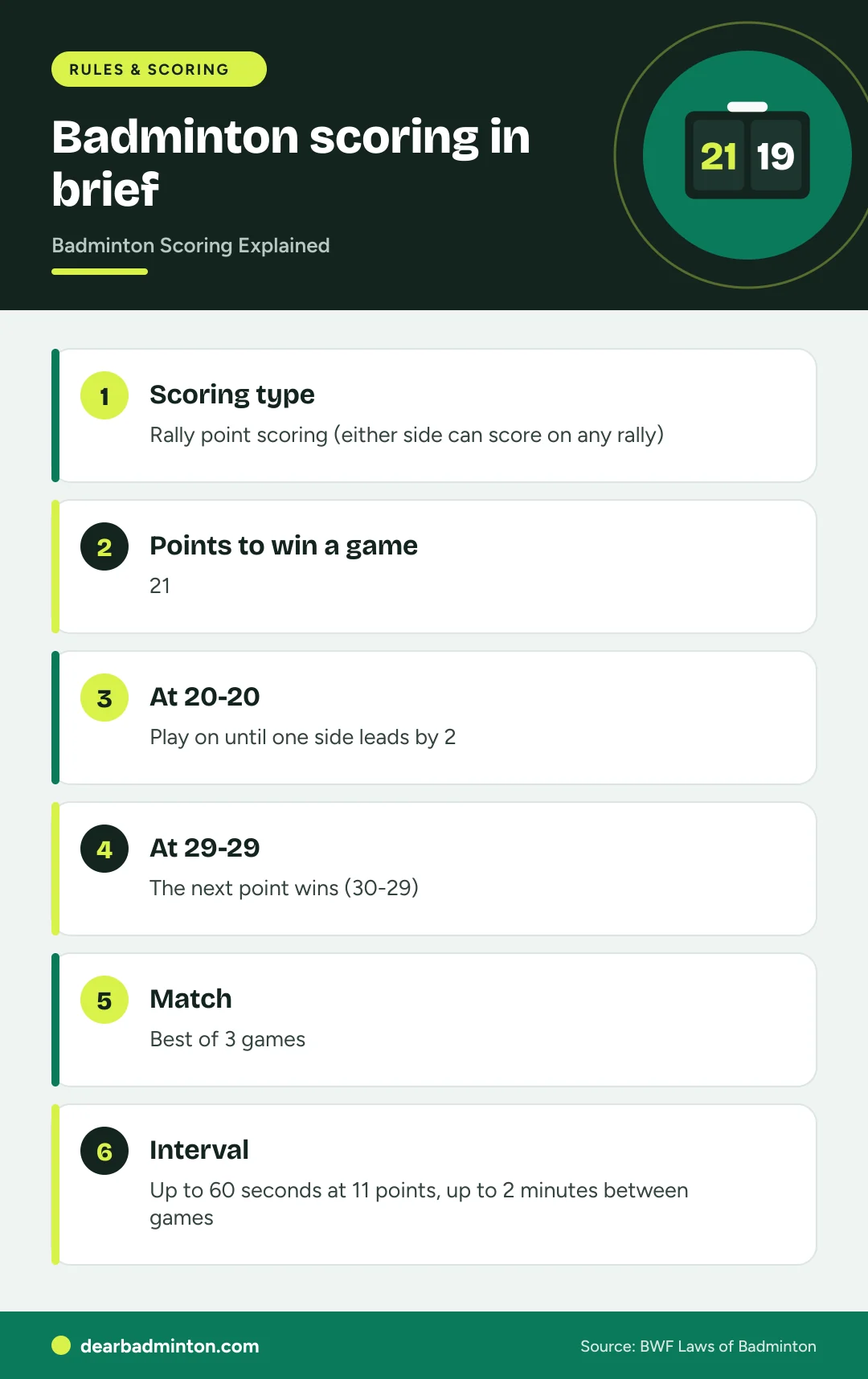
Badminton scoring in brief
- Scoring type: rally point scoring (either side can score on any rally)
- Points to win a game: 21
- At 20-20: play on until one side leads by 2
- At 29-29: the next point wins (30-29)
- Match: best of 3 games
- Interval: up to 60 seconds at 11 points, up to 2 minutes between games
How you score a point
You win a rally, and therefore a point, when:
- the shuttle lands inside your opponent’s court (lines count as in), or
- your opponent commits a fault, such as hitting the shuttle out, into the net, touching the net, or making an illegal serve.
There is no advantage to serving in terms of scoring. Both the serving and receiving side can score. That answers a common question about who can make points in a badminton game: anyone, on any rally. The only thing serving decides is who starts the rally.
If a let is called (for example, the server serves before the receiver is ready), the rally is replayed and nobody scores.
How many points to win a game
A game is won by the first side to reach 21 points, provided they are at least 2 points ahead.
| Score | What happens |
|---|---|
| 21-19 or better | Game over, leader wins |
| 20-20 | Deuce: play continues until one side leads by 2 |
| 22-20, 23-21, 27-25… | Game over, side with the 2-point lead wins |
| 29-29 | Next point wins the game |
| 30-29 | Maximum possible score in a game |
So the highest possible game score is 30-29, and the shortest possible game is 21-0.
How many games in a match
A match is the best of 3 games. The first side to win 2 games wins the match, so a match can finish 2-0 or 2-1. There is no limit on match length, but most club matches take 30 to 45 minutes.
Intervals and changing ends
- When the leading side reaches 11 points in any game, there is an interval of up to 60 seconds.
- Between games there is an interval of up to 2 minutes.
- Players change ends after the first game, after the second game (if there is a third), and in the third game when the leading side reaches 11 points.
Changing ends keeps things fair when one end has worse lighting, a draught or a background that makes the shuttle hard to see.
Who serves, and from which side
The serving side is the side that won the previous rally. The service court depends on the server’s score:
- Even score (0, 2, 4, 6…): serve from the right service court.
- Odd score (1, 3, 5, 7…): serve from the left service court.
At the start of each game the score is 0-0, so the first serve always comes from the right. The winner of a game serves first in the next game.
Singles example
Anna serves at 0-0 from the right. She wins the rally: 1-0, and she serves again, now from the left because her score is odd. She loses the next rally: 1-1, and her opponent Ben now serves. Ben’s score is 1 (odd), so he serves from his left court.
Doubles example
Doubles adds one extra rule: players only change service courts when their side wins a point on its own serve. If the receiving side wins the rally, they score, and the player standing in the correct court for their new score serves. Nobody else moves. Our doubles rules guide works through a full sequence.
How to call the score
The server (or umpire) calls the score before each serve, with the serving side’s score first. If you are serving and you have 7 points to your opponent’s 12, you call “7-12”. When the scores are level, say “all”: “5 all”, “20 all”. At 20-20 or above, the umpire calls “game point” or “match point” when one side needs a single point.
In club games the server usually calls the score aloud before each serve. It prevents arguments later.
Old scoring systems you may still hear about
Before 2006, badminton used a different system. Only the serving side could score, games were played to 15 points (11 in women’s singles), and there was a second-serve rule in doubles. If you hear older players talk about “setting” or “hand-out”, that is where it comes from.
The BWF trialled a best of 5 games to 11 points format at selected events in 2014, and proposals to adopt it permanently were voted down by member associations in 2018 and 2021. The 3 x 21 system remains the official one. Some social clubs and school PE lessons still play games to 11 or 15 to fit more matches into a session, which is fine as long as everyone agrees beforehand.
Scoring questions players ask
Is badminton rally scoring?
Yes. Since 2006 all official badminton uses rally point scoring, where every rally produces a point.
Can you score when you are not serving?
Yes. Under rally scoring, the receiving side scores whenever it wins a rally and then takes over the serve.
What happens at 20-20 in badminton?
The game continues until one side leads by 2 points, up to a maximum of 30. At 29-29 the next point wins.
What is the maximum score in a badminton game?
30-29.
How many points is a badminton match?
There is no fixed total. A match ends when one side wins 2 games, and each game ends at 21 (or later with deuce, up to 30).
Do you need to win by 2 in badminton?
Yes, from 20-20 onwards, with the exception of the 30th point, which wins the game at 30-29.
Keep a score sheet
For club nights or tournaments, a simple score sheet with columns for each game and a tick per rally is enough. Many players also use free scoreboard apps on their phones. Whatever you use, always confirm the score with your opponent at each change of ends.
For the full rules that sit around scoring, see our complete guide to the rules of badminton.