Restringing keeps a badminton racket playing the way it should. Strings lose tension from the first day they are installed, and they eventually break. You can pay a stringer to do it, or learn to do it yourself with a stringing machine. This guide covers both: how to choose string and tension, and the step-by-step process.
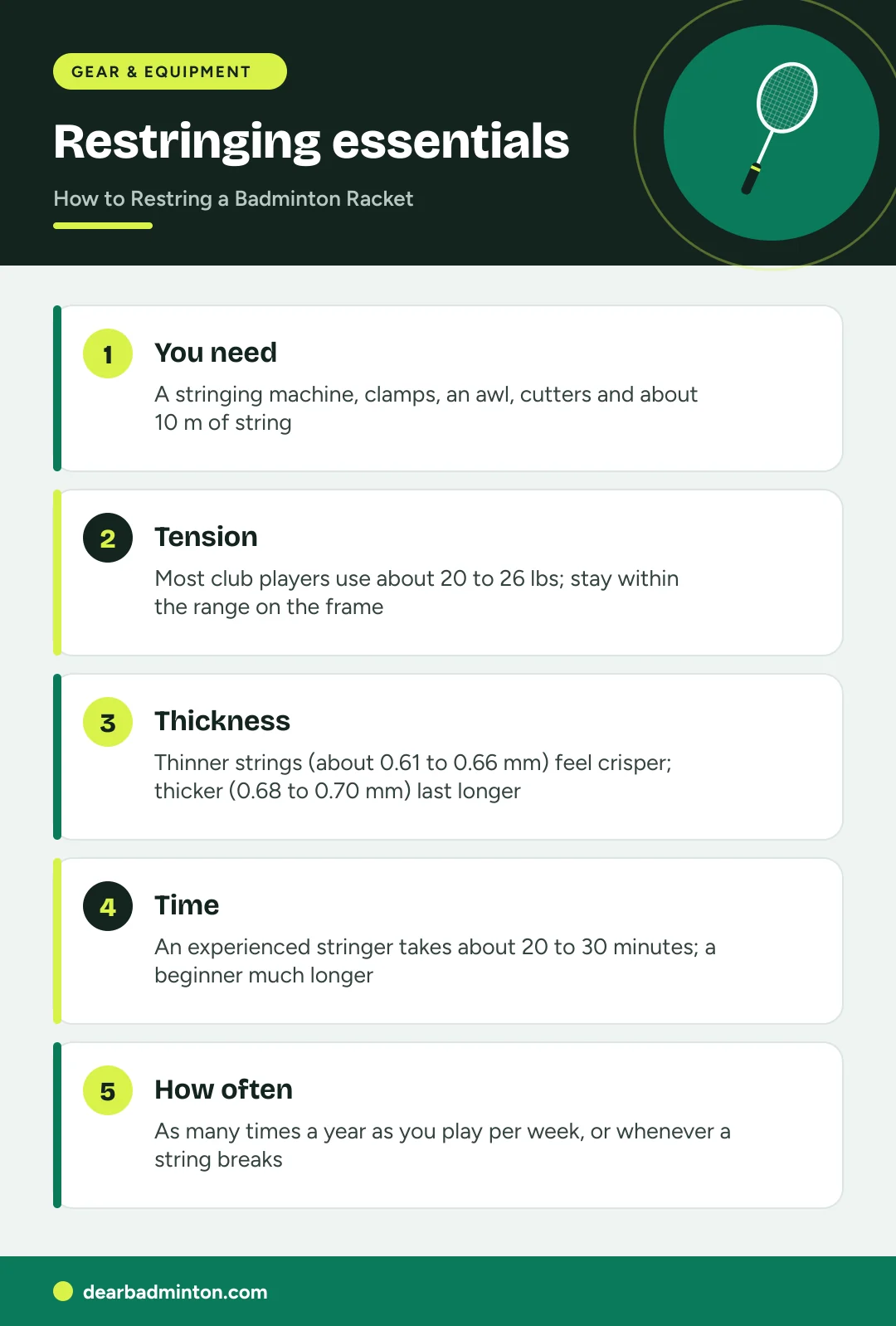
Restringing essentials
- You need: a stringing machine, clamps, an awl, cutters and about 10 m of string
- Tension: most club players use about 20 to 26 lbs; stay within the range on the frame
- Thickness: thinner strings (about 0.61 to 0.66 mm) feel crisper; thicker (0.68 to 0.70 mm) last longer
- Time: an experienced stringer takes about 20 to 30 minutes; a beginner much longer
- How often: as many times a year as you play per week, or whenever a string breaks
Should you restring it yourself?
| Option | Pros | Cons |
|---|---|---|
| Professional stringer | Consistent tension, no equipment cost, quick turnaround at most shops | Costs labour each time, plus string |
| Do it yourself | Cheaper per job if you play a lot, full control over string and tension | A stringing machine is a significant upfront cost; a mistake can crack a frame |
If you play once or twice a week, a local stringer is usually the better choice. If you play several times a week or string for a club, a machine can pay for itself.
Choosing string
Badminton strings are thin synthetic multifilaments. Two properties matter:
- Gauge (thickness): around 0.61 mm to 0.70 mm. Thinner strings give more repulsion and feel but break sooner. Thicker strings last longer and are a good choice for beginners and hard hitters who break strings often. Yonex’s BG65 (0.70 mm) and BG80 (0.68 mm) are widely used benchmarks.
- Feel: some strings are designed for repulsion (power), others for control or a softer feel. Try a durable all-round string first, then experiment.
Choosing tension
| Tension | Feel | Typical player |
|---|---|---|
| About 18 to 22 lbs | Bigger sweet spot, more power with an easy swing | Beginners and recreational players |
| About 22 to 26 lbs | Balanced power and control | Most club players |
| 26 lbs and above | Crisp control, smaller sweet spot, more breakage | Advanced players with fast swings |
Higher tension is not automatically better. Without a fast swing, high tension makes shots feel dead and increases strain on the arm. Always stay within the maximum tension printed on the racket frame. More on choosing rackets: how to choose a badminton racket.
What you need
- A stringing machine with a frame mounting system (supports at several points to prevent distortion) and a tension head
- Clamps to hold each string at tension
- An awl to open shared grommet holes
- String cutters or sharp scissors
- About 10 m of string per racket
- Replacement grommets if any are cracked
How to restring: step by step
- Cut out the old strings. Cut from the centre outwards, mains and crosses alternately, to release tension evenly. Never cut just one side of the frame.
- Check the grommets. Replace any that are cracked or split; damaged grommets cut new strings.
- Mount the racket. Secure it in the machine’s supports so the frame is held evenly at the head and throat.
- Find the stringing pattern. Check the manufacturer’s pattern for your frame: where the mains start and finish, and where the tie-off holes are. Most rackets have 20 to 22 mains and 20 to 22 crosses.
- String the mains. Start from the centre at the head, thread the vertical (main) strings down and back, pull each to tension and clamp it before threading the next. Work outwards, one side at a time or alternately, as the pattern requires.
- Tie off the mains. Tie a secure knot (a double half hitch or a parnell knot) at the designated tie-off hole.
- String the crosses. Start at the head and weave each horizontal string over and under the mains, alternating each row. Pull to tension and clamp after each cross. Many stringers add 1 to 2 lbs on the crosses.
- Tie off the crosses and trim the ends.
- Remove the racket and check. The string bed should be even, with no loose strings or distorted frame.
If you are learning, practise on an old racket first and follow a video of your specific pattern.
How often should you restring?
A common rule of thumb is to restring as many times per year as you play per week: twice a week means twice a year. Restring sooner if:
- a string breaks (always replace the whole string bed),
- shots feel dull or the shuttle “sinks” into the strings,
- the strings have moved out of line and will not stay straight.
Frequently asked questions
Can I play with one broken string?
No. Stop and restring: a broken string unbalances the tension on the frame and can cause it to crack.
How much string do I need for one racket?
About 10 m. Reels of 100 m or 200 m are cheaper per racket if you string regularly.
Why did my racket crack during stringing?
Usually because the frame was not supported evenly, tension was pulled unevenly on one side, or the tension exceeded the frame’s limit.
See also: badminton equipment and best badminton rackets.