Joining a badminton club is the fastest way to improve. You get regular court time, a range of opponents and partners, and often coaching, for far less than booking courts on your own. This guide explains how to find a club near you, what to expect at your first session, what it typically costs, and how to start a club if there is none nearby.
Finding a badminton club
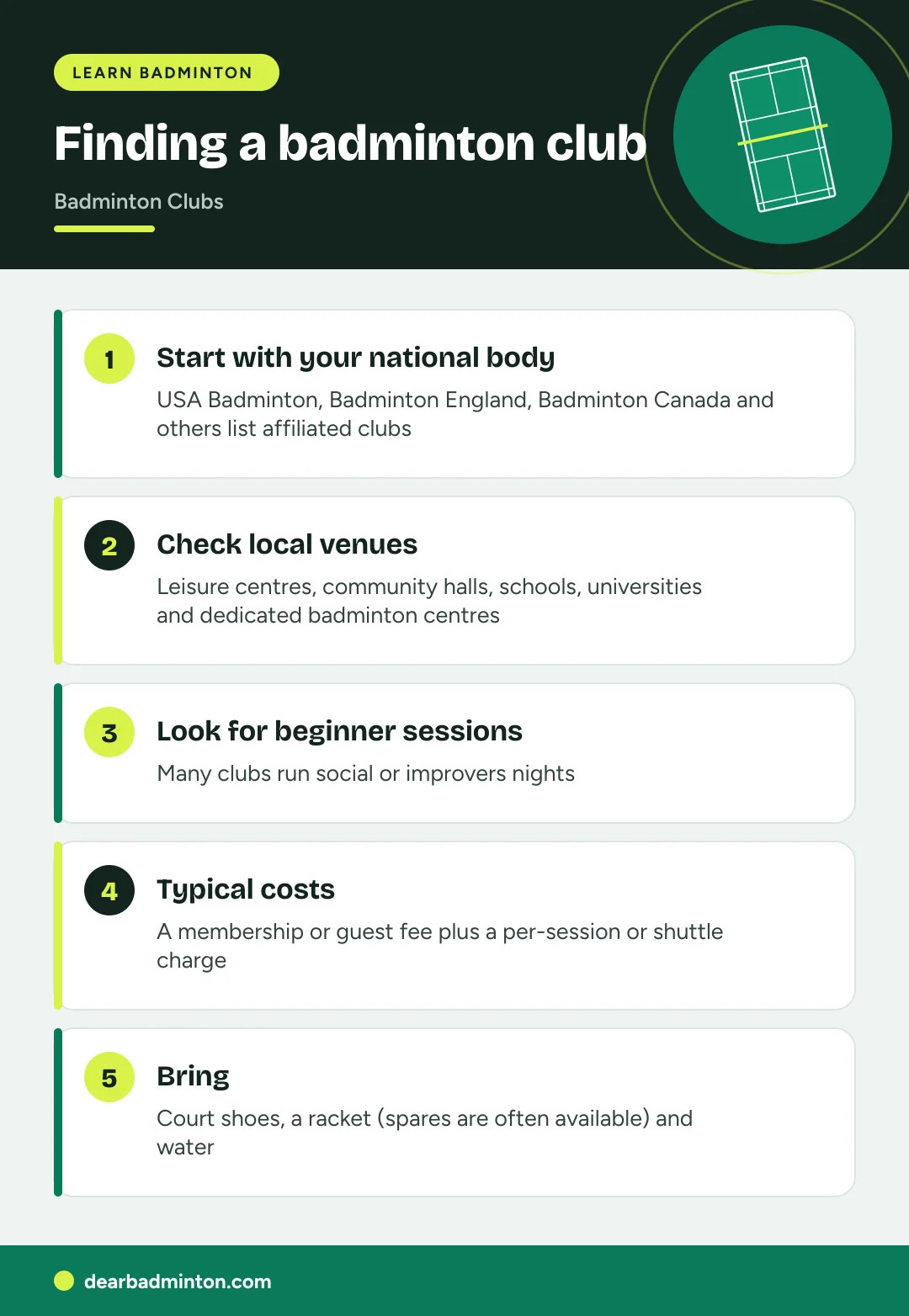
- Start with your national body: USA Badminton, Badminton England, Badminton Canada and others list affiliated clubs
- Check local venues: leisure centres, community halls, schools, universities and dedicated badminton centres
- Look for beginner sessions: many clubs run social or improvers nights
- Typical costs: a membership or guest fee plus a per-session or shuttle charge
- Bring: court shoes, a racket (spares are often available) and water
How to find a badminton club near you
- National governing body directories. In the US, USA Badminton lists member clubs and centres; in the UK, Badminton England has a club finder; most countries’ federations have similar lists.
- Dedicated badminton centres. Many large US metro areas, particularly in California, Washington, Texas and the north-east, have centres with several courts that run open play, leagues and coaching.
- Leisure centres and community halls. Check their timetables for badminton club nights or court hire.
- Universities and colleges. Student clubs often welcome community players or run alumni sessions.
- Online groups and meetups. Local social groups organise regular games, often for mixed levels.
- Search maps for “badminton”. Results for courts and centres near you, with opening hours and reviews.
Types of club and session
| Type | What it is | Good for |
|---|---|---|
| Social club night | Turn up, play rotating doubles with mixed partners | Beginners and casual players |
| Improvers or coached session | Drills and coaching, then games | Players who want to get better quickly |
| League or team club | Competitive matches against other clubs | Experienced players |
| Junior club | Coaching and games for children and teenagers | Young players, usually from about age 8 |
| Open play at a badminton centre | Pay per session, find partners on the day | Flexible schedules |
What happens at your first session
- You will usually be asked your level and paired with similar players.
- Most clubs play doubles and rotate partners after each game, so you meet everyone.
- Games are often shorter than official matches, for example one game to 21, so more people get court time.
- Players waiting for a court put their rackets or name tags in a queue.
- Feather or nylon shuttles are usually provided, sometimes for a small fee.
Brush up on the rules of badminton and doubles rules beforehand, and you will fit in quickly.
What does a badminton club cost?
Costs vary widely by country, city and venue. Typical structures are:
- Annual or monthly membership, often with cheaper session fees for members.
- Pay per session for guests or open play.
- Shuttle fees at clubs that use feather shuttles.
- Coaching charged separately, per session or per term.
Many clubs offer a free or discounted taster session, so ask before you commit.
Questions to ask before joining
- What levels play on which nights?
- Is there coaching, and is it included?
- Are shuttles feather or nylon, and who pays for them?
- How many courts are there, and how long do players wait between games?
- Are juniors welcome, and is there a safeguarding policy?
- Do members play in local leagues?
Court etiquette
- Wait your turn and do not walk behind a court during a rally.
- Call the score clearly before each serve and call your own lines fairly.
- Return shuttles to the right court, under the net or by hand, not with a big hit.
- Shake hands or tap rackets at the end of a game.
- Wear non-marking court shoes; most venues insist on them. See badminton shoes.
Badminton clubs for kids
Junior clubs teach grips, footwork and basic shots through games, usually in small groups by age and level. Look for qualified coaches, a clear safeguarding policy and light, short junior rackets. Many children start between ages 6 and 10.
Starting your own club
If there is no club nearby, starting one is simpler than it sounds:
- Book a hall with at least two courts at a regular weekly time.
- Recruit players through work, school, social media and community boards.
- Buy shared equipment: a few spare rackets and plenty of shuttles. See badminton equipment.
- Set fees that cover court hire, shuttles and insurance.
- Arrange insurance. Public liability insurance protects the club and organisers if someone is injured or property is damaged; affiliating with your national federation often includes or offers cover.
- Affiliate with your national body to get listed in club finders and access leagues.
FAQ
How do I find badminton near me?
Check your national federation’s club finder, local leisure centres and dedicated badminton centres, and search maps for “badminton”.
Can complete beginners join a badminton club?
Yes. Ask for a social or beginners night; most clubs welcome new players and lend rackets.
Do I need my own racket?
Not for a first visit at most clubs, but a light graphite racket of your own is worth buying if you keep going. See best badminton rackets.
Is badminton club insurance necessary?
For organisers, yes: public liability cover is strongly recommended and often required by venues.