One of badminton’s attractions is how little you need to start: a racket, some shuttles, the right shoes and access to a court. This guide lists all the equipment, from the essentials to the optional extras, with what to buy first and what to wear.
The essentials
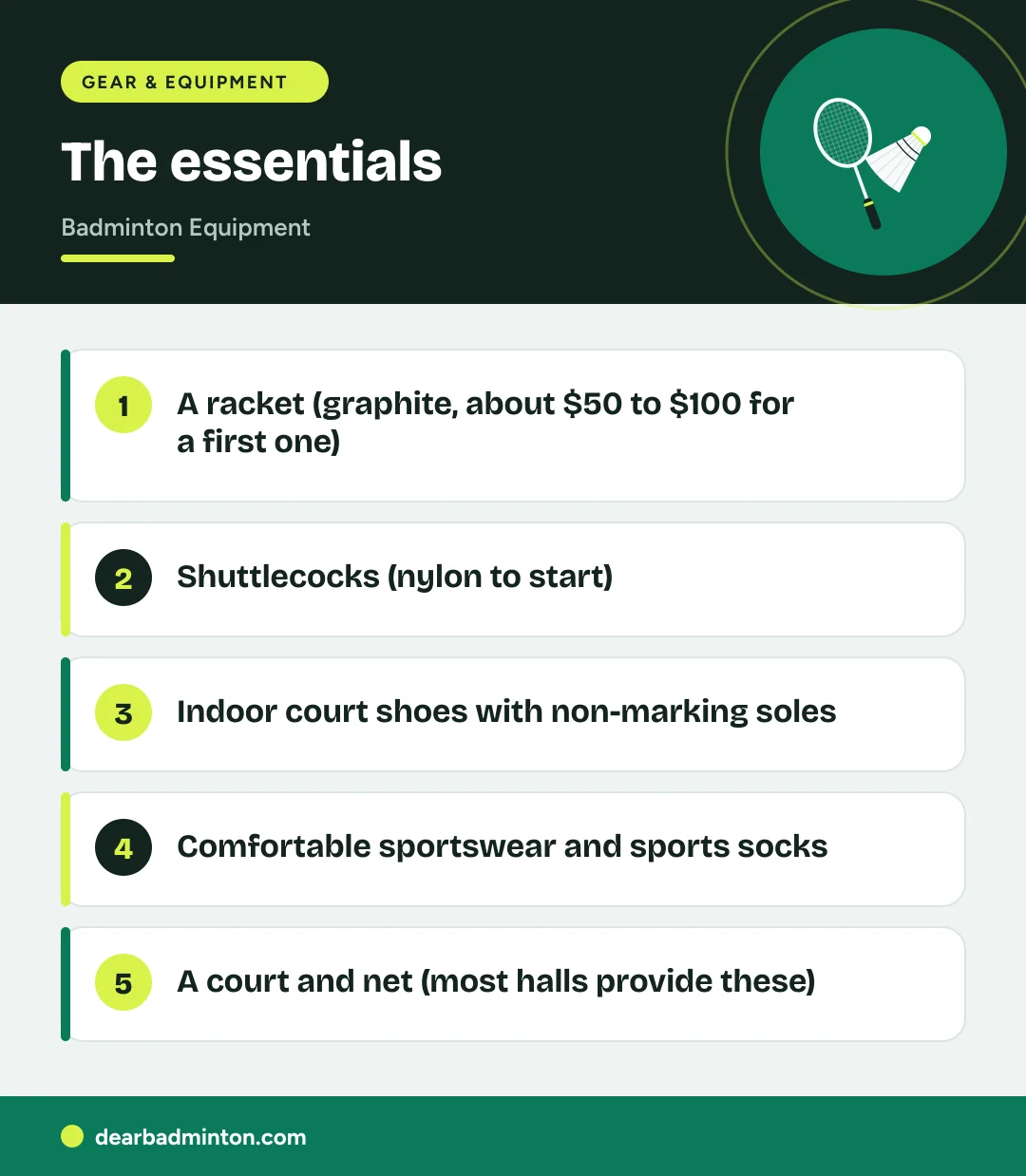
- A racket (graphite, about $50 to $100 for a first one)
- Shuttlecocks (nylon to start)
- Indoor court shoes with non-marking soles
- Comfortable sportswear and sports socks
- A court and net (most halls provide these)
Equipment checklist
| Item | Essential? | Beginner advice | Guide |
|---|---|---|---|
| Racket | Yes | Strung graphite, 4U or 5U, flexible shaft | How to choose a racket |
| Shuttlecocks | Yes | Medium-speed nylon | Shuttlecock guide |
| Shoes | Yes | Gum-rubber, non-marking court shoes | Best badminton shoes |
| Sportswear | Yes | Breathable shirt, shorts or skort, sports socks | See below |
| Court and net | Yes | Hire a court; for the garden, a portable set | Badminton sets and nets |
| Overgrips | Recommended | Cheap way to improve grip and comfort | Grip guide |
| Racket bag | Recommended | Protects the frame from heat and knocks | Kit bags |
| Water bottle and towel | Recommended | Sessions are sweaty | |
| Spare strings | Later | Strings break; carry a second racket or restring quickly | Restringing |
| Knee or ankle supports | Optional | Only if advised after an injury | |
| Eye protection | Optional | Worth considering in doubles near the net |
The racket
A badminton racket is about 665 mm to 680 mm long and weighs around 75 g to 95 g unstrung. For a first racket choose a factory-strung graphite frame in 4U or 5U with an even or head-light balance. Steel rackets from garden sets are heavy and imprecise. Specific models: best badminton rackets.
Shuttlecocks
Nylon shuttles are cheap, durable and ideal for learning. Feather shuttles fly better and are used in club and tournament play, but break quickly. Choose a speed that suits your hall’s temperature.
Shoes
The most important purchase after the racket. Badminton shoes grip the court and support your ankles on sideways movement; running shoes do not. If you play often, buy proper badminton or indoor court shoes.
What to wear for badminton
- Top: a lightweight, breathable, moisture-wicking T-shirt or polo. Cotton gets heavy with sweat.
- Bottoms: shorts, a skort or flexible leggings that allow deep lunges.
- Socks: cushioned sports socks, ideally a little thicker at the heel and ball of the foot to prevent blisters.
- Shoes: non-marking indoor court shoes.
- Optional: a headband or wristbands for sweat, and a warm layer for between games.
Most clubs have no dress code beyond non-marking shoes, though some leagues ask for team colours. In official tournaments, players follow BWF clothing and advertising regulations.
The court and net
An official court is 13.4 m long and 6.1 m wide, with a net 1.55 m high at the posts. Leisure centres, schools and clubs have courts marked out and provide nets; you usually only need to bring a racket, shuttles and shoes. For the garden, see badminton sets and nets and court dimensions.
What to buy first (and what to skip)
- Shoes if you will play more than a few times. They protect you.
- A graphite racket, factory strung.
- A tube of nylon shuttles.
- Overgrips once the original grip feels slippery.
You can skip expensive pro rackets, stiff strings at high tension, and specialist accessories until you are playing regularly.
FAQ
What equipment is needed to play badminton?
At minimum: a racket for each player, shuttlecocks, a net and a court. For regular play, add court shoes and comfortable sportswear.
How much does it cost to start badminton?
Roughly $100 to $200 for a good graphite racket, a tube of shuttles and entry-level court shoes, plus court hire or club fees.
Do I need my own racket at a leisure centre?
Many centres rent rackets, but your own lets you get used to one weight and balance.