Choosing a badminton racket comes down to four specifications: weight, balance, shaft flex and grip size. Get those right for your level and style and almost any racket from a reputable brand will serve you well. Get them wrong, and even an expensive professional frame will feel heavy, slow and unforgiving.
Quick recommendations
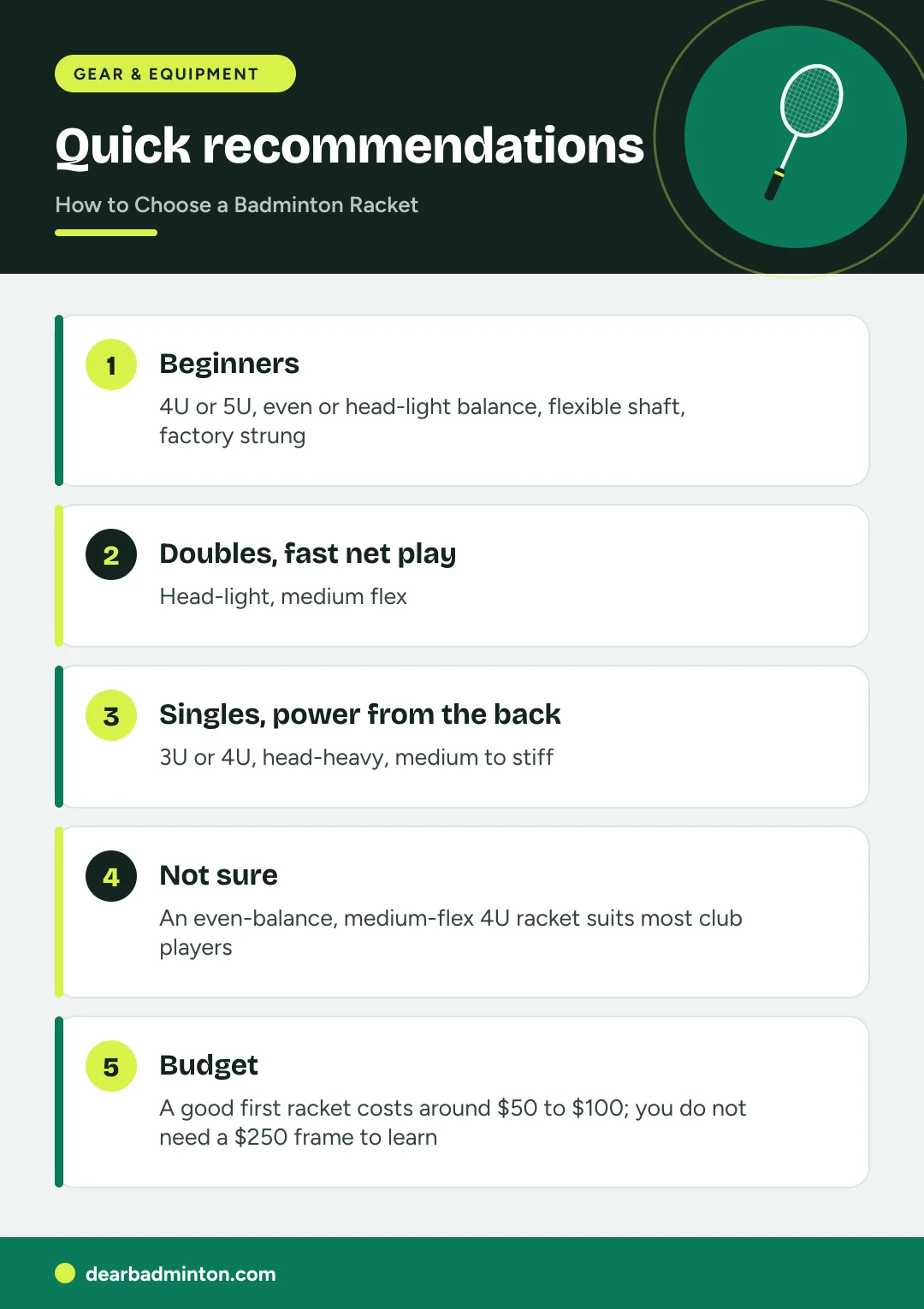
- Beginners: 4U or 5U, even or head-light balance, flexible shaft, factory strung
- Doubles, fast net play: head-light, medium flex
- Singles, power from the back: 3U or 4U, head-heavy, medium to stiff
- Not sure: an even-balance, medium-flex 4U racket suits most club players
- Budget: a good first racket costs around $50 to $100; you do not need a $250 frame to learn
1. Weight (the “U” number)
Most brands grade racket weight with a U number, and the higher the number, the lighter the frame. Weights are for the unstrung frame; strings and grip add roughly 10 g to 15 g.
| Grade | Unstrung frame weight | Typical player |
|---|---|---|
| 2U | 90 to 94 g | Strong, experienced hitters wanting stability |
| 3U | 85 to 89 g | Singles and power players |
| 4U | 80 to 84 g | Most club players, the most common grade |
| 5U | 75 to 79 g | Beginners, juniors, fast doubles handling |
Lighter rackets are quicker to swing and react with, which helps in defence and at the net. Heavier rackets feel more stable and keep momentum through the shuttle, which helps on clears and smashes. If you are unsure, choose 4U.
2. Balance: head-heavy, even or head-light
Balance describes where the weight sits along the racket. It is measured from the end of the handle: the further the balance point is from the handle, the more head-heavy the racket.
| Balance | Feels | Strengths | Suits |
|---|---|---|---|
| Head-light | Quick, easy to manoeuvre | Defence, drives, net play, fast recovery | Doubles front players, beginners, players with arm or shoulder issues |
| Even | All-round | Mix of control and power | Most club players, anyone unsure |
| Head-heavy | Powerful, slower to swing | Smashes and clears from the back | Singles players, attacking doubles back players |
As a rough guide, most rackets balance somewhere around 280 mm to 305 mm from the butt of the handle. Brand series often follow a balance: in Yonex’s current range, for example, Nanoflare frames are head-light, Astrox frames are head-heavy and Arcsaber frames are even balance.
3. Shaft flex: flexible, medium or stiff
The shaft bends during the swing and springs back at contact. How much it bends changes how the racket feels.
- Flexible: bends more, adding easy power for players with slower, less refined swings. Forgiving on timing. Best for beginners.
- Medium: the all-round choice for improving club players.
- Stiff / extra stiff: bends less, so it rewards a fast, well-timed swing with precision and control. Punishes late or weak contact. Best for advanced players.
A common mistake is buying a stiff, head-heavy professional racket because a top player uses it. Those frames need a fast, well-timed swing to work.
4. Grip size
Grip size is labelled with a G number. On Yonex rackets, a higher number means a thinner handle, so G5 is thinner than G4. Thinner handles help finger control and quick grip changes; thicker handles suit larger hands and reduce grip squeeze. If in doubt choose the thinner option: you can build a handle up with an overgrip, but you cannot make it thinner. See how to hold a badminton racket.
5. Strings and tension
Most entry-level rackets come factory strung, which is fine for beginners. When you restring, tension matters more than brand:
| Tension | Feel | Typical player |
|---|---|---|
| About 18 to 22 lbs | Larger sweet spot, more repulsion, durable | Beginners and recreational players |
| About 22 to 26 lbs | Balance of power and control | Most club players |
| 26 lbs and above | Crisp control, smaller sweet spot, strings break sooner | Advanced players with fast swings |
Always stay within the tension range printed on the frame. Thinner strings give more repulsion and feel; thicker strings last longer. How to do it yourself: how to restring a badminton racket.
6. Budget
| Price range | What you get |
|---|---|
| Under $30 | Steel or aluminium rackets in backyard sets: fine for the garden, not for club play |
| $50 to $100 | Full graphite frames, usually factory strung: the right first racket for most people |
| $130 to $200 | Mid-range graphite, better materials and consistency, usually sold unstrung |
| $250 and up | Top-of-range frames used by professionals, best suited to advanced players |
Many brands sell the same racket design at several price points. Yonex, for example, names its tiers Play, Game, Tour and Pro: a Play model is a cheaper, factory-strung version of the same family, while the Pro model uses the most advanced materials. For a beginner, the Play or Game version of a family is usually the better buy.
Recommendations by player type
| You are… | Weight | Balance | Flex |
|---|---|---|---|
| A complete beginner | 4U or 5U | Head-light or even | Flexible |
| A recreational doubles player | 4U | Head-light or even | Medium |
| An improving singles player | 3U or 4U | Even or head-heavy | Medium |
| An advanced attacking player | 3U or 4U | Head-heavy | Stiff |
| An advanced doubles front-court player | 4U or 5U | Head-light | Medium to stiff |
| A junior | 5U or junior-length racket | Head-light | Flexible |
For specific models at each price, see our best badminton rackets guide.
Mistakes to avoid
- Buying a stiff, head-heavy pro racket as a first racket.
- Choosing on looks or brand alone.
- Stringing too tight for your swing speed.
- Ignoring grip size: a handle that is too thick makes every shot harder.
- Using a cheap steel racket for club play: it is heavy and has a small sweet spot.
FAQ
What does 4U G5 mean on a badminton racket?
4U is the weight class (80 to 84 g unstrung). G5 is the grip size; on Yonex rackets, G5 is thinner than G4.
Is a head-heavy racket better for beginners?
Usually not. A head-light or even racket is easier to control and quicker in defence. Move to head-heavy once your technique and timing are consistent.
Does an expensive racket make you better?
Only up to a point. A $60 to $100 graphite racket with the right specs will improve your game far more than a $300 frame with the wrong ones.
How often should I restring?
A common rule is to restring as many times a year as you play per week, and immediately whenever a string breaks.