The grip is the first technique every badminton player learns and the one most beginners get wrong. A good grip lets you reach shuttles on both sides of your body, generate power with your fingers and forearm instead of your whole arm, and switch quickly between shots. This guide covers the main grips, how tightly to hold the racket, and how to choose grip size and grip tape.
Grip basics
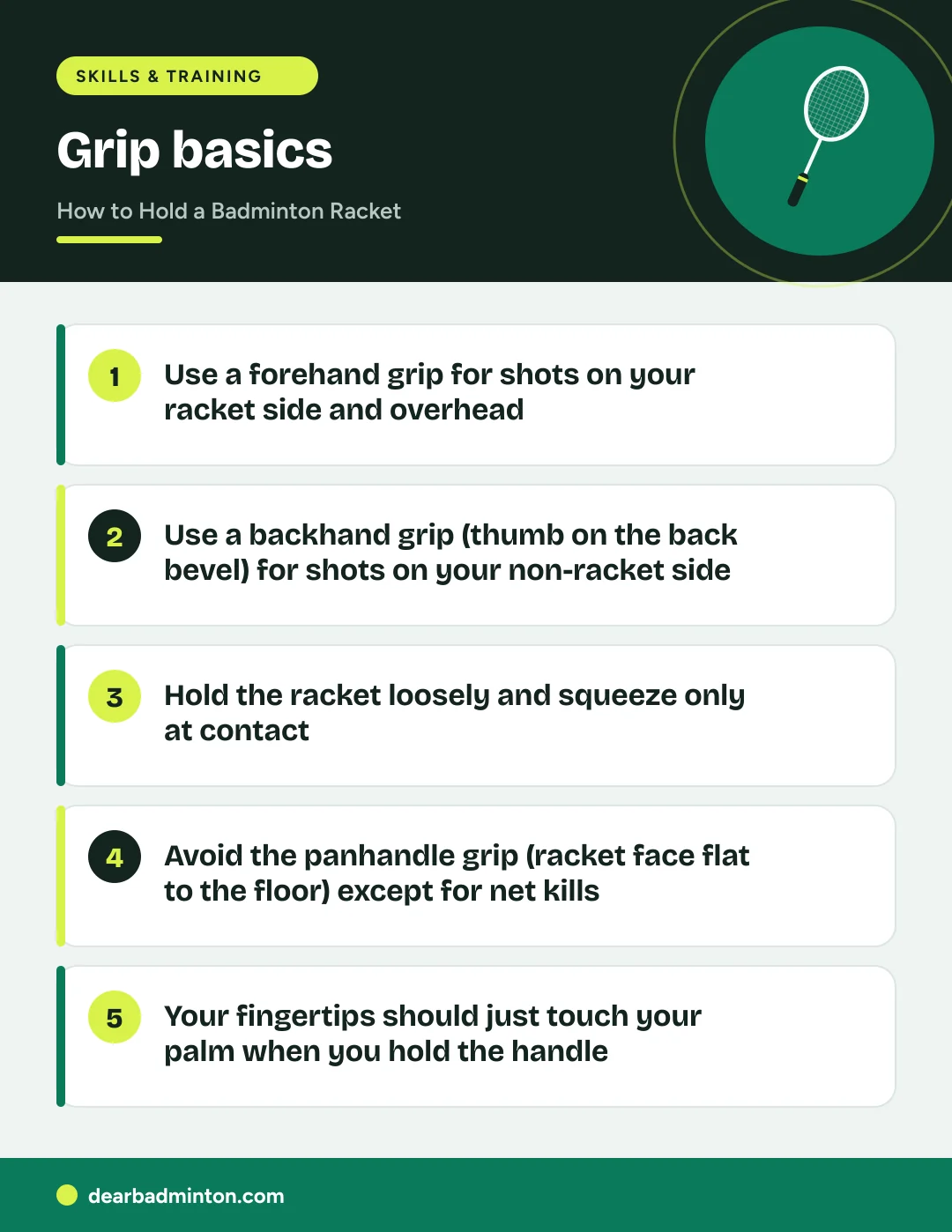
- Use a forehand grip for shots on your racket side and overhead
- Use a backhand grip (thumb on the back bevel) for shots on your non-racket side
- Hold the racket loosely and squeeze only at contact
- Avoid the panhandle grip (racket face flat to the floor) except for net kills
- Your fingertips should just touch your palm when you hold the handle
Understanding the handle
A badminton racket handle is octagonal: it has eight sides, called bevels. Two wide bevels face the same way as the strings, two narrow edges line up with the frame, and four angled bevels sit between them. Feeling these bevels tells you where your hand is without looking.
The forehand grip
Use it for overhead shots (clears, drops, smashes), forehand drives, forehand lifts and the forehand serve.
- Hold the racket by the shaft with your non-racket hand, so the frame is edge-on to the floor (the strings face left and right).
- Place your racket hand on the handle as if shaking hands with it.
- The “V” between your thumb and index finger sits on the narrow top edge of the handle.
- Spread your index finger slightly up the handle, like pulling a trigger.
- Wrap the other fingers loosely around the handle, with a small gap between your palm and the handle.
- Hold it near the end of the handle for power, or slightly higher for control at the net.
The backhand grip (thumb grip)
Use it for backhand drives, backhand net shots, backhand lifts, the backhand low serve and most defence against smashes.
- Start from the forehand grip.
- Rotate the racket slightly anticlockwise (for right-handers) so your thumb can rest flat on the wide back bevel.
- Press with the pad of your thumb, not the tip. The thumb supplies the push.
- Keep the other fingers relaxed and slightly shortened down the handle.
This thumb grip is the one most coaches teach for general backhand shots because it gives control and a quick push.
The bevel grip
A variation for backhand shots from the rear court, such as a backhand clear. The thumb rests on the angled bevel between the wide back bevel and the top edge, which lets you hit with more of a swing. It takes practice; most club players use it only for the back-court backhand.
The panhandle grip
The racket face is flat to the floor and the hand is behind it, like holding a frying pan. Beginners often hold the racket this way naturally because it feels easy, but it makes it almost impossible to play shots to the side or overhead with power. Its one good use is a net kill or net tap, when the shuttle is above the tape and you only need to tap it down.
How tight should you hold the racket?
Much looser than you think. Imagine a scale from 1 (barely holding it) to 10 (squeezing as hard as you can):
| Moment | Grip pressure |
|---|---|
| Ready position and preparation | About 3 out of 10 |
| Just before contact | Tightening quickly |
| Contact on a smash or clear | 8 to 10, for an instant |
| Contact on a drop or net shot | 4 to 6 |
| Straight after contact | Relax again |
That quick squeeze at contact, sometimes called finger power, is what makes good players’ shots fast without a big swing.
Switching grips during a rally
At club level, rallies are too fast to rebuild your grip from scratch. Keep a neutral, relaxed grip in the ready position and make small rotations with your fingers. In doubles defence many players keep a backhand grip by default, because it covers the body and backhand side; they switch to forehand only for shots clearly on the racket side.
Grip size and grip tape
Handle size
Racket brands label handle size with a G number. With Yonex, a higher G number means a thinner handle (G5 is thinner than G4). In the US and Europe, G4 or G5 is common; thinner handles help finger control, thicker ones suit larger hands.
Overgrips
An overgrip is a thin wrap you put over the original grip. It is the cheapest way to change feel and is worth replacing every few weeks if you play often.
- PU (synthetic) grips: smooth or tacky, durable, easy to clean.
- Towel grips: absorb sweat well and feel soft, but build up thickness and need changing more often.
- Thickness: each extra layer makes the handle thicker. If the handle feels too thin, add an overgrip rather than buying a new racket.
Common grip mistakes
- Panhandle grip for everything. Learn the forehand grip from day one.
- Fist grip. Squeezing with all five fingers locks the wrist and kills power.
- Holding too high up the handle on clears and smashes, which shortens the lever.
- Never using a backhand grip, which makes every backhand shot weak.
A simple grip drill
Stand in the ready position. Your partner calls “forehand” or “backhand” and points to a side; you rotate to the correct grip and shadow the shot. Do 30 calls a session until switching feels automatic. Then add it to the rallies in our badminton drills guide.
Next, put the grip to work with the types of badminton shots or learn the full game in how to play badminton.