You do not get better at badminton just by playing games. Games mix everything together; drills isolate one skill and repeat it until it becomes automatic. This guide gives you 15 drills, grouped by what you need: footwork, solo practice at home, partner routines for court time, and fitness, plus a warm-up and a simple weekly plan.
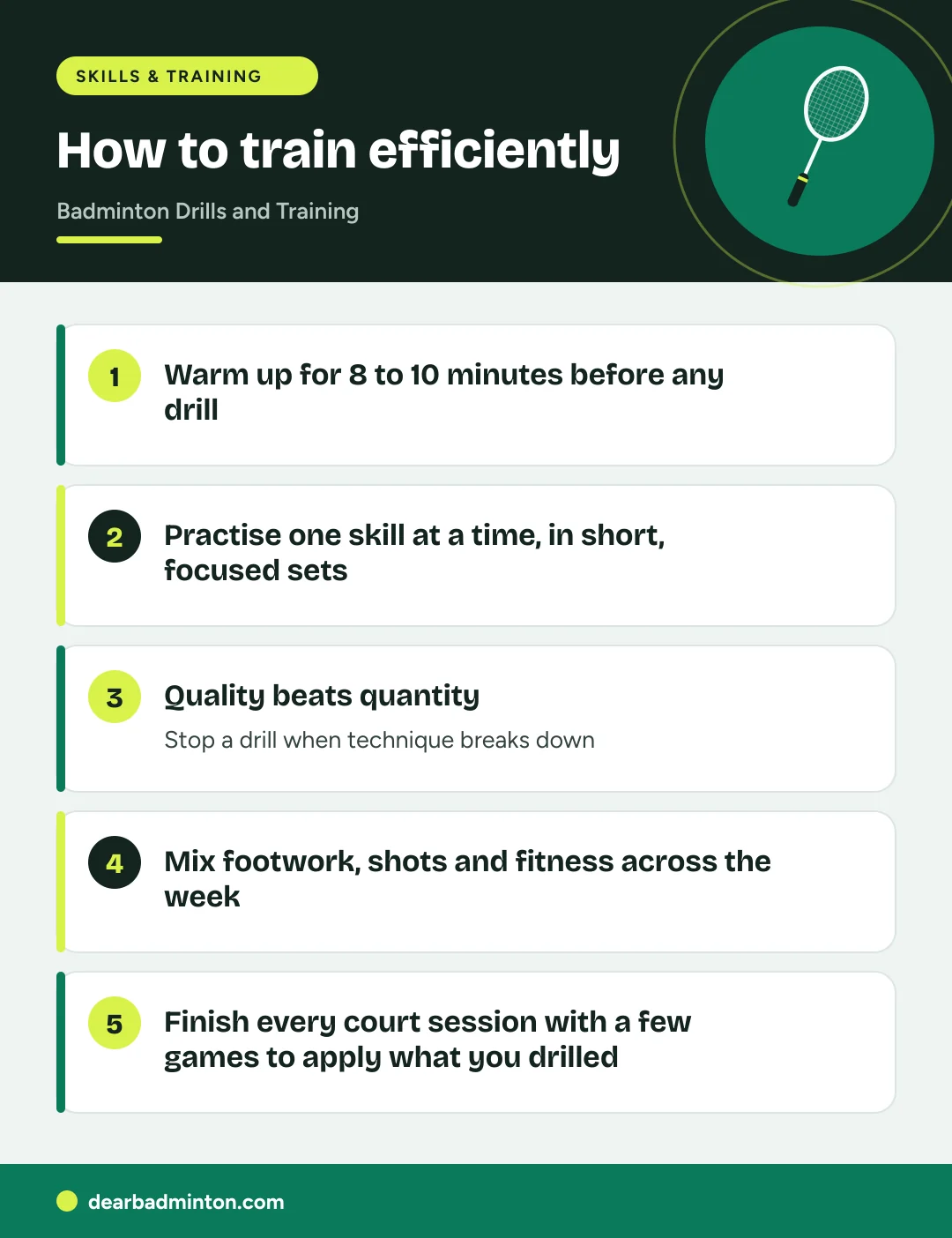
How to train efficiently
- Warm up for 8 to 10 minutes before any drill
- Practise one skill at a time, in short, focused sets
- Quality beats quantity: stop a drill when technique breaks down
- Mix footwork, shots and fitness across the week
- Finish every court session with a few games to apply what you drilled
Warm-up (8 to 10 minutes)
- Light jog or skipping, 2 minutes.
- Arm circles, shoulder rolls and wrist rotations, 1 minute.
- Walking lunges and side lunges, 10 each side.
- High knees, heel flicks and side shuffles across the court, 2 lengths each.
- Shadow swings: 10 forehand and 10 backhand, building to full speed.
- Easy rally, gradually increasing pace.
Footwork drills
Footwork is the skill that separates club players from beginners. Most of these need no shuttle.
1. Six-corner shadow
Start in the centre of the court. Move to each corner in turn (front left, front right, mid left, mid right, rear left, rear right), play a shadow shot, and recover to the centre. 3 sets of 2 minutes, 1 minute rest. Use a partner pointing at corners at random once you are comfortable.
2. Lunge to the net
From the centre, take two quick steps and a long lunge with your racket leg to the front corner. Push back to the centre. 3 sets of 10 each side. Keep your knee in line with your toes.
3. Rear-court chassé
Side-on chassé steps backwards to the rear corner, scissor jump on the shadow smash, recover forward. 3 sets of 8 each side.
4. Split-step reaction
In the ready position, do a small hop (split step) as your partner pretends to hit, then push off in the direction they point. 3 sets of 20 calls.
Solo drills (at home or alone on court)
Good news if you want to know how to practise badminton alone: many of the most useful drills need only a wall, a racket and some shuttles.
5. Wall rally
Stand about 2 m from a wall and keep the shuttle going against it with flat drives, forehand and backhand. Count your best streak. It builds reaction speed and racket control.
6. Wall drive and block
From 3 m, alternate hard drives with soft blocks that drop the shuttle near the wall. 5 minutes. Teaches touch under pressure.
7. Serve practice
On court, put a target (a towel or shuttle tube) just behind the short service line and another near the back line. Serve 20 low serves and 20 high serves to each service court. Record your hits.
8. Shuttle pick-up
Place shuttles in the four corners. Start in the centre, collect one shuttle at a time and bring it back to the centre. Time yourself; aim to beat it each week. Great for footwork fitness.
9. Racket juggling
Bounce the shuttle on the strings, alternating forehand and backhand faces, then the frame. Aim for 50 in a row. Develops fine racket feel for net shots.
Partner drills (court time)
10. Clear-to-clear
Both players hit overhead clears from baseline to baseline. Focus on getting behind the shuttle and full length. 5 minutes.
11. Clear-drop routine
Player A clears; player B drops; A lifts back to B. B always attacks, A always defends. 5 minutes each role. See the drop shot guide.
12. Smash and defend
A lifts to B, B smashes, A blocks to the net, B moves in and plays a net shot or kill. 10 rallies, swap roles. Builds the attacking pattern and the defence. Technique in the smash guide.
13. Drive exchange (doubles)
Both players in mid-court, flat drives back and forth at net height, as fast as possible while staying controlled. 3 sets of 1 minute.
14. Net play
Both players at the net, playing only net shots, trying to keep them tight. Any shuttle above the tape can be pushed or killed. 5 minutes.
15. Multi-shuttle feeding
One player stands at the net with 20 shuttles and feeds quickly to different corners; the other moves and returns each one. Change the feed to train a specific shot. 20 shuttles, 3 rounds. This is how coaches train speed and consistency.
Badminton exercises for beginners: fitness off court
| Exercise | Why it helps | Sets |
|---|---|---|
| Squats | Leg strength for lunges and jumps | 3 x 12 |
| Walking lunges | Front-court reach and knee stability | 3 x 10 each leg |
| Skipping | Footwork rhythm and calf endurance | 5 x 1 minute |
| Plank | Core stability for overhead shots | 3 x 30 to 45 seconds |
| Side shuffles | Lateral speed | 4 x 20 seconds |
| Shoulder band rotations | Protects the shoulder for smashing | 3 x 15 each way |
Start with body weight only and build gradually. If you have joint problems, check with a physiotherapist before adding jump training.
A simple weekly plan
| Day | Session | Time |
|---|---|---|
| Day 1 | Court: warm-up, footwork drills 1 and 4, clear-drop routine, games | 90 min |
| Day 2 | Home: fitness circuit + wall drills 5 and 9 | 30 min |
| Day 3 | Rest or easy walk | |
| Day 4 | Court: serve practice, smash and defend, net play, games | 90 min |
| Day 5 | Home: shadow footwork + skipping | 20 min |
| Weekend | Club games or a match | 1 to 2 hours |
If you only play once a week, use the first 30 minutes for two drills and the rest for games.
How to get the most from drills
- Film yourself occasionally on your phone. You will spot grip and footwork faults immediately.
- One focus per session, for example late contact on clears.
- Keep score in drills (hits on target, longest rally) so you can see progress.
- Stretch after, especially calves, hamstrings and shoulders.
Related guides: types of badminton shots, badminton tips and tactics and how to hold a badminton racket.