Badminton is a racket sport for two players (singles) or four players (doubles). You hit a feathered shuttlecock back and forth over a high net, and you win a point when it lands in your opponent’s court or they make a mistake. It is one of the easiest sports to start, because the shuttle slows down in the air and gives you time to reach it, and one of the hardest to master, because at top level it is the fastest racket sport in the world.
This guide takes you from zero to your first proper game.
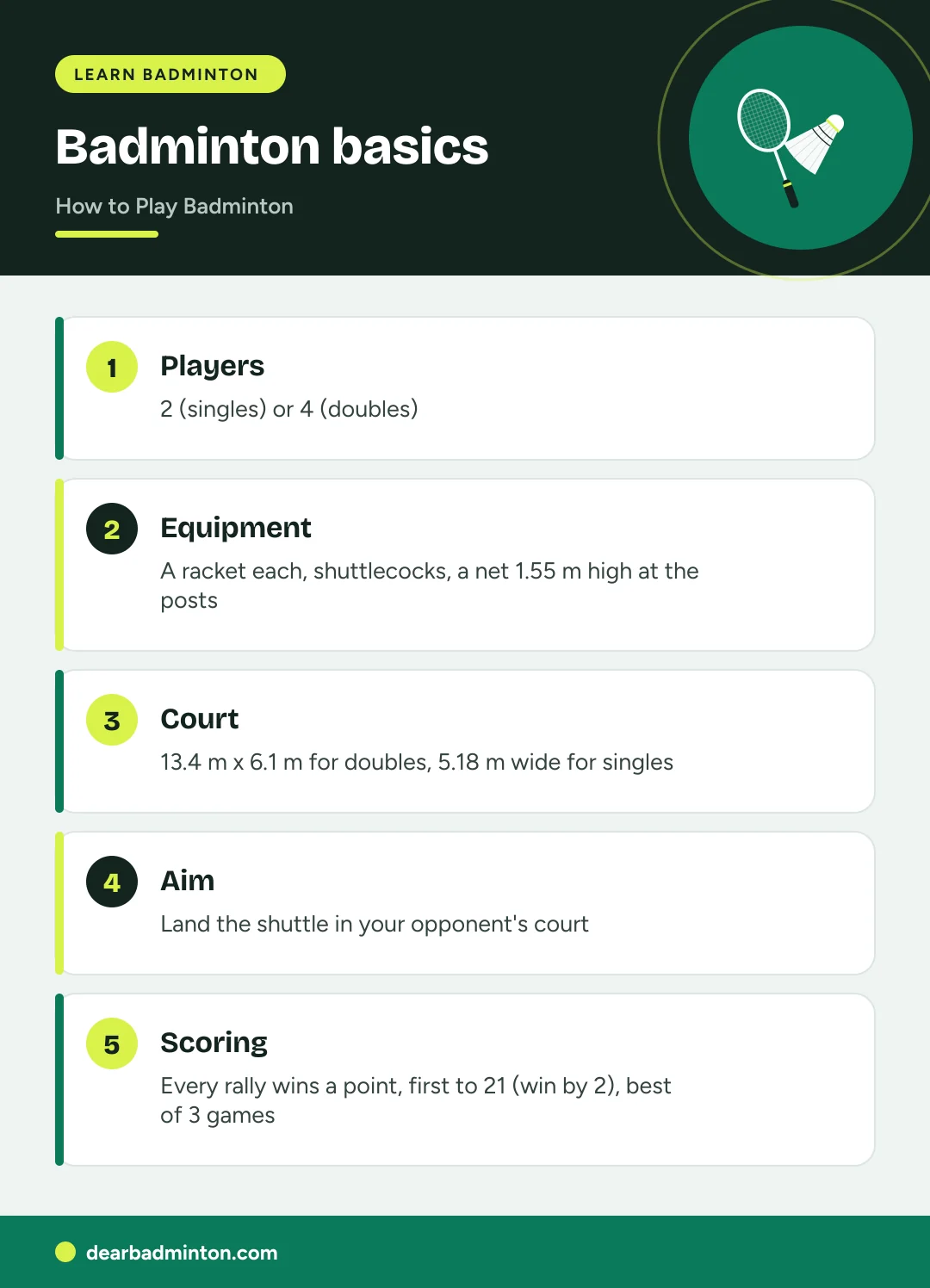
Badminton basics
- Players: 2 (singles) or 4 (doubles)
- Equipment: a racket each, shuttlecocks, a net 1.55 m high at the posts
- Court: 13.4 m x 6.1 m for doubles, 5.18 m wide for singles
- Aim: land the shuttle in your opponent’s court
- Scoring: every rally wins a point, first to 21 (win by 2), best of 3 games
What is badminton?
Badminton is played indoors on a rectangular court divided by a net. Players use light rackets (around 80 g to 95 g) to hit a shuttle that weighs only about 5 g. Unlike tennis, the shuttle never bounces: every shot is played out of the air, and a rally ends when the shuttle touches the floor.
It has been an Olympic sport since 1992 and is especially popular in Asia and Northern Europe. China, Indonesia, Japan, Denmark, Malaysia, South Korea and India produce most of the world’s top players. For recreational players it is a friendly, social sport you can play at any age, at a club, a leisure centre, or in the garden. Read more in where badminton is most popular and the history of badminton.
What you need to play
- A racket. Beginners should pick a light, flexible, head-light or even-balance racket. See how to choose a badminton racket.
- Shuttlecocks. Nylon shuttles are cheap and durable, perfect for learning. Feather shuttles fly better but break quickly. See our shuttlecock guide.
- Shoes. Non-marking indoor court shoes with good grip and cushioning. Running shoes are a common cause of rolled ankles. See badminton shoes.
- A court and net. Most sports halls have badminton courts marked out. For the garden, a portable badminton set is the easy option.
- Comfortable sportswear. Shorts or leggings and a breathable T-shirt are enough.
The full list is in our badminton equipment guide.
The court
The court is 13.4 m long. Doubles uses the full 6.1 m width; singles uses the inner sidelines, 5.18 m apart. Lines are in. The net is 1.55 m high at the posts and 1.524 m in the middle. Two lines matter most for beginners:
- the short service line, 1.98 m from the net, which every serve must pass, and
- the centre line, which splits each half into a left and right service court.
All the measurements are in our court dimensions guide.
The basic rules
- Toss to decide who serves first.
- Serve diagonally, underarm, from behind the short service line. The whole shuttle must be below 1.15 m when you hit it, and both feet must stay on the floor.
- Rally. Each side hits the shuttle once and returns it over the net. You cannot hit it twice in a row or pass to your partner.
- Win the rally when the shuttle lands in your opponent’s court, or they hit it out, into the net, or commit a fault (such as touching the net).
- Score a point for every rally you win, whether you served or not.
- Win the game at 21 points with a 2-point lead (maximum 30). Win the match by taking 2 games.
More detail: rules of badminton, scoring, serving rules.
How to hold the racket
The most important technique for a beginner is the grip.
- Forehand grip: hold the racket as if shaking hands with it, with the racket face edge-on to the floor. The “V” between your thumb and index finger sits on the top edge of the handle.
- Backhand grip: from the forehand grip, turn the racket slightly and place your thumb flat on the wide back bevel of the handle for extra push.
Hold it loosely, like a tube of toothpaste you do not want to squeeze. Tension kills control and power. Step-by-step photos and drills: how to hold a badminton racket.
The ready position and footwork
Stand near the middle of your half, feet shoulder-width apart, knees slightly bent, weight on the balls of your feet, racket up in front of you. After every shot, move back towards this base position. Good badminton players are not the ones who hit hardest, but the ones who are always in position early.
The first shots to learn
| Shot | What it does | When to use it |
|---|---|---|
| Serve | Starts the rally | Every rally |
| Clear | High, deep shot to the back of the opponent’s court | To push them back and buy time |
| Drop shot | Soft shot that falls just over the net | To bring them forward |
| Smash | Steep, powerful downward shot | To finish a rally when the shuttle is high |
| Net shot | Gentle tap from near the net that tumbles over | To force a lift |
| Lift | Underarm shot from the forecourt high to the back | Defence, when you are under pressure at the net |
| Drive | Fast, flat shot at about net height | Mid-court exchanges, mostly doubles |
Start with the serve, the clear and the lift, because they keep rallies going. Then add drops and smashes. Our guide to badminton shots explains each one, with separate guides for the drop shot and smash.
Your first game: a simple plan
- Warm up for five minutes: light jogging, arm circles, lunges.
- Rally gently with a partner, aiming to keep the shuttle in the air as long as possible. Count your best rally.
- Practise serves into each service court.
- Play a game to 11 first, so you learn the scoring without getting tired.
- Play a full game to 21 when you are ready.
How hard is badminton to learn?
Badminton is easy to start and hard to master. Most people can rally within their first session, because the shuttle slows down quickly and the racket is light. Developing clean technique, fast footwork and tactics takes years, and elite players are among the fittest athletes in any sport: a top-level match involves constant sprints, lunges and jumps. For recreational players, though, badminton is a great workout at whatever intensity you choose. See badminton benefits.
Badminton for beginners: common mistakes
- Gripping too tightly. Relax your hand until the moment of impact.
- Standing still after hitting. Always move back to the centre.
- Using the arm only. Power comes from turning your body and using your legs.
- Hitting everything hard. Placement beats power: make your opponent move.
- Wrong shoes. Wear indoor court shoes to protect your ankles and knees.
Where to play
Most leisure centres, schools, universities and community halls rent courts by the hour, and many run social sessions where you can turn up and play. Badminton clubs welcome beginners and are the fastest way to improve. In the US, USA Badminton lists member clubs; in the UK, Badminton England has a club finder.
Frequently asked questions
How many players are in badminton?
Two in singles (one per side) and four in doubles (two per side). Mixed doubles has one man and one woman on each side.
Does the shuttle bounce in badminton?
No. The rally ends as soon as the shuttle touches the floor.
Can you play badminton outside?
Yes, in calm weather, with outdoor shuttles that resist the wind better. Many families play in the garden with a portable net.
How long is a badminton game?
A game to 21 usually takes 15 to 25 minutes for club players. A best-of-three match takes 30 to 60 minutes.
Is badminton good exercise?
Yes. It combines short sprints, lunges and jumps, which build cardiovascular fitness, leg strength and agility.
Ready for more? Learn the language of the game in our badminton terms glossary.