A full badminton court measures 13.4 m long by 6.1 m wide (44 ft by 20 ft) for doubles. Singles is played on the same length but a narrower width of 5.18 m (17 ft). The net is 1.55 m (5 ft 1 in) high at the posts and 1.524 m (5 ft) at the centre. Those four numbers come from the BWF Laws of Badminton and are the same in every club, school and Olympic hall.
This guide explains every line on the court, what it is used for, and how much space you need to fit one.
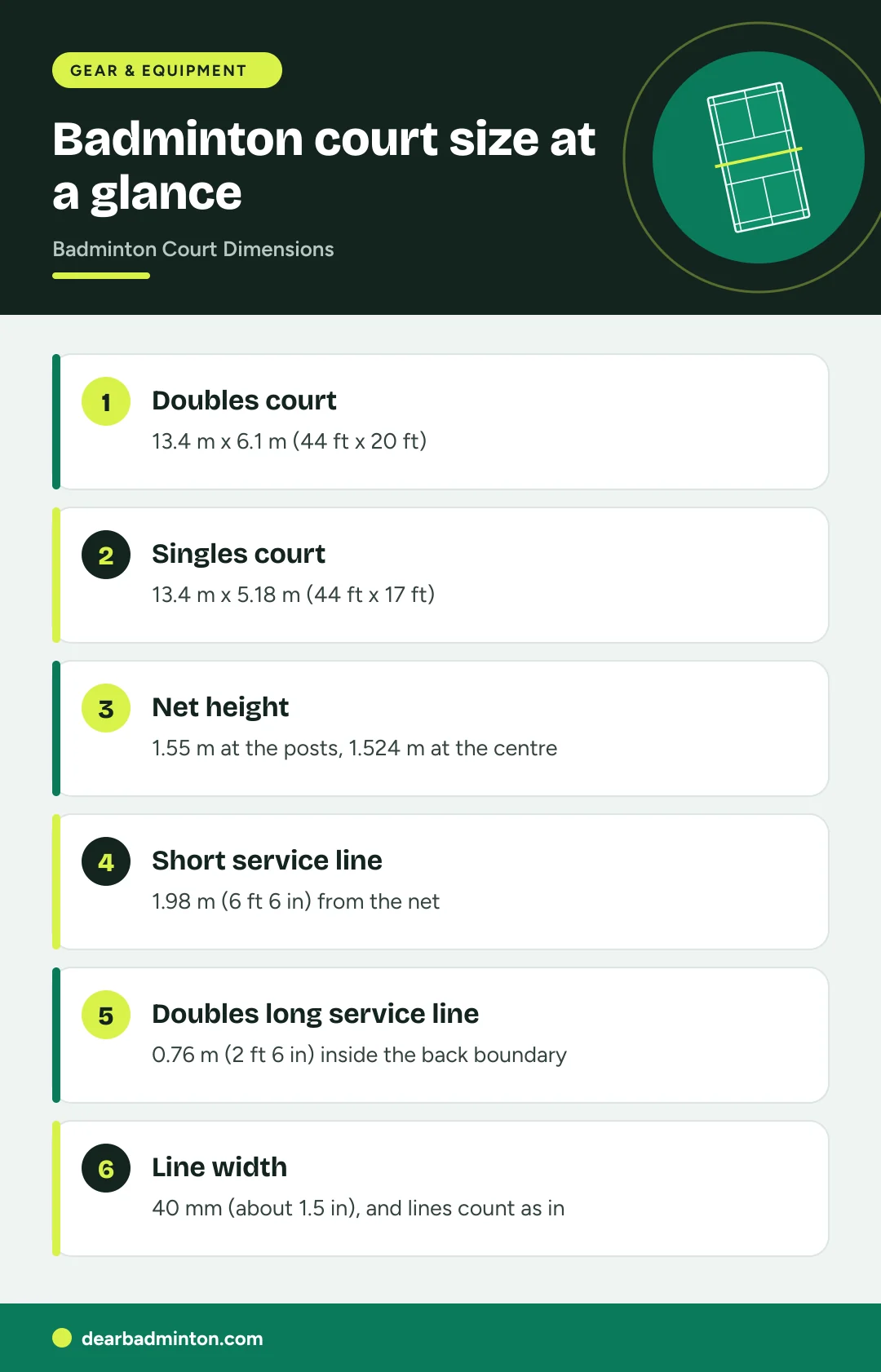
Badminton court size at a glance
- Doubles court: 13.4 m x 6.1 m (44 ft x 20 ft)
- Singles court: 13.4 m x 5.18 m (44 ft x 17 ft)
- Net height: 1.55 m at the posts, 1.524 m at the centre
- Short service line: 1.98 m (6 ft 6 in) from the net
- Doubles long service line: 0.76 m (2 ft 6 in) inside the back boundary
- Line width: 40 mm (about 1.5 in), and lines count as in
Official badminton court dimensions
| Measurement | Metric | Imperial |
|---|---|---|
| Court length (singles and doubles) | 13.40 m | 44 ft |
| Court width, doubles | 6.10 m | 20 ft |
| Court width, singles | 5.18 m | 17 ft |
| Net to short service line | 1.98 m | 6 ft 6 in |
| Back boundary to doubles long service line | 0.76 m | 2 ft 6 in |
| Gap between singles and doubles sidelines | 0.46 m | 1 ft 6 in |
| Net height at posts | 1.55 m | 5 ft 1 in |
| Net height at centre | 1.524 m | 5 ft |
| Line width | 40 mm | about 1.5 in |
| Diagonal of full doubles court | 14.72 m | about 48 ft 4 in |
All measurements are taken from the outside edge of the boundary lines, which is why a shuttle that lands on a line is in.
The lines and what they are for
Outer sidelines (doubles sidelines)
The outermost lines along the length of the court. They mark the width of the court for doubles rallies and for the doubles serve.
Inner sidelines (singles sidelines)
Running 0.46 m inside the outer sidelines, these mark the width of the court for all singles play, including the serve.
Back boundary line
The line at each end of the court. It is the back limit for every rally in both singles and doubles, and for the singles serve.
Doubles long service line
A line 0.76 m inside the back boundary. It matters only for the doubles serve: a doubles serve that lands between this line and the back boundary is out. Once the rally is under way, the full length of the court is in play again.
Short service line
The line 1.98 m from the net on each side. A serve must reach at least this line. The area between the net and this line is the forecourt. Unlike pickleball’s non-volley zone, it has no restrictions during a rally: you can stand there and hit the shuttle out of the air.
Centre line
The line that runs from the short service line to the back boundary, dividing each half into a left and right service court.
Service court dimensions
The service court is the box the serve must land in. It is a different shape in singles and doubles:
| Service court | Length | Width |
|---|---|---|
| Singles | 4.72 m (15 ft 6 in): short service line to back boundary | 2.59 m (8 ft 6 in): centre line to inner sideline |
| Doubles | 3.96 m (13 ft): short service line to doubles long service line | 3.05 m (10 ft): centre line to outer sideline |
A simple way to remember it: singles serves are long and thin, doubles serves are short and fat. Our serving rules guide explains which side to serve from.
Badminton net height and size
The top of the net is 1.524 m (5 ft) from the floor at the centre of the court and 1.55 m (5 ft 1 in) over the doubles sidelines, where the posts stand. The slight dip in the middle comes from the tension of the net cord.
Other net specifications from the Laws:
- The posts are 1.55 m high and are placed on the doubles sidelines, even for singles.
- The net is 760 mm (2 ft 6 in) deep, made of fine dark cord with a mesh of 15 mm to 20 mm.
- It is at least 6.1 m wide so it covers the full doubles court.
- The top is edged with a 75 mm white tape, folded over the cord.
- There should be no gap between the ends of the net and the posts.
If you are buying a net for the garden, see our guides to badminton sets and nets. Many backyard nets are adjustable, so set them to 1.55 m at the posts for proper play.
How much space do you need for a badminton court?
The playing area itself is 13.4 m x 6.1 m, or 81.74 square metres (880 square feet). You need more than that to play comfortably, because players move beyond the lines to retrieve shots.
As a rule of thumb for a home or school setup:
- Floor area: aim for at least 1.5 m to 2 m of clear space beyond every side and back line. That puts the total footprint at roughly 16.5 m x 9 m to 17.5 m x 10 m.
- Between courts: leave at least 1 m to 2 m between adjacent courts so players do not collide.
- Ceiling height: the higher the better. Under about 7 m, high clears and serves will hit the ceiling. Halls built for competition are usually much taller. If you only have a low ceiling, you can still play, but agree a local rule that a shuttle touching the ceiling is a fault.
Outdoors, wind matters more than space. Choose a sheltered spot and use outdoor shuttles; see our shuttlecock guide for the difference.
Can you play badminton on a tennis court?
Yes. A tennis court is 23.77 m x 10.97 m for doubles, so a full badminton court fits easily inside one half, and two badminton courts can fit side by side across the whole tennis court with room around them. You will need your own portable badminton net and posts, because a tennis net is only 0.914 m high at the centre, far too low for badminton. Chalk or temporary court markers make the lines easy to set out.
The bigger challenge is the wind. Badminton shuttles are much lighter than tennis balls, so outdoor courts work best on calm days.
Badminton court vs other courts
| Court | Size (doubles) | Net height at centre |
|---|---|---|
| Badminton | 13.4 m x 6.1 m (44 x 20 ft) | 1.524 m (5 ft) |
| Pickleball | 13.41 m x 6.10 m (44 x 20 ft) | 0.86 m (34 in) |
| Tennis | 23.77 m x 10.97 m (78 x 36 ft) | 0.914 m (3 ft) |
| Volleyball (indoor) | 18 m x 9 m | 2.43 m men, 2.24 m women |
Pickleball uses exactly the same footprint as a badminton doubles court, which is why many sports halls paint both on the same floor. The nets, lines and service rules are very different though. See pickleball vs badminton and badminton vs tennis for full comparisons.
Court surface
Competition badminton is played on synthetic court mats laid over a sprung wooden floor. The mat gives grip and some cushioning, and most mats are green, as in our diagram above. Club and school courts are usually sprung wood or a sports vinyl. Concrete works for casual outdoor games, but it is hard on your knees, and you should wear proper badminton shoes on any indoor surface.
How to mark out a badminton court
- Mark the two back boundary lines 13.4 m apart, each 6.1 m long.
- Join their ends to make the outer sidelines, then check the diagonals are equal (14.72 m) so the court is square.
- Mark the net line across the middle, 6.7 m from each back line.
- Mark the short service lines 1.98 m from the net on each side.
- Mark the inner sidelines 0.46 m inside each outer sideline.
- Mark the doubles long service lines 0.76 m inside each back boundary.
- Mark the centre line from each short service line to the back boundary.
- Use 40 mm wide tape or paint, measuring every distance to the outside edge of the lines.
Frequently asked questions
What are the dimensions of a badminton court in feet?
44 ft long and 20 ft wide for doubles, 44 ft by 17 ft for singles. The net is 5 ft high at the centre and 5 ft 1 in at the posts.
Is a singles court smaller than a doubles court?
Only in width. Singles uses the inner sidelines (5.18 m or 17 ft wide) but the full 13.4 m length, including the back tramlines.
What is the back tramline in badminton?
The 0.76 m strip between the doubles long service line and the back boundary. It is out for a doubles serve, but in for everything else.
How high is a badminton net compared with a tennis net?
A badminton net is about 61 cm (2 ft) higher at the centre than a tennis net: 1.524 m versus 0.914 m.
How many badminton courts fit in a basketball court?
A standard basketball court (28 m x 15 m) can usually fit three badminton courts laid side by side across its length, with limited space between them. Many school gyms mark three or four.