Compare Badminton and Tennis: Which sport suits your needs?
You have been standing at this crossroads longer than you would like to admit.
Maybe someone at your workplace plays tennis and keeps telling you to join him/her. Maybe you watched a badminton match at the Olympics and felt something stir inside you.
Maybe you just want to get fit, have fun and stop dreading your workouts. But every time you try to figure out which sport to choose, you end up more confused than when you started.
Here is what nobody tells you. Most comparisons of badminton and tennis miss the point entirely. They list speeds and court sizes and call it a day. But that does not help you. You are not a statistic. You are a person trying to find a sport that fits your life.
So, we, together, are going to do this differently. We are going to look at what these sports actually feel like from the inside, what they demand from our body and our mind, which one suits different types of people and personalities, and which one will genuinely make you a better, fitter and happier version of yourself.
By the time you finish reading this, you will know exactly which court to walk onto first.
Let us get into it. Just lend me your undivided attention.
1. Why most people pick the wrong sport and how to avoid that mistake:
Here is a pattern I have seen more times than I can count.
When someone decides to take up a racket sport. He picks tennis because it looks prestigious or badminton because his friend plays it. He invests in equipment, books courts and throws himself into it. Six months later, he has quietly stopped going.
Not because the sport is bad. But because it was the wrong sport for him.
The problem is not commitment. The problem is that most people choose a sport based on image rather than suitability. Tennis carries a certain reputation. Badminton gets unfairly dismissed as a garden game. Neither perception is accurate. And, both cost people the chance to find a sport they would genuinely love.
So, before we compare anything, ask yourself these three questions honestly.
- Do you want short, explosive and high-intensity sessions or you wish to go for longer, flowing, endurance-based ones?
- Do you prefer indoor play that is weather-proof or outdoor courts with open sky above you?
- Are you drawn to a sport with a massive global community around you, or one where you become part of a passionate, dedicated minority in your country?
Your answers already point toward one sport more than the other. Keep them in mind as we go through everything below.
Here is a practical tip: Before choosing a sport, try a beginner session of both. Most leisure centers and tennis clubs offer taster sessions. One hour on each court will tell you more than any online article ever could.
2. A fresh look at the origins of both Sports:
Most people know the basics. Badminton came from a Duke’s estate in 1873. Tennis came from French monks hitting balls against walls in the 11th century. Both are old. Both are respected. Move on.
But here is the angle that rarely gets mentioned.
Both badminton and tennis were shaped by the social class of the people who first played them, and that history still quietly influences how each sport is perceived today.
Tennis began as a pastime of French aristocracy and later English upper classes. Wimbledon, founded in 1877, was built on manicured grass in a wealthy London suburb.
The white clothing tradition, the strawberries and cream, the deference to tradition, all of it reflects the sport’s origins in privilege. That legacy is not a criticism. It is fascinating. But it explains why tennis carries a certain weight of formality and prestige that badminton simply does not.
Badminton, meanwhile, spread from English drawing rooms to the British military stationed in India, and from there into the hands of ordinary working people across Asia.
In China, Indonesia, Malaysia and South Korea, badminton became the sport of the streets, the community halls and the local parks. No membership fees. No dress codes. Just a racket, a shuttle and a net.
One sport grew upward into prestige. The other grew outward into the hands of the people.
Neither path is superior. But understanding this helps explain why badminton has 220 million players worldwide while tennis has roughly 87 million, and yet tennis generates dramatically more commercial revenue. Culture and history shape sport in ways that statistics alone never capture.
Interesting Fact! The Duke of Beaufort’s estate, Badminton House in Gloucestershire, still exists today. It is best known now as the home of the Badminton Horse Trials, one of the world’s premier equestrian events. The sport that carries its name has quietly become one of the most played games on the planet.
3. The court size debate: Bigger court does not mean more running across it
People assume that because a tennis court is four times larger than a badminton court, tennis players must run more. It seems logical. More space, more running. Right?
Wrong. And this misconception leads a lot of people to underestimate badminton’s physical demands completely.
Badminton Court Dimensions:
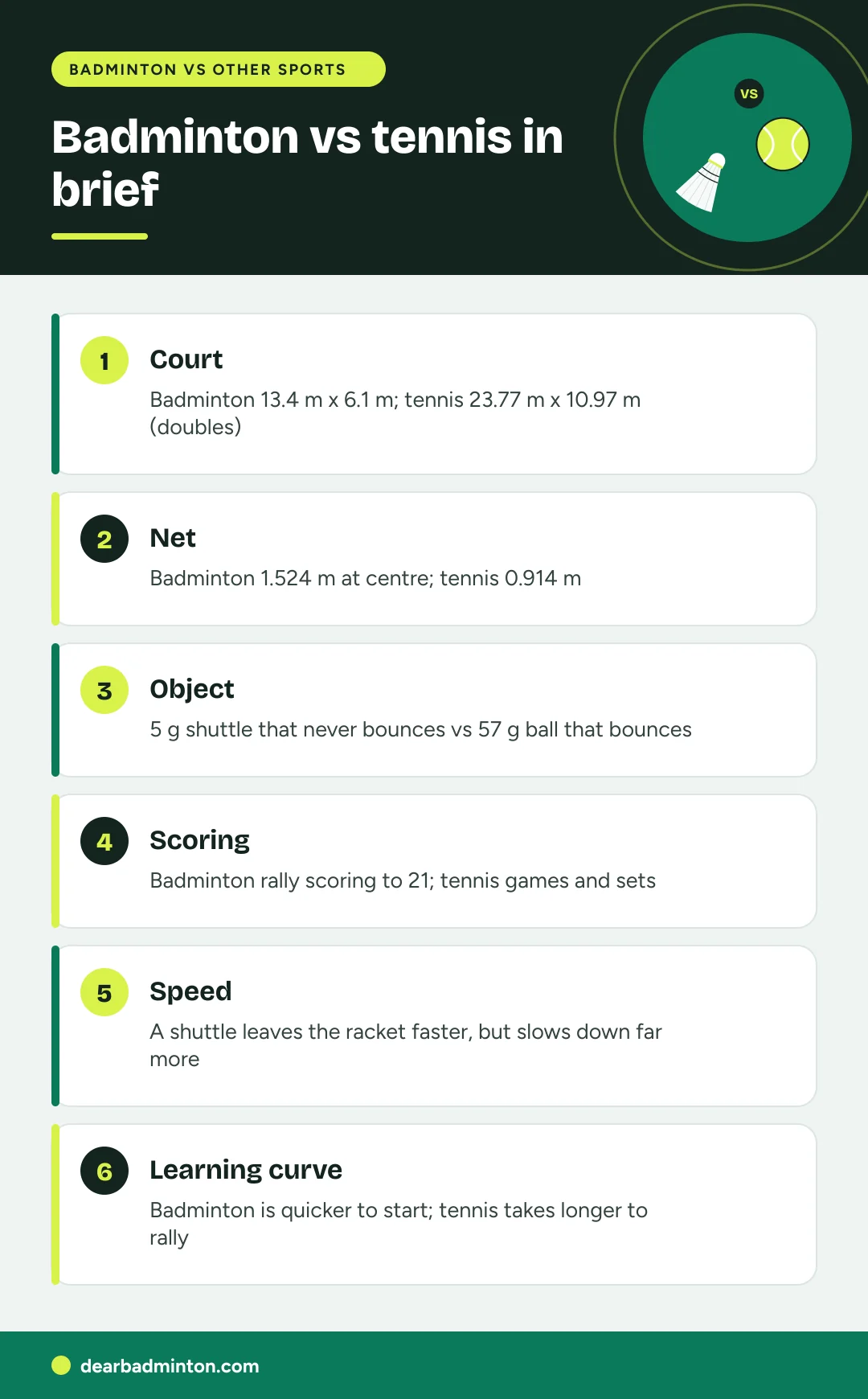
The court measures 13.41 meters in length. For singles play the width is 5.18 meters. For doubles it extends to 6.1 meters. The net stands at 1.524 meters at the center and 1.55 meters at the posts.
Tennis Court Dimensions:
The court measures 23.77 meters in length. For singles the width is 8.23 meters. For doubles it expands to 10.97 meters. The net sits at just 0.914 meters at the center.
Now, here is the insight that changes everything.
In tennis, you cover greater distances per point but you do it less frequently per minute. A wide forehand might send you sprinting four meters, but you then have time to recover, reset and breathe while your opponent prepares their next shot.
In badminton, the distances per movement are shorter but the frequency is brutal. You are changing direction every four to five seconds. You lunge to the net, recover to center, sprint to the back corner, jump for a smash and lunge again, all within a single rally. The court is small but the movement never stops.
Research consistently shows that badminton players cover more distance per minute of active play than tennis players. The court is compact. The demands are not.
Tennis courts also come in four surface types, grass, clay, hard court and carpet. Each surface changes the bounce, the pace and the tactics of the game fundamentally.
Badminton is always played on smooth indoor flooring, typically wood or synthetic sports surface. The consistency of the surface in badminton means you can focus entirely on your opponent rather than reading the bounce.
Actionable Tip: If you want to test your badminton footwork before stepping on court, try this drill at home. Mark six points on the floor in a rough hexagon around a center position. Sprint from center to each point and back, touching the floor each time, as fast as possible for 30 seconds. That is essentially what badminton footwork demands in a match.
4. Badminton Racket vs Tennis Racket: What the racket weight difference really means
Pick up a badminton racket. Now pick up a tennis racket.
The difference is shocking the first time you feel it.
A professional badminton racket weighs between 80 and 100 grams. Some models weigh as little as 70 grams, lighter than a large chicken egg. The frame is made from carbon fiber, titanium, aluminum alloy or composite materials. The maximum length is 680 millimeters. The stringed hitting surface must not exceed 280 millimeters in length and 220 millimeters in width under BWF regulations.
A professional tennis racket weighs between 255 and 340 grams. That is up to four times heavier. The maximum length is 737 millimeters. The hitting surface is considerably larger, built to absorb and redirect the force of a heavy rubber ball at high speed.
But here is the insight most people miss.
The weight difference is not just about how the racket feels in your hand. It fundamentally changes which part of your body generates power in each sport.
In badminton, power comes from the wrist. The racket is so light that the snap and rotation of the wrist generates the speed needed to send a shuttle flying at 400 kilometers per hour. If you try to muscle a badminton shot with your whole arm, you will play badly. The wrist is everything.
In tennis, power comes from the full kinetic chain. Legs drive into the ground, hips rotate, the core transfers energy into the shoulder, the arm swings through and the racket drives into the ball. Wrist action matters, but it is one link in a much longer chain.
String tension tells the same story from a different angle. Badminton strings are typically tensioned between 20 and 30 pounds. Tennis strings sit between 45 and 65 pounds. Higher tension in tennis handles a heavier ball and generates topspin. Lower tension in badminton creates a trampoline effect that propels a tiny shuttle at explosive speed.
Interesting Fact! Professional badminton players often restring their rackets before every tournament match. A single smash can snap a string if the tension is too high or the string is even slightly worn. The cost of restringing, typically 25 to 40 dollars per racket, is one of the hidden ongoing expenses of competitive badminton.
[Best Badminton Rackets Buying Guide]
5. Shuttlecock vs Tennis Ball: How Physics makes badminton a unique racket sport worldwide
Of everything in this comparison, this is the part that genuinely fascinates me the most every single time I think about it.
The shuttlecock is the only sports projectile in the world that behaves the way it does. Nothing else comes close.
The Shuttlecock:
A regulation feather shuttlecock weighs between 4.74 and 5.50 grams. It consists of 16 goose or duck feathers embedded in a cork base covered with leather. The feathers form a conical skirt shape that creates extraordinary aerodynamic drag during flight.
When a shuttlecock is smashed at full power, it can travel at speeds exceeding 400 kilometers per hour. The world record, set by Tan Boon Heong of Malaysia in a 2013 speed test, reached 493 kilometers per hour.
Yet within just one second of flight, that same shuttle can slow from 300 kilometers per hour to under 50 kilometers per hour. The aerodynamic drag is that powerful.
No other object in sport decelerates that dramatically. A golf ball, a tennis ball, even a cricket ball, none of them lose velocity anything like as rapidly as a shuttlecock.
This unique flight characteristic is what gives badminton its extraordinary visual quality. Shots that appear impossible become makeable because the shuttle slows so sharply.
The Tennis Ball:
A regulation tennis ball weighs between 56 and 59.4 grams, approximately ten times heavier than a shuttlecock. It is made of hollow rubber with a felt outer covering.
The fastest serve ever recorded was hit by Sam Groth of Australia in 2012 at 263.4 kilometers per hour. During rally play, groundstrokes typically travel at 100 to 200 kilometers per hour.
Unlike the shuttlecock, the tennis ball maintains much of its velocity throughout its trajectory because its smooth, round shape generates far less drag. It also bounces.
The ball must bounce between 135 and 147 centimeters when dropped from 254 centimeters under official testing conditions.
The shuttlecock never bounces. The moment it touches the floor, the rally ends. This single physical difference changes the entire tactical nature of each sport.
The Fresh Angle Nobody Talks About:
The shuttlecock’s dramatic deceleration actually makes badminton more mentally demanding than most people realise. Because the shuttle slows so sharply mid-flight, reading the shot early is critical.
You cannot wait to see where it lands and then move. By the time it lands, you are already too late. You must read the opponent’s body, racket angle and wrist position before the shuttle is even struck, and commit to your movement immediately.
This is a skill that takes years to develop and that separates good badminton players from great ones.
Interesting Fact! Synthetic shuttlecocks, made from nylon or plastic, are widely used in recreational and club play. They are more durable and considerably cheaper than feather shuttles. However, they fly slightly differently, typically slightly faster than feather shuttles in cooler temperatures and slightly slower in warm ones. Professional tournaments always use feather shuttles.
6. Which sport is faster? The answer might surprise you
Here is a question that sounds simple but actually has two completely different answers depending on what you mean by “faster.”
If you mean the raw speed of the projectile, badminton wins by a significant margin. The world record shuttlecock smash at 493 kilometers per hour is nearly twice the speed of the fastest tennis serve ever recorded.
In match conditions, professional badminton smashes regularly exceed 380 to 400 kilometers per hour. Professional tennis serves typically peak at around 220 to 250 kilometers per hour during actual match play.
If you mean the speed of movement required from the players, the answer becomes more nuanced.
In badminton, players must react to a smash from the back of a 13 meter court in approximately 0.3 seconds. That is faster than many standard human reflex responses operate naturally.
The nervous system is pushed to its absolute limit. Footwork must be explosive and the change of direction speed is extraordinary, covering six corners of a compact court repeatedly throughout each rally.
In tennis, players cover greater distances per movement but have marginally more time to read the ball. A serve at 200 kilometers per hour across a 23 meter court gives the receiver approximately half a second to respond.
That extra fraction of a second might sound trivial but at elite level it is the difference between being completely overwhelmed and having just enough time to set up a return.
Court movement in badminton and tennis therefore trains completely different athletic qualities.
Badminton sharpens the very edge of your reaction speed and explosive agility. Tennis builds powerful sustained lateral movement and longer sprint recovery.
The Insight That Changes Your Training:
If you play badminton seriously, train your nervous system as deliberately as you train your muscles. Sprint intervals, reflex drills and rapid direction changes should be core parts of your fitness routine. Your reaction time is a trainable quality, not a fixed one.
If you play tennis seriously, focus on building aerobic base fitness alongside your explosive movement work. Long rallies on clay courts in particular demand sustained cardiovascular output that few other sports replicate.
[Here is our Badminton Drill Guide]
7. Is Badminton harder than tennis? An honest and personal answer is down here
I want to be straight with you on this one because I have seen too many clickbait articles give you a confident answer that ignores the full picture.
I have played badminton my whole life. I took up tennis seriously when I was in my late twenties. Both sports humbled me. In completely different ways. And I can tell you with absolute certainty that neither sport is simply “harder” than the other.
What they are is hard in ways that do not overlap much at all.
Why Badminton is Hard:
The wrist mechanics in badminton take a long time to develop properly. The backhand smash, which requires the wrist to generate explosive rotational power from a completely unnatural angle at full speed, is widely considered one of the most technically demanding skills in any racket sport. You do not pick that up in a few weeks.
The deceptive stroke play in badminton, where you use the exact same body position and swing to play a smash, a drop shot or a net shot, depending on the last possible flick of your wrist, takes years to develop convincingly. Elite players can make you commit to moving in completely the wrong direction before you even realise what has happened.
The reaction speed required is genuinely extreme. When someone smashes at you from eight meters away at 380 kilometers per hour, you are not thinking. You are reacting. And if your footwork is not already in the right position before the smash is struck, you are not getting to that shuttle. The cognitive and physical demands happen simultaneously and at extraordinary speed.
Why Tennis is Hard:
The physical endurance demanded by tennis at competitive level is formidable. A five-set Grand Slam match lasting four hours requires you to maintain technical precision, tactical clarity and emotional composure simultaneously across an enormous span of time. That is a different kind of hard.
The topspin forehand, which is the most important shot in modern tennis, takes considerable time and physical development to execute with real power and consistency. Generating heavy spin while directing the ball accurately, at pace, under match pressure, is genuinely difficult.
Managing the mental complexity of tennis scoring, recovering from losing a set, holding serve under pressure and staying emotionally stable during long deuce games, adds a psychological dimension that is unique to the sport.
The Learning Curve for Beginners:
Honestly, badminton is quicker to start enjoying. You can have a genuinely fun rally within your first few sessions. Tennis often feels frustrating in the early weeks because controlling a heavy ball with a heavy racket across a large court requires more physical coordination and timing to develop.
However, and this matters, the technical ceiling in badminton is extraordinarily high. Reaching an advanced level in badminton arguably requires more hours of specific deliberate practice than reaching the equivalent level in tennis.
Verdict: Tennis is harder physically over long competitive matches. Badminton is harder in reaction speed, wrist technique and deceptive shot play. Do not let anyone tell you one is simply harder. They are both genuinely challenging and genuinely rewarding in ways the other is not.
8. Which sport burns more calories? Real results that I calculated myself regularly
Let me share something that genuinely surprised me the first time I wore a heart rate monitor during a competitive badminton singles match.
I expected a moderate workout. What I got was data that looked more like a high-intensity interval training session than a sport.
My heart rate was spiking to 180 to 190 beats per minute during rallies and dropping to 130 to 140 in the brief pauses between points, over and over again, for the entire match.
That pattern, intense effort followed by brief recovery, is one of the most effective metabolic training methods known in sports science.
Badminton Calories Burned:
An average person weighing around 70 kilograms burns approximately 450 to 550 calories per hour playing badminton. In a fast-paced competitive singles match, that figure can climb to 600 calories or above. The explosive nature of the sport, with its constant sprinting, lunging, jumping and rapid directional changes, keeps the metabolic demand high throughout.
The cardiovascular system in badminton is pushed primarily through the anaerobic pathway, meaning short bursts of very high intensity followed by brief recovery. This mirrors high-intensity interval training protocols that are widely recognised as highly effective for fat burning and cardiovascular improvement.
Tennis Calories Burned:
An average person weighing around 70 kilograms burns approximately 400 to 600 calories per hour playing tennis, depending on the intensity and format of play. Competitive singles tennis on a fast surface burns at the higher end. Recreational doubles tennis burns somewhat fewer calories because each player covers less court.
The cardiovascular demand in tennis sits more in the aerobic zone, particularly during long baseline rallies, though competitive match play creates regular bursts of higher intensity.
For Weight Loss, Which is Better?
Both are excellent. The difference is in how your body burns the calories.
Badminton burns calories in explosive intervals that elevate your metabolism for hours after the session ends. This is the “afterburn effect” that sports scientists call excess post-exercise oxygen consumption. Tennis burns calories through more sustained aerobic effort, which is excellent for cardiovascular health and base fitness.
If your goal is maximum calorie burn in minimum court time, badminton has a genuine advantage. If you enjoy longer sessions and value the meditative rhythm of sustained aerobic exercise, tennis serves you better.
Beyond Calories:
Both sports develop outstanding physical qualities beyond simple calorie burn.
Badminton builds explosive leg power, remarkable wrist and forearm strength, excellent core stability and extraordinary hand-eye coordination. The deep lunging movements are particularly effective for the inner thigh muscles and hip flexors.
Tennis develops strong muscular endurance throughout the legs, arms and core. Repeated groundstrokes build impressive shoulder and forearm strength. Multiple studies have shown that regular tennis players demonstrate higher bone density than non-players, because the impact loading nature of the sport stimulates bone growth.
A landmark study published in the British Journal of Sports Medicine found that regular participation in racket sports was associated with a 47 percent reduction in all-cause mortality compared to sedentary individuals. Playing racket sports is quite literally linked to living longer.
Workable Tip: If fitness is your primary motivation for taking up a racket sport, play badminton singles rather than doubles. The singles game demands complete court coverage from one player, maximising your calorie burn and cardiovascular output in every session.
9. Badminton vs Tennis Stamina: Sprint sport vs endurance sport
This is one of the most misunderstood areas of the entire badminton vs tennis debate. So we are going to clear it up properly.
People see a tennis match lasting four hours and assume tennis players need more stamina than badminton players. That assumption is only partially correct, and the full picture is considerably more interesting.
Badminton as a Sprint Sport:
Badminton is fundamentally an anaerobic sport. The energy system it relies on most heavily is the phosphocreatine and anaerobic glycolytic system, which powers explosive efforts lasting between two and fifteen seconds.
In professional doubles badminton, rallies typically last between four and eight seconds. In singles they run slightly longer. The recovery between each rally is short, often just five to fifteen seconds in fast-paced competitive play. Then the explosive effort begins again.
This is almost identical in structure to high-intensity interval training. The result is that badminton develops extraordinary explosive power, muscular strength and cardiovascular efficiency in ways that sustained jogging or steady aerobic exercise simply cannot produce.
Professional badminton players have been measured performing over 300 directional changes per match in a singles game. The musculoskeletal demand of that level of repeated explosive movement is comparable to elite football players in terms of agility and conditioning requirements.
Tennis as an Endurance Sport:
Tennis, particularly clay court tennis with long baseline rallies, demands considerably greater aerobic endurance. Rallies can last 20 to 40 shots on clay, keeping players moving continuously for 20 to 30 seconds at a time. Recovery periods between points are typically 20 to 25 seconds, longer than in badminton, which allows the aerobic system to partially recover before the next burst.
Over a five-set Grand Slam match lasting four to five hours, the cumulative aerobic demand is enormous. This is why the greatest tennis players invest heavily in long-distance running, cycling and sustained aerobic conditioning alongside their court work.
The Practical Takeaway:
If you currently do mostly steady-state cardio, cycling or jogging, tennis may feel more manageable initially because it demands a similar energy output pattern. Badminton may leave you gasping in ways you did not expect.
If you already do interval training or team sports like football or basketball, you will likely adapt to badminton more quickly because the energy system demands are familiar.
Neither starting point is wrong. Both sports will develop new fitness qualities you did not have before, which is exactly the point.
[Master Badminton Shots Easily]
10. How long do matches last? Active play time compared my myself
Here is a comparison that the mainstream sports media almost never discusses, and it fundamentally changes how you think about both sports.
Badminton Match Duration:
A typical competitive badminton match lasts between 45 minutes and one hour for a two-game victory. Close three-game matches can last up to two hours. Approximately 50 to 60 percent of a badminton match’s total duration involves the shuttle actively in play.
Tennis Match Duration:
A typical professional tennis match lasts between one and a half and three hours. Grand Slam five-set matches regularly push four to five hours. The longest match in professional tennis history, the Isner vs Mahut first-round match at Wimbledon 2010, lasted 11 hours and 5 minutes across three days.
However, only approximately 20 to 30 percent of a tennis match’s total duration involves the ball actually in play. The remaining 70 to 80 percent consists of ball bouncing rituals before serves, towelling off, retrieving balls, changing ends and the various other pauses that are built into the sport’s rhythm.
The Fresh Perspective:
Tennis matches are longer, but badminton offers more actual game time per hour spent on court. If you have one hour to play, badminton will give you 30 to 36 minutes of genuine physical activity. Tennis will give you around 12 to 18 minutes of ball-in-play time from that same hour.
This is not a criticism of tennis. Those pauses serve important psychological and physical purposes. They allow players to reset mentally, manage their breathing and construct tactical plans. The longer match format creates dramatic momentum swings and emotional storylines that badminton’s faster format cannot produce in the same way.
But if you are playing for fitness, the active play time difference is genuinely significant.
Interesting Fact! The BWF introduced the rally point scoring system in 2006 specifically to increase the amount of active play time in badminton and make the sport more commercially appealing for television. Before 2006, only the serving side could score, matches dragged considerably and television broadcasters struggled to schedule them reliably.
11. Scoring Systems: Simple vs Dramatic
The scoring system of a sport shapes everything about how it feels to play and watch. Get it right and you get drama, tension and moments that live forever in sporting memory.
Badminton Scoring:
Badminton uses the rally point system. Every rally produces a point, regardless of who served. This makes the scoring fast, clear and easy for new fans to follow immediately.
You need 21 points to win a game. Every match is the best of three games, meaning the first to win two games takes the match. If both sides reach 20 points, a deuce is called.
At deuce, the first side to lead by two consecutive points wins the game. The maximum score is capped at 30. If the score reaches 29 all, the next point wins outright.
There is a 60 second interval when the leading score reaches 11 points in each game and a two minute interval between games. In the deciding third game, players change ends when the leading score reaches 11 points.
The team or player that wins a game serves first in the following game.
Tennis Scoring:
Tennis uses one of the most unique and frankly dramatic scoring systems in all of sport. When I first tried to explain it to a friend who had never watched tennis, she stared at me for a full ten seconds before asking if I was making it up.
A match consists of sets. Men play the best of three sets in most tournaments and the best of five in Grand Slams. Women play the best of three across all tournaments.
To win a set you must win six games with at least a two-game lead. If a set reaches six games all, a tiebreaker is played, first to seven points with a two-point lead required.
To win a game you must win four points. These are scored as 15, 30, 40 and then game. If the game reaches 40 all, it is called deuce. At deuce a player must win two consecutive points to take the game. There is no cap. A deuce game can theoretically last forever.
The 15, 30, 40 scoring is believed to originate from clock faces used in early versions of the game, where points were marked at 15-minute intervals around the dial.
The Interesting Contrast:
Badminton’s scoring is democratic and transparent. Every point counts equally. Tennis scoring creates layers of jeopardy where a single game can swing the entire emotional momentum of a match. Losing a game to love, being broken in the final set, saving match points at deuce, these are moments of drama that badminton’s cleaner system simply cannot generate in the same way.
Both approaches are brilliant. They just create entirely different emotional experiences for the player and the spectator.
12. Serving Rules: A weapon in tennis, an art in badminton
The serve starts every rally. It is the first statement of intent in every point. And the two sports have taken completely opposite approaches to what the serve is allowed to be.
Badminton Serving Rules:
In badminton, the serve is deliberately constrained by the BWF. The rules are designed to prevent the serve from being an outright match-winning weapon, so that rallies develop and the game becomes a contest of skill throughout every point.
The serve must be directed diagonally to the opponent’s service court. The server’s feet must remain in contact with the ground throughout the service action. Jumping during a serve is a fault. The shuttle must be struck below 1.15 meters from the floor at the moment of contact. The racket head must be pointing downward at impact.
In singles, if the server’s score is even, the serve is made from the right service court. If the score is odd, the serve is made from the left. In doubles, only one service is allowed per side per turn. There is no second serve in badminton. A service fault immediately gives a point to the opponent.
Types of serves include the high serve, which drives the opponent deep to the baseline, the low serve, which barely clears the net tape and demands a tight return, the flick serve, which deceives a receiver expecting a low serve, and the drive serve, which travels fast and flat toward the back of the court.
Tennis Serving Rules:
In tennis, the serve is the single most powerful weapon in the sport. There are no restrictions on swing, racket angle or ball height. The only rules are positional. The server must stand behind the baseline and direct the ball diagonally into the correct service box. Stepping on or over the baseline before contact is a foot fault.
Critically, tennis gives the server two attempts at each serve. A first serve fault is simply replayed. A fault on the second serve is a double fault and the point goes immediately to the opponent.
A serve that clips the net cord and lands in the correct service box is a let and is replayed without penalty.
Serve types include the flat serve, which is fast and direct, the slice serve, which curves sharply away from the receiver, and the kick serve, which bounces high and awkwardly into the body.
The Insight Worth Noting:
In professional badminton, the serve is actually the moment when the server is most vulnerable. A serve that rises even slightly too high is immediately attacked. Professional badminton serves routinely clear the net tape by just two or three millimeters. The server is essentially trying to make the return as difficult as possible while staying within rules that leave almost no margin for aggression.
In professional tennis, a perfectly executed first serve can win the point before the receiver touches the ball. The record for aces in a single match is 113, achieved by Ivo Karlovic of Croatia in 2009. Imagine winning over 100 points without your opponent ever being able to play a shot.
That scenario is simply not possible in badminton by design. The two sports have made philosophically opposite choices about what a serve should be.
13. Singles and Doubles: Which format is right for you?
Both sports offer singles and doubles play, but the experience of each format is quite different between the two sports.
Badminton Formats:
Badminton is the only racket sport in the world that officially recognises and equally celebrates five distinct competitive formats. Men’s singles, women’s singles, men’s doubles, women’s doubles and mixed doubles all carry equal prestige at the Olympic Games and at BWF World Championships.
In singles, the court uses the full length but a narrower width of 5.18 meters. In doubles, the full width of 6.1 meters is used with a shorter service line creating a tighter service box. The tactics, physical demands and playing styles differ significantly between formats.
Mixed doubles in badminton is widely considered the most tactically sophisticated and entertaining format in the sport. The traditional formation places the woman at the forecourt and the man at the rear, but elite modern pairs have evolved far beyond this structure, using dynamic rotational systems that make the format unpredictable and exciting.
Tennis Formats:
Tennis recognises the same five formats but treats them unequally. Singles is the premier discipline at virtually every professional event. Doubles carries less prize money and commercial attention on the main tour. Mixed doubles in tennis appears only at Grand Slams and the Olympics, making it a format most professional players contest only occasionally.
The doubles court in tennis is wider than the singles court, with the tramlines added on each side. The service boxes remain the same size in both formats.
Which Format Should You Choose as a New Player?
We would generally recommend doubles for beginners in both sports. In badminton doubles, you cover half the court rather than all of it, which makes the game more manageable while you develop your technique. In tennis doubles, the wider court and net player positions create more variety and less sustained running per point.
Singles is where the real physical challenge lives in both sports. It is also where your individual skill development accelerates fastest, because you have nowhere to hide on the court.
14. Faults, Lets and Penalties
Every sport protects its integrity with clear rules for violations. Both badminton and tennis take this seriously.
Badminton Faults:
Service faults include serving from outside the correct court, feet leaving the ground, the shuttle struck above the legal 1.15 meter height, the racket head not pointing downward at contact and the shuttle landing outside the designated service court.
General faults include the shuttle touching the player’s body, the player’s body or racket touching the net, the shuttle falling on the wrong side, a double hit where the shuttle is struck twice in one stroke, carrying or slinging the shuttle on the racket rather than striking it cleanly and reaching over the net to play a shot.
Every fault produces an immediate point for the opponent.
Badminton Lets:
A let is not a fault. It is a neutral replay with no penalty. Lets are called when the receiver was not ready, when a shuttle from an adjacent court interferes with play, when the shuttle breaks mid-rally, when external disturbance affects play and when both players commit a fault simultaneously.
Badminton Penalty Cards:
The yellow card is a formal warning. No point is lost. The red card results in one point deducted from the offending player. The black card results in immediate disqualification.
Tennis Faults and Misconduct:
Service faults include the ball landing outside the service box, foot faults, missing the ball entirely and the ball hitting the net without going over. Double faults hand the point to the opponent.
Play faults include the ball bouncing twice, hitting the ball before it crosses the net, touching the net and double hits.
Misconduct in tennis begins with a code violation warning, progresses to a point penalty, then a game penalty and ultimately to default or disqualification from the match.
Interesting Fact! In 2020, Novak Djokovic, the world number one and heavy favourite at the US Open, was defaulted from the tournament after accidentally striking a line judge in the throat with a ball during a frustrated moment between points. The rule was applied immediately and without exception, regardless of his status in the sport.
15. Skills and Shots: What you need to learn?
Let us be practical here. What do you actually need to develop to play each sport reasonably well?
Badminton Skills and Shots:
The first thing you need to develop is your ready stance. Before every return, stand with slightly bent knees, weight on the balls of your feet and your racket raised in front of you. This position allows you to explode in any direction within a fraction of a second. Without this stance, your footwork will always be one step behind.
Footwork is, above everything else, the most important skill in badminton. Without efficient footwork, no technical stroke can be executed correctly. Badminton footwork patterns cover six corners of the court from a central base position, and learning to move between them smoothly is the foundation of everything else you will develop.
The forehand and backhand grips are the two primary grips, with the panhandle grip used for net play. A relaxed, flexible grip that shifts quickly between shots is the mark of a skilled player. Gripping the racket too tightly kills wrist speed and therefore kills your shot quality.
Strokes cover overhead forehand, overhead backhand, underarm forehand and underarm backhand. Each serves a distinct tactical purpose.
Shots include the smash in forehand, backhand and jumping varieties, the drop shot, the clear, the net shot, the drive and the lift. The smash is your primary attacking weapon. The drop shot is your primary deception tool. The clear pushes your opponent back. The net shot creates opportunities at the front. Learning all of these takes time, but even basic versions of each shot will transform your game quickly.
Tennis Skills and Shots:
The split step is the foundation of tennis movement, a small anticipatory jump performed as your opponent strikes the ball that loads your legs for immediate lateral movement.
Footwork in tennis covers greater distances but with more time per movement than badminton. The approach to the ball, the recovery position and your court awareness are all critical.
Grips include the Eastern, Western, Continental and Semi-Western. The Continental grip is used for serves and volleys. The Semi-Western and Western grips generate topspin forehands. Learning the right grip for each shot type is fundamental.
Strokes include the forehand and backhand groundstrokes, the volley, the half-volley and the overhead smash. Shots include the flat serve, slice serve and kick serve, the topspin forehand, the slice backhand, the drop shot, the lob and the passing shot.
Actionable Tip for Badminton Beginners: Start by developing your low serve, your clear and your basic footwork before anything else. These three elements will allow you to construct a proper rally and start enjoying the game within your first few weeks of practice.
Actionable Tip for Tennis Beginners: Focus first on your forehand groundstroke and your split step. These two skills form the backbone of recreational tennis and will make your early sessions feel far more rewarding.
16. Badminton vs Tennis for Beginners: Where should you start?
I want to speak directly to you if you are a complete beginner right now, because I remember exactly what it felt like to stand on a court for the first time not knowing what I was doing.
It is slightly terrifying. It is also one of the best feelings in the world once the first rally connects properly.
Here is the honest comparison for beginners.
Badminton is generally quicker to start enjoying. The shuttle moves slowly enough at a casual recreational pace for most beginners to track and respond to comfortably. Within two or three sessions, most people can sustain a basic rally and feel the pleasure of the game.
The equipment is lighter and the court is smaller, which both reduce the physical coordination required in the early stages.
Tennis is often more frustrating initially. Controlling a heavier ball with a heavier racket across a larger court takes more physical development and timing to manage.
Many beginners send the ball long or into the net repeatedly in their first sessions. That is normal and it passes, but it can be discouraging if you are not expecting it.
For children, both sports are outstanding choices. Badminton suits younger children particularly well because the lighter equipment fits developing motor skills naturally. Tennis has exceptional junior development pathways globally and enormous school program presence, particularly in Western countries.
For adults returning to exercise after a long break, both sports are accessible. Badminton may be gentler on the joints in the very early stages because the lighter racket and shorter court movements create less impact loading per session.
The Mistake to Avoid:
Do not judge either sport entirely by your first two or three sessions. Both sports have a brief frustration period before the enjoyment kicks in properly. Give yourself at least four to six weeks of regular play before deciding whether the sport is right for you. Almost everyone who pushes through the early awkward phase goes on to love the sport they chose.
17. Cost and Accessibility: The honest breakdown
Sport should be accessible to everyone. Let us look at what each sport actually costs to play regularly.
Badminton Costs:
A beginner badminton racket costs between 15 and 50 US dollars. A quality intermediate racket sits between 50 and 150 dollars. Professional-grade rackets cost between 100 and 300 dollars or more.
Indoor court rental typically costs between 10 and 25 US dollars per hour. Badminton shoes built for court play cost between 40 and 120 dollars.
The ongoing cost to budget for in badminton is shuttlecocks. A tube of six feather shuttlecocks costs between 15 and 30 dollars, and feather shuttles can be damaged within a single hard session. Synthetic shuttlecocks are more affordable and durable, making them the practical choice for recreational players.
Tennis Costs:
A beginner tennis racket costs between 30 and 80 US dollars. An intermediate racket sits between 80 and 200 dollars. Professional-grade rackets cost between 150 and 350 dollars or more.
Court rental costs between 15 and 50 US dollars per hour, though many cities offer free public outdoor tennis courts in parks. Tennis balls are far more cost-effective than shuttlecocks. A can of three balls costs 4 to 8 dollars and lasts multiple sessions.
The Key Difference:
Tennis has better free public court availability in Western countries. Parks and schools provide outdoor courts at no cost in many cities. Badminton always requires an indoor facility, which almost always involves a rental fee.
However, in Asia, badminton court availability is extraordinary. Community halls, sports centers and dedicated badminton facilities are abundant and affordable across China, Indonesia, Malaysia, South Korea and India. In those countries, badminton is considerably more accessible than tennis.
Fun Fact! Despite having 220 million players worldwide, badminton generates a fraction of the commercial revenue of tennis. The highest prize pool at a BWF World Championship is approximately 1 million US dollars. Wimbledon distributes over 50 million US dollars in prize money annually. The grassroots participation numbers of badminton far exceed tennis globally, yet the commercial gap between the two sports remains enormous.
18. Popularity and Global Reach: The numbers tell a surprising story
Here is something that genuinely surprises most people when they first hear it.
Badminton is one of the most widely played sports in the entire world, with an estimated 220 million active participants. Tennis has approximately 87 million. Badminton has more than twice the number of regular players.
Yet ask most people in Western countries which sport is more popular and they will say tennis without hesitation.
The reason for this gap in perception is geography and media. Badminton’s enormous participation base is concentrated in South and Southeast Asia. China, Indonesia, India, Malaysia, South Korea, Thailand, Japan and Vietnam are all countries where badminton is a genuine national sport. In these countries it is played in schools, parks, community halls and professional stadiums with equal enthusiasm.
Tennis dominates in Europe, North America and Australia. These are the regions with the largest television audiences and commercial advertising markets. The Grand Slam tournaments generate hundreds of millions in revenue and attract global broadcast deals. The ATP and WTA tours have genuinely worldwide reach.
So badminton is played by more people. Tennis is watched by more people and generates more money. Both facts are true simultaneously.
A Question Worth Asking:
Does commercial scale make a sport better? Or does the number of people playing it speak more honestly to its quality? We would argue the answer is somewhere in between. A sport that 220 million people choose to play in their free time, often with minimal equipment and no commercial infrastructure around them, is doing something profoundly right.
Do you know! India has become one of the fastest growing badminton nations in recent years. The success of players like P.V. Sindhu, who won back-to-back Olympic medals, and Saina Nehwal has inspired millions of Indian children and adults to take up the sport. India now represents one of the largest and most rapidly expanding badminton communities in the world.
19. Badminton vs Tennis: Head-to-Head Comparison Table
| Category | Badminton | Tennis |
|---|---|---|
| Origin | Ancient Asia, modern form 1873 | 11th century France, modern form 1873 |
| Governing Body | BWF, 190 plus members | ITF, 210 plus members |
| Court Length | 13.41 meters | 23.77 meters |
| Court Width (Doubles) | 6.1 meters | 10.97 meters |
| Net Height (Center) | 1.524 meters | 0.914 meters |
| Projectile | Feather shuttlecock, 4.74 to 5.50 grams | Rubber felt ball, 56 to 59.4 grams |
| Racket Weight | 80 to 100 grams | 255 to 340 grams |
| Fastest Recorded Speed | 493 km per hour | 263 km per hour |
| Reaction Time Required | Under 0.3 seconds | Slightly more time available |
| Scoring to Win a Game | 21 points, rally point system | 4 points per game, 6 games per set |
| Second Serve Allowed | No | Yes |
| Active Play Time Per Hour | 30 to 36 minutes | 12 to 18 minutes |
| Calories Burned Per Hour | 450 to 550 | 400 to 600 |
| Primary Energy System | Anaerobic, explosive bursts | Aerobic, particularly over long matches |
| Court Surface | Always indoor | Grass, clay, hard court, carpet |
| Formats | 5 equally prominent formats | 5 formats, singles most prominent |
| Olympic Sport Since | 1992 | 1896, with a long break |
| Global Players | Approximately 220 million | Approximately 87 million |
| Easier for Beginners | Slightly yes | Slightly harder initially |
| Better for Explosive Fitness | Yes | No |
| Better for Long Match Endurance | No | Yes |
| Commercial Revenue | Modest | Enormous |
20. Final Verdict: Which sport should you choose?
We have covered a lot of ground together. So, let us bring it home cleanly.
There is no single correct answer to whether badminton or tennis is better. That question is honestly the wrong one to ask. The right question is which sport suits the life you are actually living and the person you genuinely are.
Choose badminton if you want explosive, high-intensity sessions that push your reflexes, agility and wrist skills to their limits in a compact indoor environment. Choose badminton if you want to be part of one of the most widely played sports on earth. Choose badminton if you want a sport that is gentle enough for beginners to enjoy quickly but technically demanding enough to challenge you for a lifetime.
Choose tennis if you love the rhythm of sustained, open-court competition across a larger playing field. Choose tennis if you are drawn to the grandeur of the Grand Slam tradition, the variety of court surfaces and the dramatic multi-set match format. Choose tennis if you want a sport that will build your aerobic endurance and bone strength over years of consistent play.
Or, as I eventually decided myself, play both.
Badminton sharpens your reflexes, agility and wrist dexterity in ways that transfer directly to every other sport you play. Tennis builds your endurance, power and sustained mental composure in ways that complement explosive sports perfectly. Together they make you a more complete athlete than either sport alone.
Above all, stop overthinking it. Pick up a racket. Get onto a court. Play.
The best sport in the world is always the one that makes you feel most alive when you are right in the middle of it.
Tips to Avoid Common Mistakes When Choosing Between Badminton and Tennis:
Do not choose a sport based on what your friends play if their lifestyle and fitness goals are different from yours.
Do not judge badminton by a casual garden game you played at a summer party. That experience has almost nothing in common with real badminton. Do not judge tennis by how hard it felt in your first week.
The early coordination challenges pass faster than you expect. Do not assume the more expensive or prestigious sport will make you happier. The sport that makes you show up consistently is the right one.
Three Questions for You:
Have you tried both sports at least once, or are you basing your opinion on watching them rather than playing them?
If someone offered you a free hour-long coaching session tomorrow, which sport would you book it for and why?
What is the single biggest thing stopping you from picking up a racket and starting today?
Answer me in the comment box below to let me know if I could be of some help to your wonderful journey ahead!
References: