Pickleball vs Badminton πŸ“πŸŽΎ Which Sport is Better for You?

For starter, I myself had a trouble in finding out subtle differences between badminton and pickleball. However, when I had a firsthand and regular interaction with both these similar-looking sports, I observed that they had different approaches to gameplay. Let’s see what I ultimately discovered for me and for you.

Badminton is a game of speed, intelligence and extraordinary physical demand. Pickleball, on the other hand, is a game of patience, placement and accessible fun.

At first glance, both sports look almost identical. You see a net divides the court, a racket-type instrument is held in the hand and a light projectile travels back and forth between opponents.

But once you step onto the court and actually play both sports, you quickly realise that comparing them is like comparing a sprinter to a long-distance walker. Both are athletes. Both are moving. But the experience could not be more different.

I have played and observed both sports at a club level for years, and the question I hear most often from beginners and recreational players is a deceptively simple one. Which sport is better for you? The honest answer is that there is no universal winner. There is only the right sport for your specific goals.

In this article, I have broken down every meaningful difference between pickleball and badminton. It ranges from fitness and skill development to cost and community. So, that you can make a clear and confident move based on what you actually want from sport.

1. Fitness and Weight Loss | Which Sport Gives You a Better Workout?

One of the most frequently misunderstood things about badminton is just how physically demanding it truly is. It is not simply a backyard game or a casual pastime. Badminton is one of the most cardiovascularly intense racket sports in the world.

A competitive game demands constant movement. It demands explosive lunges toward the net, rapid directional changes, powerful jumps to attack overhead shuttles and fast recovery sprints back to the base position. Your heart rate does not settle during a badminton rally. It climbs and stays high.

From my own experience while watching beginners step onto the court for the first time, even a short five-minute rally session leaves them breathing hard and reaching for their water.

This is not because they are unfit. It is because badminton asks the entire body to perform simultaneously. Your footwork, arm power, core stability and mental sharpness all working at once.

According to health research, a 30-minute session of competitive badminton can burn between 300 and 450 calories. That is comparable to cycling or swimming at moderate intensity, from a sport that most people think of as recreational.

Pickleball is genuinely active. One should not dismiss it as passive or effortless. Like badminton, it demands movement, positioning and coordination. But the smaller court size, the slower ball speed, and the more measured rally pattern mean that the body simply does less work per minute compared to badminton.

It is a wonderful low-impact workout, particularly for those who need to manage joint stress. But if calorie burn, cardiovascular conditioning and athletic development are your goals, badminton is the stronger choice by a clear margin. Choose wisely. Choose better.

2. Ease of Learning | Which Sport Can You Pick Up Faster?

There is a famous truth in sport. The easier a game is to start, the harder it is to reach the top of. Pickleball reflects this perfectly. One can pick up a paddle, step onto the court and begin enjoying genuine rallies within the very first session.

The ball moves slowly enough that the reaction window is forgiving. The court is compact enough that positioning is instinctive. The rules are simple enough to memorize in twenty minutes. This accessibility is the sport’s greatest strength. And, it is the reason pickleball has grown so rapidly across the world.

One the other hand, badminton requires more patience at the beginning. The shuttlecock behaves in ways that surprise new players. It decelerates rapidly in flight and drops faster than the eye expects, which means your timing and racket preparation must adapt quickly.

The grip, the swing path and the footwork all need foundational attention from early on. One who neglects the basics in badminton finds that bad habits form very quickly and become difficult to correct later.

This does not mean badminton is inaccessible. It means the first two to three weeks feel challenging before they feel rewarding. Once the fundamentals click into place, and with the right guidance they click quite quickly, the game opens up in a way that pickleball simply cannot match.

Think of it like learning a musical instrument. A keyboard is immediately playable but the musician who persists with the piano discovers a world of expression the keyboard cannot offer. Think exactly like that.

3. Long-Term Skill Development | Which Sport Rewards Dedication More?

This is perhaps the most important difference between the two sports for anyone who wants his/her game to keep growing over months and years. Badminton has an almost unlimited skill ceiling.

Professional players train eight or more hours daily, year after year, and still discover new layers to improve. They invent deceptive shot variations, recovery footwork patterns, net play precision, defensive positioning under pressure.

There is always another level above you in badminton, and that is one of the things that makes it so deeply rewarding.

I have observed that recreational badminton players who commit to the sport consistently find themselves improving in visible and measurable ways every three to six months.

Their movement becomes sharper. Their shots become more controlled. Their tactical reading of the rally also improves. The game does not plateau on them. They plateau only when they stop practising.

Pickleball offers meaningful skill development too, particularly in placement, kitchen (non-volley zone) discipline and doubles communication. But one who plays pickleball seriously will find that the skill arc flattens within one to two years for most recreational players.

There is a comfortable level of competence that is reachable relatively quickly and many players settle there contentedly.

For those who want a sport that continues to challenge, teach, and reward them for a lifetime — badminton is the answer.

4. Game Speed and Excitement | Which Is More Thrilling?

If one truly wants to understand the difference in excitement between these two sports, there is a simple exercise. That is to watch one minute of competitive badminton and then one minute of competitive pickleball side by side. The contrast is immediate and unmistakable.

Badminton shuttles in professional play have been recorded travelling at over 300 kilometres per hour. Even at a club level, the speed of the game is extraordinary.

A fast rally, two players exchanging smashes, defensive clears, and net drops in rapid succession, produces an adrenaline response that very few recreational sports can replicate.

There is something uniquely thrilling about a game that forces you to react before you have consciously decided to move.

Your body learns to read the opponent, anticipate the shuttle and commit to the movement before the thinking brain catches up. That is a remarkable athletic experience.

Whereas, pickleball is a more thoughtful game. Players have more time to read the ball, plan their shot and position themselves deliberately. This well-thought pace is precisely what makes pickleball so accessible and so enjoyable socially.

However, if raw excitement, speed, and physical intensity are what you crave from sport, badminton is in a different category.

5. Social and Casual Play | Which Is Better for Groups?

One of pickleball’s most underappreciated qualities is how naturally it brings people together. The lower physical demand means that players of very different ages and fitness levels can share a court without the game feeling unbalanced or unfair.

A 60-year-old and a 25-year-old can have a genuinely competitive rally in pickleball. While in badminton, the difference in physical capacity between those two players would likely be overwhelming.

It is observed at community sports centres and recreational clubs that pickleball sessions attract a wider social mix than almost any other racket sport.

Families play it together. Corporate team events use it. Retirement communities have built entire social programmes around it. The sport’s doubles format, far more commonly played than singles in pickleball, further encourages conversation, teamwork and mutual enjoyment.

Badminton has a vibrant social culture too. Particularly, at club level. But its higher intensity and steeper skill gradient can make casual mixed-ability sessions feel one-sided.

Badminton clubs tend to attract more competitive-minded players, which is wonderful for those who want to push themselves but can feel unwelcoming to complete beginners.

If your goal is a sport that brings people together effortlessly across different ages and abilities, pickleball is the more natural fit. It ultimately depends on your own choice.

6. Cost and Equipment | Which Is Easier on Your Wallet?

Just as one cannot cut wood without the right tools, one cannot play badminton or pickleball without the right equipment. The good news is that getting started in either sport does not require significant investment.

For pickleball, a solid beginner paddle costs between £25 and £80. Pickleball balls are durable and inexpensive, typically costing around £10 for a pack of several. Many parks and community centres now offer free-to-use pickleball courts, making the entry cost genuinely low.

For badminton, a good beginner racket costs between £20 and £60. Court hire at a leisure centre runs approximately £6 to £12 per hour. The main ongoing expense that surprises many new players is shuttlecocks.

Feathered shuttles, which serious players prefer for their superior flight, can cost £25 to £40 per tube and may last only one or two sessions before the feathers begin to break. Synthetic shuttles last longer and cost less, but they do not fly with quite the same quality.

For casual and recreational players, both sports remain affordable. For those who progress to competitive badminton, equipment costs grow gradually. You need better rackets, stringing costs and quality court shoes. Not to worry, these are incremental expenses, not sudden ones.

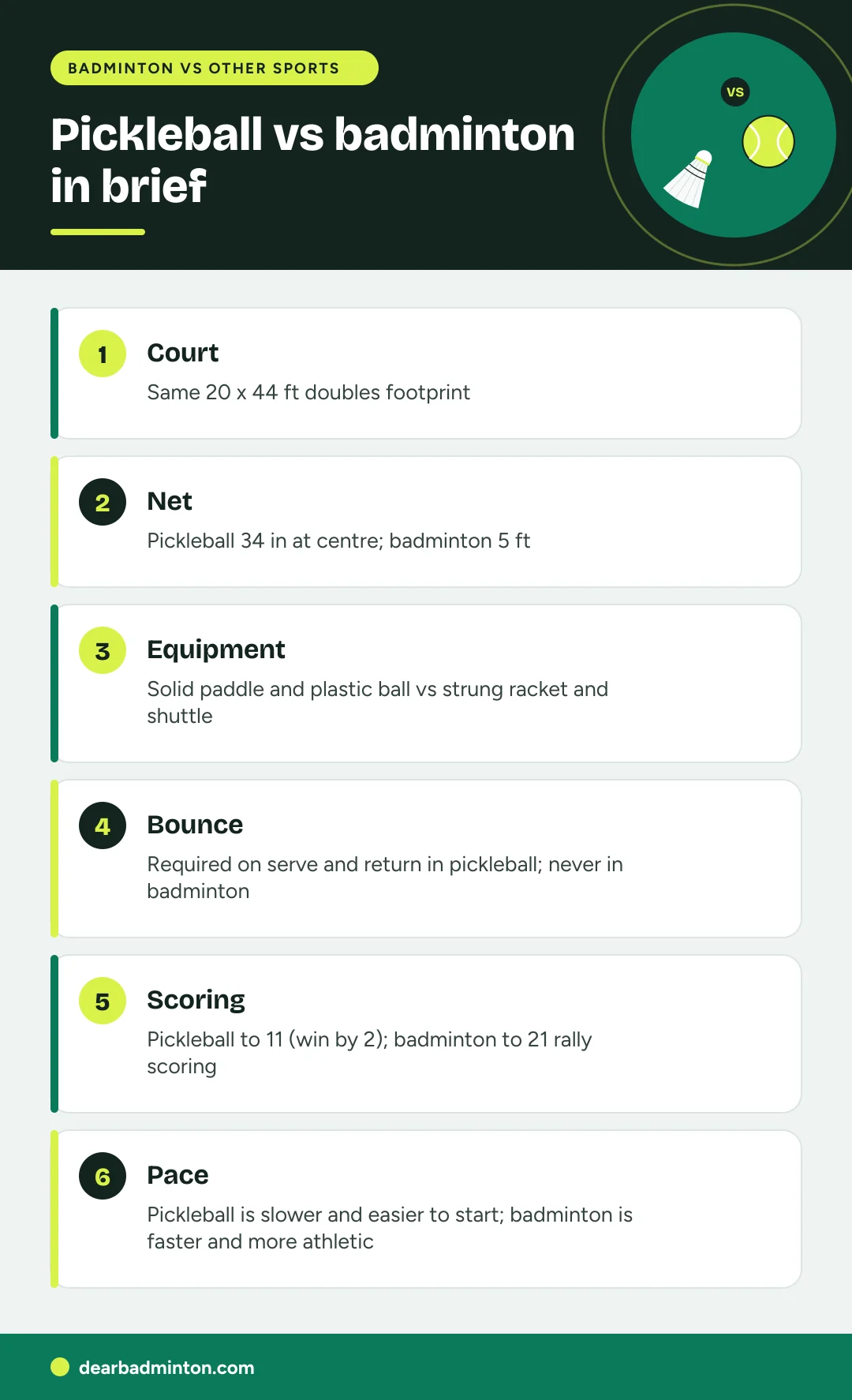
7. Pickleball vs Badminton | Key Differences (Quick Answer)

Pickleball and badminton differ mainly in speed, physical demand, learning difficulty and gameplay style. Badminton is a fast, high-intensity racket sport that requires quick reflexes, advanced footwork and strong cardiovascular fitness. It is played on a larger court with a higher net and uses a feather or synthetic shuttlecock.

Whereas, pickleball is a slower, low-impact paddle sport played on a smaller court with a lower net. It uses a plastic perforated ball and focuses more on control, positioning and strategy rather than speed or power. See down below for subtle differences.

Factor🏸 Badminton🟑 Pickleball
Basic Equipment/GearsLightweight stringed racket + feather/synthetic shuttlecockSolid paddle + perforated plastic ball
Court SizeLarger court (covers more movement area)Smaller court (less movement required)
Net HeightHigher net (more vertical challenge)Lower net (easier clearance)
Game SpeedExtremely fast, explosive ralliesSlower, controlled rallies
Physical DemandVery high cardio + full-body movementModerate, low-impact activity
Learning CurveModerate to difficult for beginnersVery easy for beginners
Skill RequirementHigh technical skill (footwork, timing, shots)Moderate skill (placement, control, positioning)
Main FocusSpeed, reflexes, agility, powerControl, placement, patience
Rally StyleShort, intense, fast exchangesLonger, slower, strategic rallies
Calories BurnedHigh (300–450+ per 30 mins competitive play)Moderate (200–350 per 30 mins)
Injury RiskModerate (joint stress due to intensity)Low (softer movement, less strain)
Social PlayCompetitive club-style environmentHighly social, casual-friendly
Best ForAthletes, fitness-focused playersBeginners, families, casual players
Cost FactorModerate (shuttle replacement cost adds up)Low to moderate (minimal ongoing cost)
Skill Growth CurveContinuous long-term improvementEarly plateau after intermediate level

Who Should Choose Badminton?

Choose badminton if you are someone who believes in earning improvement through dedicated practice. It is the sport for those who want serious cardiovascular fitness, who enjoy fast and explosive competition and for those who find satisfaction in a game that never stops teaching them something new.

One who wants to be genuinely athletic. The one who enjoys pushing ones physical limits on the court. And, the one who wants to look back after a year of playing and see clear and tangible progress. Only that person belongs to badminton.

The game demands more than pickleball. But what it gives back in physical fitness, tactical depth and competitive excitement is extraordinary.

Who Should Choose Pickleball?

Choose pickleball if you want to step onto the court and start enjoying the game from your very first session. It is the sport for those who prioritise social connection, who want low-impact physical activity, or who are returning to sport after injury or a long break.

One who wants a sport they can share with friends and family of all ages, one who prefers a measured and strategic game over a physically demanding one. And, the one who simply wants to have fun without a steep learning curve. Only that person will thrive in pickleball.

FAQs

1. Is badminton harder than pickleball to learn?

Yes. Badminton has a steeper learning curve, particularly in footwork, grip technique and shuttle timing. Pickleball is significantly easier to begin enjoying as a complete beginner. However, with the right foundational coaching, badminton’s learning curve becomes much more manageable in the first few weeks.

2. Which burns more calories — badminton or pickleball?

Badminton burns considerably more calories. A competitive 30-minute badminton session burns approximately 300 to 450 calories. A comparable pickleball session burns roughly 200 to 350 calories depending on intensity. Badminton’s larger court, faster pace, and explosive movement demands far more physical output.

3. Can a person play both badminton and pickleball?

Absolutely YES. Many players enjoy both sports and find that they complement each other well. Badminton players often use pickleball as a lower-intensity active recovery activity. The spatial awareness and net-play instincts from one sport transfer partially to the other.

4. Is badminton good for weight loss?

Badminton is one of the most effective recreational sports for weight loss. Its high-intensity, full-body movement. It combines footwork, explosive arm power and constant directional changes. All of them make it an exceptional calorie-burning activity. Consistent sessions three to four times per week will produce real and visible results.

5. Which sport is safer for the joints?

Pickleball is generally considered lower impact on the knees, hips, and ankles due to its smaller court and slower movement demands. Badminton’s explosive lunges and fast directional changes carry a higher risk of ankle and knee strain, particularly without proper footwork technique and court shoes.

Final Words:

To be very honest, there is no single correct answer to the question of which sport is better. Just as one cannot say whether a sprinter or a marathon runner is the superior athlete. Because they are built for entirely different purposes. One cannot declare pickleball or badminton the universal winner. They serve different people with different goals.

Badminton is the sport of serious athletic development, explosive excitement and lifelong improvement. It is demanding, technical and completely addictive once the fundamentals are in place. For those who want to grow as athletes and competitors, it is simply one of the finest sports in the world.

Pickleball is the sport of accessibility, community and immediate enjoyment. It removes barriers, welcomes all ages and delivers genuine fun from the very first session. For those who want sport to be social and inclusive above all else, it is an exceptional choice.

Choose based on your own goals. Do not pick on trends, not on what your friends are playing. Even not on which sport appears more popular this year. Choose the sport that matches what you want your experience on the court to feel like. Then commit to it fully, practise consistently and let the game teach you everything it has to offer.


If you want to start your badminton journey the right way? Read our [Complete Beginner’s Guide to Badminton Rules for Singles] or explore our [Ten Essential Skills and Tactics] that gives new players the foundation every coach wants to see. Visit dearbadminton.com for weekly training guides built for every level of player.

Leave a Comment

x