A drop shot in badminton is a soft, controlled shot played from the middle or back of the court that travels just over the net and falls steeply into your opponent’s forecourt. Its job is to make your opponent run forward and lift the shuttle, which sets up your next attacking shot. A good drop looks like a smash or a clear until the last moment, then slows down and dies near the net.
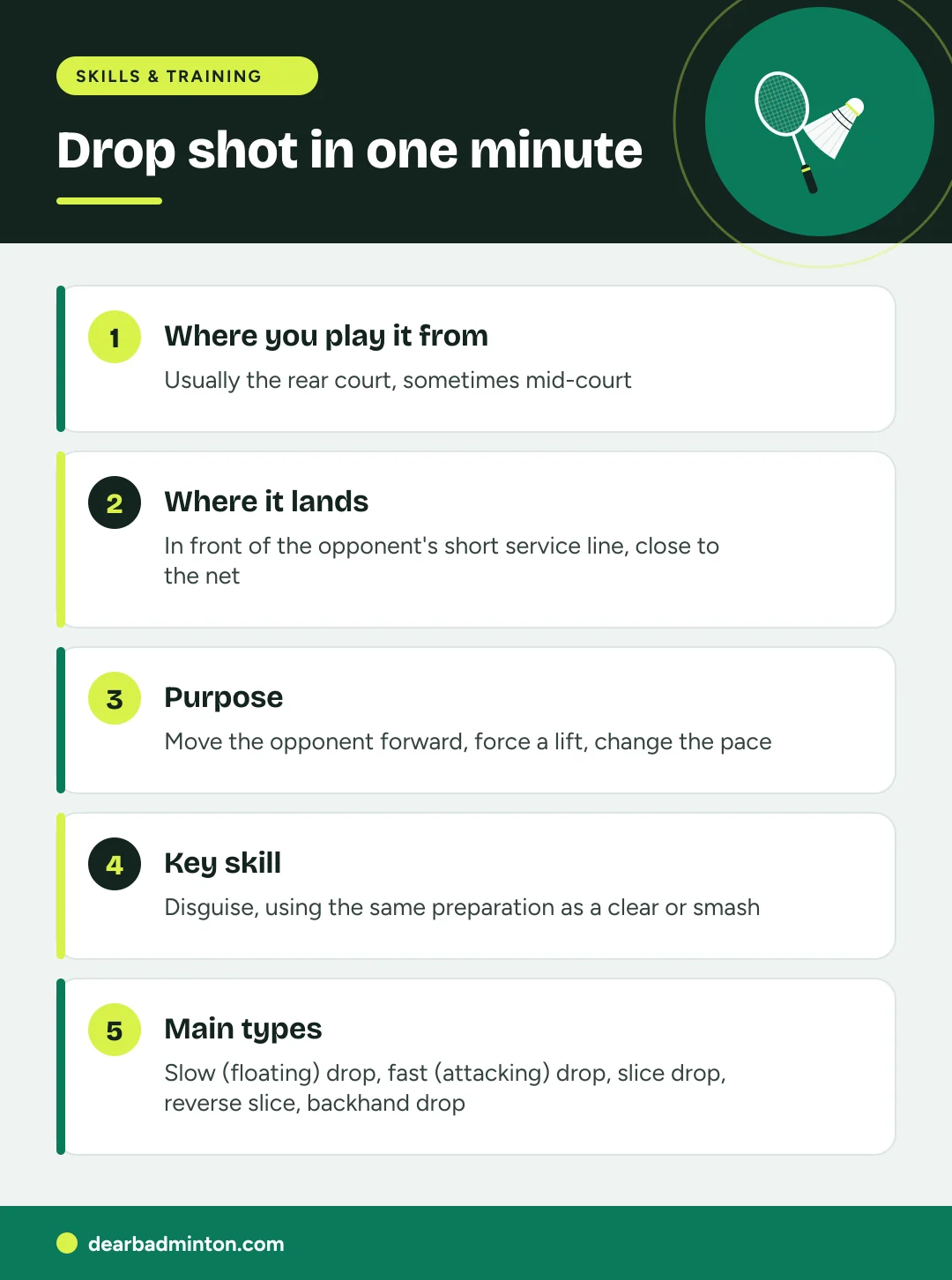
Drop shot in one minute
- Where you play it from: usually the rear court, sometimes mid-court
- Where it lands: in front of the opponent’s short service line, close to the net
- Purpose: move the opponent forward, force a lift, change the pace
- Key skill: disguise, using the same preparation as a clear or smash
- Main types: slow (floating) drop, fast (attacking) drop, slice drop, reverse slice, backhand drop
Why the drop shot matters
Badminton is a game of moving your opponent. A clear sends them to the back, a smash forces a defensive block, and a drop brings them all the way to the net. Mixing those three from the same preparation is what makes a player hard to read. The drop shot is especially useful:
- in singles, to pull an opponent forward after you have pushed them back with clears,
- against a player who stands deep expecting a smash,
- when you are tired and need a lower-energy shot that still keeps you on the attack.
Types of drop shot
Slow drop (floating drop)
The shuttle travels in a gentle arc, peaks on your side of the net and drops close to the tape on the other side. It takes longer to arrive, so it needs excellent disguise, but it lands very close to the net and forces the deepest possible lunge.
Fast drop (attacking drop)
Hit with more speed and a flatter, steeper path, the fast drop lands a little further from the net, around the short service line. It gives your opponent less time to react and is the most common drop in modern singles. It is sometimes called a half smash when hit even harder.
Slice drop
You brush across the shuttle with an angled racket face instead of hitting it flat. The slice makes the shuttle slow down sharply and can change its direction. A forehand slice from the right rear court usually goes cross-court.
Reverse slice drop
The racket face cuts across the shuttle in the opposite direction, usually sending it straight down the line while the body action suggests cross-court. It is a deceptive shot used by advanced players.
Backhand drop
Played from the backhand rear corner when you cannot get round the shuttle to play an overhead forehand. The backhand drop is easier to control than a backhand clear because it needs less power, which makes it a useful escape shot for club players.
How to play a forehand drop shot: step by step
- Move into position. Get behind and slightly to the side of the shuttle, side-on to the net, with your racket foot back. Late footwork is the cause of most poor drops.
- Prepare exactly as for a clear or smash. Racket up, non-racket arm pointing at the shuttle, weight on the back foot. This is where the disguise comes from.
- Swing as if to hit hard. Start the forward swing with the same speed as a clear.
- Slow the racket at contact. Just before impact, relax your grip and reduce racket speed, so the shuttle is guided rather than hit. For a slice, angle the racket face and brush across the cork.
- Contact high and in front. Hit the shuttle at the highest comfortable point, slightly in front of your body. Contact too far behind you sends the shuttle up and gives your opponent time.
- Follow through and recover. Let the racket continue down naturally, then move back to the centre of the court ready for the reply, which is usually a lift or a net shot.
Use a relaxed forehand grip. A tight grip makes it impossible to feel the shuttle and control the pace.
Where to aim
- Straight drop: shorter distance, reaches the net faster, but your opponent has less distance to cover too.
- Cross-court drop: travels further, so it gives your opponent more time, but it makes them move diagonally across the court. Use it when they are already leaning the other way.
- Target zone: in front of the short service line, close to the sidelines. A drop that lands in the middle of the forecourt is easy to reach.
Common drop shot mistakes
| Mistake | What happens | Fix |
|---|---|---|
| Slowing the swing early | Opponent reads it and arrives early | Keep full swing speed until just before contact |
| Hitting the shuttle too high above the net | Easy net kill or push for the opponent | Aim for the shuttle to peak on your side of the net |
| Contact behind the body | Shuttle floats, lands mid-court | Move earlier, hit in front |
| Gripping too tightly | No feel, drops go long or into the net | Relax fingers until the moment of contact |
| Always playing the same drop | Opponent anticipates it | Mix straight, cross-court, slow and fast |
Drop shot drills
1. Clear-drop routine (two players)
Player A clears from the back; player B plays a drop; A lifts it back to B’s rear court; repeat for 10 minutes, then swap roles. This builds the movement pattern from rear court to forecourt and back.
2. Target drops
Place a towel or two shuttle tubes in the forecourt corners. Your partner feeds high serves, and you play 20 drops to each target. Count how many land on or near it.
3. Disguise drill
Your partner stands at the net and calls “clear” or “drop” only after you start your swing. You must change shot at the last moment, which trains the same preparation for both.
4. Shadow footwork
Without a shuttle, move from the centre to the rear corner, play a shadow drop, and recover to the centre. Ten repetitions to each rear corner, three sets. Footwork is half of a good drop.
More routines are in our badminton drills guide.
How to defend against a drop shot
- Keep your ready position slightly forward of centre when your opponent is in the rear court.
- Watch the racket face at contact, not the body: a slowing racket and open face signal a drop.
- Push off early with a lunge to the forecourt, racket up.
- Reply with a tight net shot if you reach it early, or a deep lift if you are late.
Drop shot vs other shots
| Shot | Played from | Lands | Speed |
|---|---|---|---|
| Drop shot | Rear or mid-court, overhead | Opponent’s forecourt | Slow to medium |
| Net shot | Forecourt | Opponent’s forecourt | Very slow |
| Clear | Rear court | Opponent’s rear court | Medium, high arc |
| Smash | Rear or mid-court | Opponent’s mid or rear court | Very fast, steep |
See all the shots in our guide to badminton shots and learn the attacking alternative in the smash guide.
Frequently asked questions
Is a drop shot the same as a net shot?
No. A drop shot is played from the middle or back of the court and travels a long way before falling near the net. A net shot is played from near the net, usually from below the tape.
What is the difference between a slice drop and a normal drop?
A normal drop is hit with a flat racket face and relies on reduced racket speed. A slice drop brushes across the cork with an angled face, which slows the shuttle more sharply and can change its direction, making it harder to read.
Should beginners learn the drop shot?
Yes, once they can hit a consistent overhead clear. The drop uses the same preparation, so learning both together builds good habits.
What is a half smash?
A shot between a fast drop and a full smash: hit with medium power on a steep angle, landing around the short service line or mid-court.