The smash is badminton’s main attacking shot: a powerful overhead stroke that sends the shuttle steeply downwards into your opponent’s court. It is the shot that wins most points at every level, and it is also the fastest stroke in any racket sport. Guinness World Records lists the fastest badminton hit at 565 km/h (351 mph), by India’s Satwiksairaj Rankireddy in a 2023 test.
This guide explains the types of smash, how to hit one, where to aim, and how to defend against it.
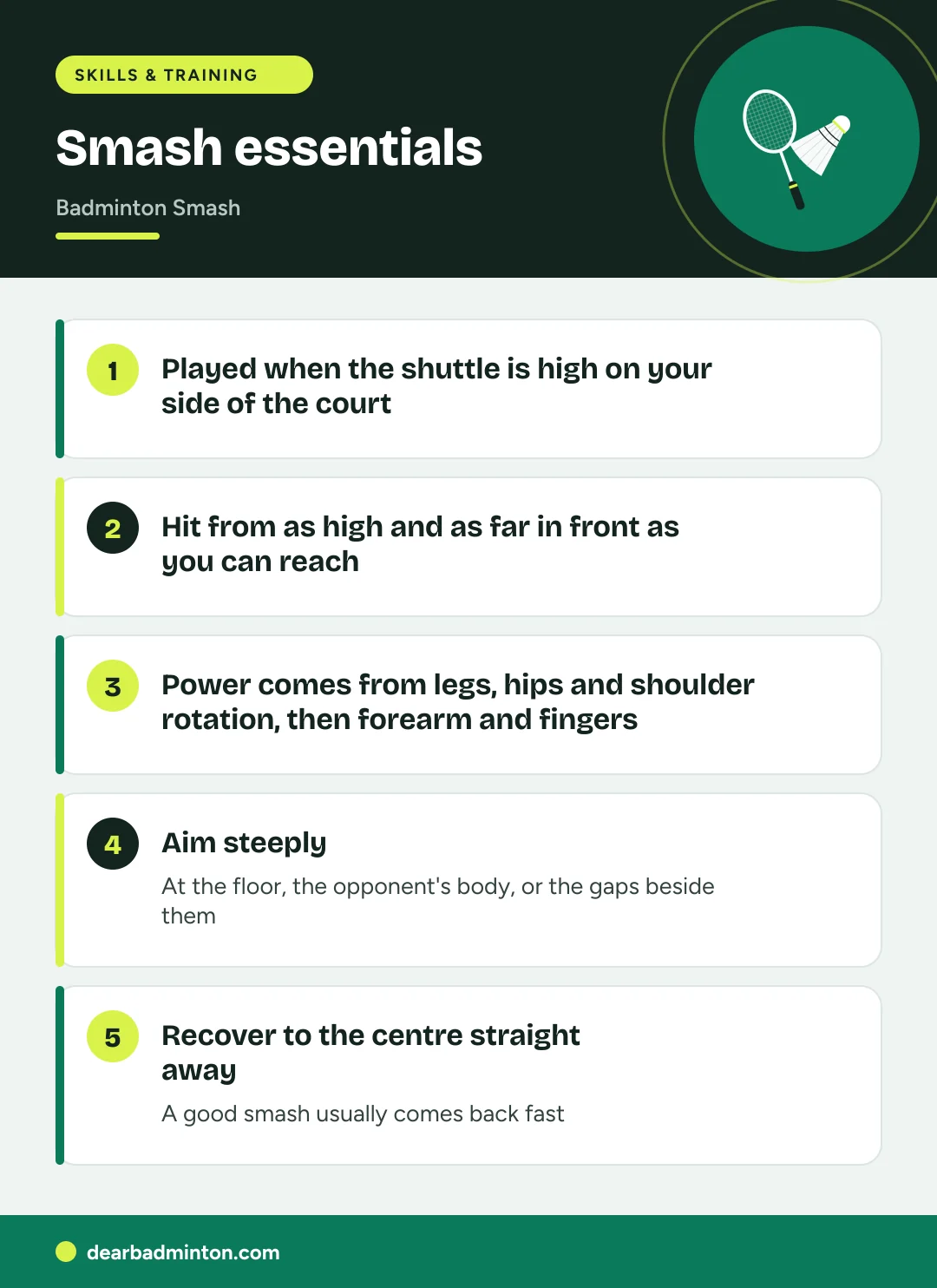
Smash essentials
- Played when the shuttle is high on your side of the court
- Hit from as high and as far in front as you can reach
- Power comes from legs, hips and shoulder rotation, then forearm and fingers
- Aim steeply: at the floor, the opponent’s body, or the gaps beside them
- Recover to the centre straight away: a good smash usually comes back fast
What is a smash in badminton?
A smash is an overhead shot hit with maximum or near-maximum speed on a downward angle. If you come from volleyball, it is badminton’s equivalent of a spike, and players do sometimes call it that. The goal is to make the shuttle land before your opponent can reach it, or to force a weak reply you can finish at the net.
You can only smash effectively when the shuttle is above and in front of you. If it has dropped too low or got behind you, a clear or drop is the better choice.
Types of smash
Full smash
Maximum power from the rear court, the classic attacking shot in singles and doubles. It is fastest off the racket but takes the most energy and gives your opponent the most time, because it travels the furthest.
Stick smash
A shorter, sharper action using mostly the forearm and fingers, with less backswing. Common in doubles from the mid-court, where speed of preparation matters more than raw power. It is steep and quick to hit, and you recover faster.
Half smash
A controlled smash at medium pace, aimed steeply to land around the short service line. It keeps the pressure on while saving energy and is harder to read than a full smash.
Slice smash
The racket face cuts across the shuttle, adding angle and changing its speed. It is useful for cross-court smashes and for making the shuttle drop sharply.
Jump smash
The player jumps to hit the shuttle at a higher point, creating a steeper angle. It looks spectacular and is effective, but it costs energy and makes recovery harder. Learn a solid standing smash first.
How to smash: step by step
- Get behind the shuttle early. Move so the shuttle will drop slightly in front of your racket shoulder. Late footwork is the main reason smashes fail.
- Turn side-on. Racket foot back, non-racket shoulder pointing at the net, weight on the back foot.
- Prepare high. Racket up and back, elbow at shoulder height, non-racket arm raised and pointing at the shuttle for balance and timing.
- Drive from the legs and hips. Push off the back leg and rotate your hips and shoulders towards the net.
- Lead with the elbow, then snap. The elbow comes through first, then the forearm rotates (pronation) and the fingers squeeze the grip at the moment of contact. This is where most of the speed comes from, not from the wrist alone.
- Contact high and in front. Hit the shuttle at the highest comfortable point, slightly in front of your body, with the racket face angled down.
- Follow through and recover. Let the racket swing across your body, step the back foot forward, and get ready for the reply.
A relaxed forehand grip is essential. Squeezing the handle throughout the swing slows the racket down.
Where to aim a smash
- The body: a smash aimed at your opponent’s racket hip or shoulder is very hard to return cleanly, especially in doubles.
- The sidelines: forces a long reach and often a weak lift.
- Down the middle (doubles): can cause confusion over who takes it.
- Steep, not long: a smash that lands near the back line gives your opponent time. Aim to land it in the front half of their court.
How fast is a badminton smash?
| Level | Approximate speed off the racket |
|---|---|
| World record (Guinness, 2023 test) | 565 km/h (351 mph) |
| Elite men in competition | Roughly 350 to 450 km/h |
| Strong club players | Roughly 200 to 300 km/h |
| Recreational players | Roughly 100 to 200 km/h |
These numbers are speeds as the shuttle leaves the racket. Because of the drag created by its feather skirt, a shuttle loses most of that speed within a few metres, which is why even world-class smashes can be returned. Guinness credits the 565 km/h record to Satwiksairaj Rankireddy (14 April 2023, at Yonex’s factory in Saitama, Japan), beating the previous mark of 493 km/h set by Tan Boon Heong. More on shuttle flight in our shuttlecock guide.
Common smash mistakes
| Mistake | Effect | Fix |
|---|---|---|
| Hitting with a straight arm | Slow, flat smash | Lead with the elbow, then rotate the forearm |
| Contact behind the head | Shuttle goes up or long | Move earlier, hit in front |
| All arm, no body | Low power, sore shoulder | Rotate hips and shoulders, use your legs |
| Gripping tightly the whole time | Racket head slows down | Relax, then squeeze at contact |
| Smashing everything | Tired, predictable | Mix with drops and clears |
How to defend a smash
- Stand slightly wider and lower, racket in front at waist height, usually with a backhand grip because it covers most of the body.
- Watch the opponent’s racket, not just the shuttle, to read the direction early.
- Block short to the net if they smash from deep, or drive flat if the smash is slow.
- Lift high and deep if you are under pressure, to buy time.
Smash drills
- Feed and smash: a partner hits high serves or lifts to your rear court; play 10 smashes straight, then 10 cross-court.
- Smash, block, kill: smash, your partner blocks to the net, you move forward and kill or net. Builds the attacking sequence.
- Shadow smash with recovery: without a shuttle, move to the rear corner, play a full shadow smash, recover to the centre. Three sets of ten.
More routines in our badminton drills guide. Compare the smash with other shots in types of badminton shots.
FAQ
Can you spike in badminton?
Yes. The badminton version of a spike is the smash, and a jump smash is the closest equivalent to a volleyball spike.
Is a smash legal from anywhere on the court?
Yes, as long as you hit the shuttle on your own side of the net. A smash at the net is called a net kill.
Does a heavier racket smash faster?
Not necessarily. A head-heavy racket adds momentum, but racket head speed matters more. Many players smash harder with a lighter racket they can swing faster. See how to choose a badminton racket.