Badminton is one of the most accessible ways to get fit. You can play it at a gentle social pace or as an intense interval workout, indoors all year round, alone with one partner or in a group of four. This guide covers the main benefits, how many calories it burns, and how to get the most from playing regularly.
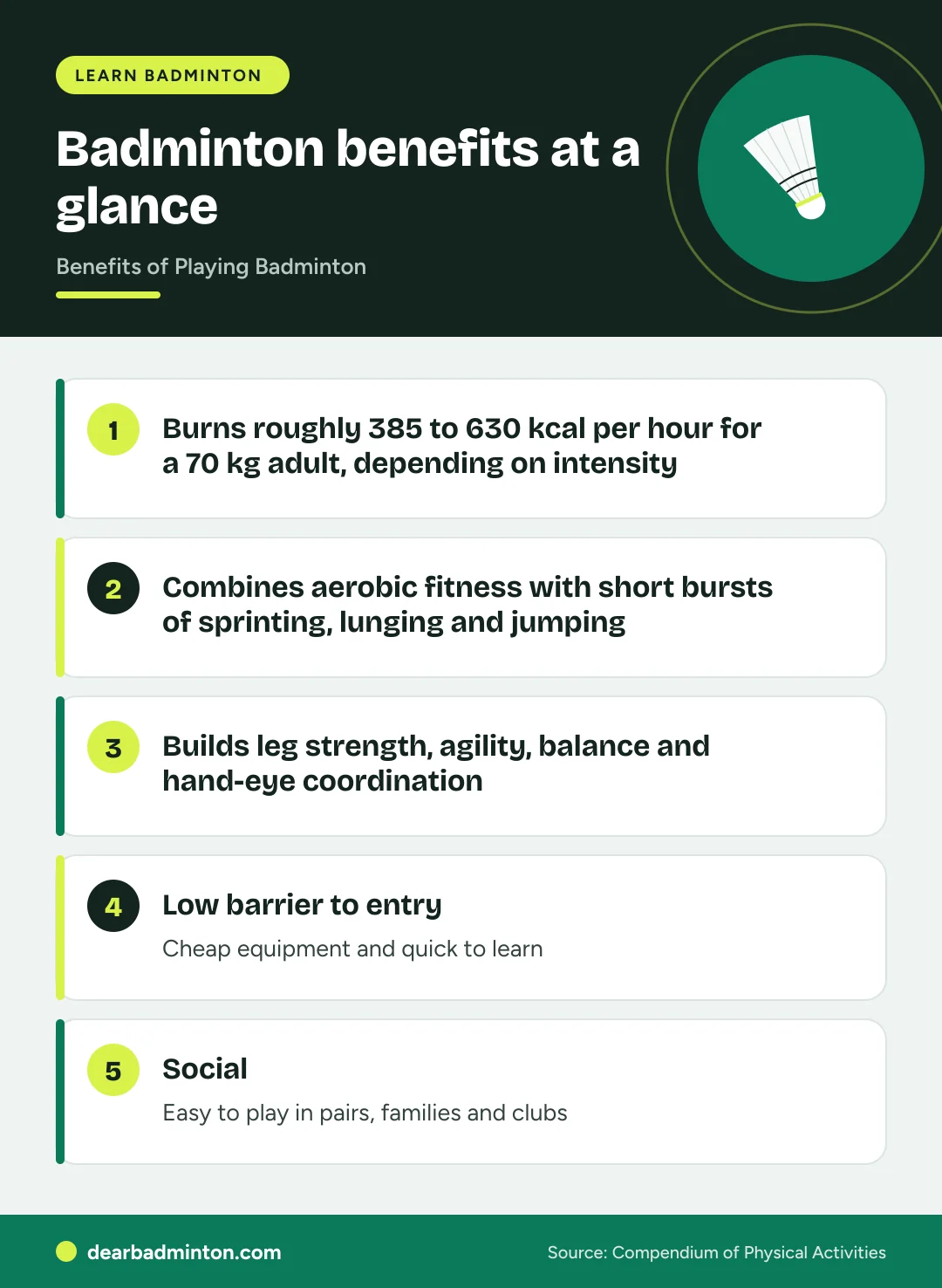
Badminton benefits at a glance
- Burns roughly 385 to 630 kcal per hour for a 70 kg adult, depending on intensity
- Combines aerobic fitness with short bursts of sprinting, lunging and jumping
- Builds leg strength, agility, balance and hand-eye coordination
- Low barrier to entry: cheap equipment and quick to learn
- Social: easy to play in pairs, families and clubs
How many calories does badminton burn?
The Adult Compendium of Physical Activities, the standard research reference for exercise intensity, gives badminton these values. Multiply the MET value by your body weight in kg to estimate calories per hour.
| Activity | MET | kcal per hour (60 kg) | kcal per hour (70 kg) | kcal per hour (85 kg) |
|---|---|---|---|---|
| Badminton, social singles and doubles | 5.5 | 330 | 385 | 468 |
| Badminton, competitive | 7.0 | 420 | 490 | 595 |
| Badminton, competitive match play | 9.0 | 540 | 630 | 765 |
| Tennis, doubles (for comparison) | 6.0 | 360 | 420 | 510 |
| Tennis, singles (for comparison) | 8.0 | 480 | 560 | 680 |
These are estimates for continuous play. Real numbers vary with fitness, rest between rallies and how much of the session is spent waiting for a court.
Can badminton help you lose weight?
It can help, because regular play burns a meaningful number of calories and is enjoyable enough that people keep doing it. Weight loss still depends on your overall energy balance, mainly diet plus total activity. No sport can target fat in one part of the body, such as the belly; fat loss happens across the body as a whole.
To make badminton count for fitness:
- Play singles or fast doubles rather than gentle rallies.
- Keep moving between points and limit long breaks.
- Play two or three times a week rather than one long session.
- Add drills, which are more continuous than games. See badminton drills.
Fitness benefits
Cardiovascular fitness
Rallies alternate short, intense bursts with brief recovery, much like interval training. Over time this builds aerobic capacity and the ability to recover quickly between efforts.
Leg strength and agility
Lunges, split steps and jumps work the thighs, glutes and calves, and the constant changes of direction train agility and balance.
Upper body and core
Overhead shots use the shoulders, back and core, and fast exchanges build forearm and grip strength.
Reaction speed and coordination
Tracking a shuttle that changes speed sharply trains hand-eye coordination and quick decision-making.
Other benefits
- Social: clubs and leisure centre sessions are an easy way to meet people, and doubles is played in groups.
- Year-round: played indoors, so weather does not interrupt your routine.
- Accessible: cheap to start, quick to learn, and playable at any age and level. See how to play badminton.
- Mental focus: rallies demand full attention, which many players find a good break from work and screens.
Why play badminton regularly?
Occasional games are fun, but regular play is where the fitness and skill gains add up. Two or three sessions a week lets you improve technique between sessions, builds fitness steadily and makes it easier to stick with the habit. Joining a club also gives you a range of partners at different levels.
Staying injury-free
- Warm up for 8 to 10 minutes before playing.
- Wear proper court shoes, the best protection against ankle sprains. See badminton shoes.
- Build up gradually if you are new to exercise or returning after a break.
- Cool down and stretch calves, hamstrings and shoulders afterwards.
If you have a heart condition, joint problems or another health concern, check with a doctor before starting a new sport.
How does badminton compare with other sports?
A competitive badminton match is in the same intensity range as singles tennis and squash, and well above table tennis. For a sport-by-sport comparison, see badminton vs tennis, badminton vs squash and pickleball vs badminton.
Source for MET values: the Adult Compendium of Physical Activities.