Badminton vs Squash – Which is harder, calories burned, fitness

Here is something that happens at sports clubs all over the world, practically every week.

A badminton player and a squash player get into an argument about which sport is more demanding. The squash player talks about relentless rallies, non-stop running and lung-burning endurance. Whereas, the badminton player talks about lightning reflexes, explosive smashes and shuttle speeds that exceed a Formula 1 car.

Both of them are right. And both of them are missing the bigger picture entirely.

I have played badminton my entire life. I started as a child, competed at club level through my twenties and have been coaching and writing about the sport for years. When a squash-playing friend challenged me to try his sport seriously about four years ago, I genuinely did not know what I was walking into.

What I found on that squash court surprised me. And what I found when I started comparing the two sports honestly, looking at the research, the physiology, the injury data and the real experiences of players who have played both, surprised me even more.

So, if you have ever wondered that badminton or squash is harder, which one burns more calories, which is safer, which is better for your health long-term, or simply which one you should choose, this is the most complete and honest answer you will find anywhere.

We are going to cover everything. Yes, literally everything. Not just the surface level comparisons, but the real data, the research and the insights that experienced players know from years on court and the practical guidance that will actually help you make the right decision.

Let us get into it.

1. The essential difference between Badminton and Squash:

On the surface, badminton and squash look like they belong to the same family. Both use rackets. Both require extraordinary athleticism. Both are played in enclosed indoor spaces. Both will humble you quickly if you walk onto the court underestimating them.

But once you step inside each sport, the differences become profound.

Badminton is a game of explosive, vertical and three-dimensional movement. The shuttle travels at speeds no other sports projectile reaches, then decelerates so dramatically that reading the flight early is the difference between winning and losing the rally. Every shot can be played at multiple heights, angles and speeds from the same body position. Deception is built into the very DNA of the sport.

Squash, on the other hand, is a game of relentless, horizontal and sustained pressure. The ball never leaves the enclosed box of the court. Rallies can last 50, 60, even 100 shots as both players grind for dominance. The walls are weapons. Positioning, patience and physical endurance are tested continuously from the first point to the last.

One sport tests the absolute edge of your reaction speed and explosive power. The other tests how long you can sustain elite physical and mental performance under mounting pressure.

Neither description is more impressive than the other. They are simply different sporting challenges that demand different athletic qualities.

The question is not which sport is better. The question is which one is better for you.

2. Origins and history: Two sports, two worlds

Understanding where each sport came from helps explain why they feel so fundamentally different today.

Badminton:

Badminton traces its origins back over two thousand years. Ancient versions of the game were played in China, Greece, India and Japan, where players used paddles and feathered objects simply to keep a cork in the air. No net. No court. No rules. Pure skill and enjoyment.

The modern sport was born in 1873 at Badminton House in Gloucestershire, England, the country estate of the Duke of Beaufort. During a gathering at the estate, guests introduced a net to the old battledore and shuttlecock game they were playing indoors. The Duke loved it. The sport took his home’s name and never looked back.

The Bath Badminton Club, founded in 1877, became the world’s first official badminton club. The Badminton World Federation was established in 1934 and today governs over 190 member nations. Badminton entered the Olympic Games in 1992 and has been a permanent, beloved fixture ever since.

Today, badminton has an estimated 220 million active players worldwide, making it one of the most widely played sports on the planet. It dominates the sporting culture of China, Indonesia, India, Malaysia, South Korea, Thailand, Japan and Vietnam.

Squash:

Squash was born in London around 1830, at Harrow School, where students discovered that a punctured racketball, which squashed on impact with the wall, created a more interesting game than a regular bouncing ball. The sport grew rapidly through English private schools and universities before spreading across the British Empire.

The World Squash Federation governs the sport today across more than 185 member nations. Squash has repeatedly sought Olympic inclusion but has not yet achieved it, remaining one of the most significant omissions from the Olympic program despite widespread participation and elite competitive infrastructure.

Interestingly, squash has produced some of the most remarkably dominant individual athletes in the history of sport. Jahangir Khan of Pakistan was unbeaten in professional competition for five years and eight months from 1981 to 1986, winning 555 consecutive matches. No athlete in any major sport has approached that level of dominance over a comparable period.

Interesting fact! Despite being estimated to have around 20 million active players worldwide compared to badminton’s 220 million, squash has arguably produced a higher concentration of elite athletic achievement per participant than almost any other racket sport. The sport’s demanding physical nature filters for extraordinary athletes.

3. Court size and dimensions: Smaller court does not mean that it is easier

One of the most persistent misconceptions in the badminton versus squash debate is the assumption that court size directly determines how much running each sport demands. The reality is far more interesting than that.

Badminton Court Dimensions:

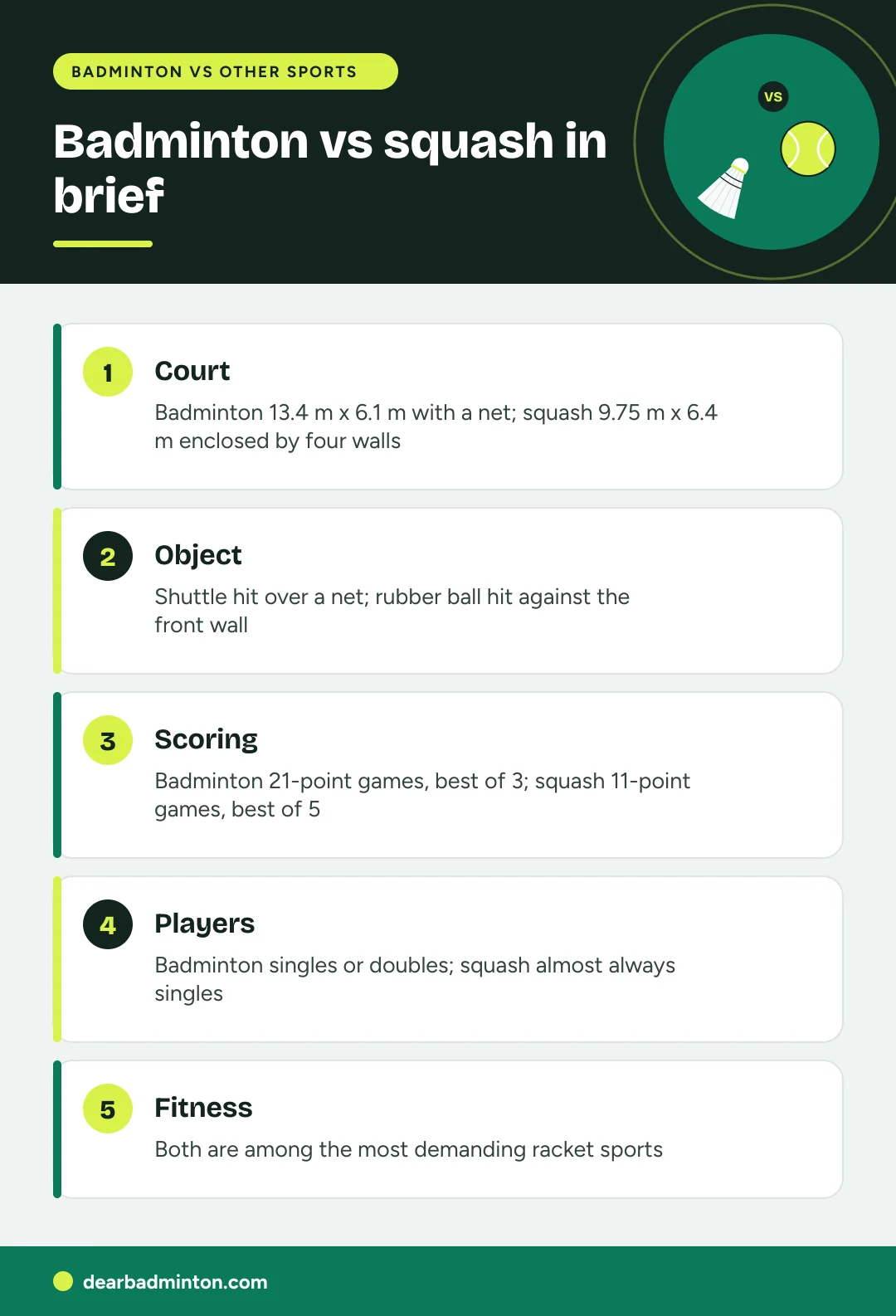
The badminton court measures 13.41 meters in length. For singles play the width is 5.18 meters and for doubles it extends to 6.1 meters. The net stands at 1.524 meters at the center, noticeably taller than a tennis net, which fundamentally shapes the arc and trajectory of every shot.

The court is divided into precise zones including the short service line, the long service line for doubles, the center line and the back boundary line. Each zone has specific tactical significance that experienced players exploit continuously.

Squash Court Dimensions:

A standard squash court is considerably smaller but enclosed on all four sides by solid walls. The court measures 9.75 meters in length and 6.4 meters in width. The front wall has a tin at the bottom, the out line at the top and the service line in between. The side walls and back wall all form active playing surfaces.

The T position, the central junction of the two service boxes on the floor, is the tactical heart of the squash court. Controlling the T means controlling the match.

The Movement Reality:

Here is the insight that changes how most people think about both sports.

The badminton court is larger than the squash court but the movement demands per minute of actual play are comparable, and in some research studies higher in badminton. The reason is frequency of direction change.

Badminton players perform explosive direction changes approximately every four to five seconds during active rally play. The shuttle moves in three dimensions, high lobs, flat drives, tight net shots, steep smashes, requiring constant vertical as well as horizontal movement that squash simply does not demand.

In squash, the enclosed court and wall rebounds mean that players can sometimes allow the ball to pass them and use the back wall to bring it back into play. This tactical option reduces the movement demand in certain situations. In badminton, once the shuttle passes you, the rally is over. Every shot demands a committed movement response.

Research consistently shows that professional badminton players perform over 300 directional changes during a singles match. The stop-go explosive nature of that movement places extraordinary demands on the fast-twitch muscle fibres and the anaerobic energy system.

Practice Tip: If you want to experience the true movement demand of badminton before stepping on court, set a timer for 20 seconds and perform explosive lunges and direction changes as fast as possible. Rest for 10 seconds. Repeat 10 times. That pattern approximately mirrors what your legs go through during a competitive badminton singles game.

4. Equipment compared: Rackets, shuttles and squash balls

The equipment differences between badminton and squash are significant and they fundamentally shape how each sport is played and what physical qualities each sport develops.

Badminton Racket:

A professional badminton racket weighs between 80 and 100 grams. Some elite models weigh as little as 70 grams, lighter than a large chicken egg. The frame is made from carbon fiber, titanium, aluminum alloy or composite materials. The stringed hitting surface must not exceed 280 millimeters in length and 220 millimeters in width under BWF regulations. The overall maximum length is 680 millimeters.

String tension in badminton ranges from 20 to 30 pounds. The lighter tension creates a trampoline effect that propels the ultra-light shuttle at extraordinary velocities. The wrist is the primary power generator. A relaxed, flexible grip that snaps through contact is the hallmark of an experienced badminton player.

Squash Racket:

A squash racket weighs between 110 and 170 grams, noticeably heavier than a badminton racket. The frame is typically made from graphite or composite materials. The hitting surface is larger than a badminton racket’s stringing area. String tension is typically between 24 and 32 pounds.

The squash swing involves more arm and shoulder than badminton. Where badminton power comes primarily from wrist snap, squash power comes from a more sweeping motion that engages the full kinetic chain from legs through core through shoulder and arm.

The Shuttlecock:

A regulation feather shuttlecock weighs between 4.74 and 5.50 grams. It consists of 16 goose or duck feathers embedded in a cork base. The feathered skirt creates extraordinary aerodynamic drag that produces the shuttle’s unique flight characteristics.

When struck at full power, the shuttle can exceed 400 kilometers per hour. Yet within one second of flight, aerodynamic drag can slow it from 300 kilometers per hour to under 50 kilometers per hour. No other sports projectile in the world decelerates this dramatically.

This unique flight characteristic requires badminton players to read the shuttle’s trajectory from the moment of their opponent’s contact, not from the shuttle’s flight path, because by the time you react to where it is going, it has already slowed and changed.

The Squash Ball:

A squash ball is a hollow rubber sphere weighing between 23 and 25 grams. Unlike the shuttlecock, the squash ball must be warmed up before play because its bounce characteristics change with temperature. A cold squash ball barely bounces at all. A warm ball generates a responsive, lively bounce that makes proper rallying possible.

Squash balls come in different speed ratings indicated by colored dots. The double yellow dot is the slowest and is used in professional competition. Yellow dot balls are for advanced players. Red and blue dot balls are faster and more suitable for beginners.

The squash ball does not slow down dramatically in flight the way a shuttlecock does. It maintains pace until it contacts a wall or the floor, then its trajectory and speed depend on the angle and force of impact in ways that require spatial awareness and anticipation that is completely foreign to players from other racket sports.

Interesting fact! When Alex Robertson, a competitive squash player and writer, first tried badminton seriously, he described loving how hard you can crack the shuttlecock without it going out of court. This captures something important about the sport. The aerodynamic drag of the shuttle creates a natural boundary that allows maximum power to be applied safely within the court. In squash, applying maximum power carries a much greater risk of the ball going out of court or into the tin.

[Find out badminton sets here!]

5. Speed and reaction time: Which sport is simply faster?

This is the question that starts more arguments between badminton and squash players than any other. Let us settle it properly.

Raw Projectile Speed:

Badminton is officially recognised by the Guinness World Records as the fastest racket sport in the world.

The world record shuttlecock smash speed was set by Tan Boon Heong of Malaysia in a 2013 speed test at 493 kilometers per hour. In professional match conditions, smash speeds regularly exceed 380 to 400 kilometers per hour.

The fastest squash shot ever recorded reached approximately 270 to 300 kilometers per hour. In professional match conditions, squash ball speeds typically range from 150 to 250 kilometers per hour.

Badminton wins the raw speed comparison by a significant margin.

Reaction Time Required:

A professional badminton player receiving a smash from the back of a 13 meter court has approximately 0.3 seconds to read, move and respond. That is at or beyond the limit of standard human reflex responses, which is why elite badminton players train their nervous system responses as deliberately and intensively as their muscles.

In squash, the ball travels over a longer effective distance before the player must respond, and the wall bounce system gives players additional processing time in many situations. The reaction demands in squash, while genuinely extreme at the elite level, are measurably less immediate than in badminton in most rally situations.

The Wall Bounce Factor:

Here is the insight that most speed comparisons miss entirely.

In squash, players can strategically allow the ball to pass them and use the side wall or back wall rebound to bring the ball back into a playable position closer to them. This tactical option fundamentally reduces the reaction urgency in certain situations because the player knows the wall will do some of the work.

In badminton, there are no walls. There is no recovery mechanism. Once the shuttle passes you, the rally is over. Every single shot demands an immediate, committed response. There is no equivalent of the squash back-wall let-off. This asymmetry makes the pure reaction demand of badminton uniquely relentless.

Court Coverage and Movement Speed:

While badminton requires faster individual reactions, competitive squash at the advanced level demands faster sustained running speeds across a match.

Squash rallies can run to 50 or 60 shots with both players continuously in motion. The cardiovascular demand of that sustained running at high pace is considerable.

In badminton, the movement is faster per individual burst but the rally structure is shorter. The net result for overall match-level running is broadly comparable between the two sports at competitive level.

Interesting fact! A forum discussion among intermediate players who competed in both sports revealed a consistent observation. Players with a strong badminton background found they could compete surprisingly effectively in squash relatively quickly, primarily because their badminton-trained reaction speed gave them a significant advantage. This cross-sport transfer of reaction ability is one of the most underreported benefits of serious badminton training.

6. Is badminton harder than squash: The honest answer is here

Let me be direct with you here because this is the question most people came to this article to answer, and it deserves a genuinely honest response rather than a diplomatic non-answer.

Both sports are hard. They are hard in ways that barely overlap. Declaring one simply harder than the other misses the specific nature of each sport’s demands.

That said, here is what the evidence and experience actually tell us.

Why Badminton is Harder?

The reaction speed and wrist mechanics that are required in badminton are more technically demanding than anything squash requires.

The backhand smash in badminton, which generates explosive rotational power from the wrist at a completely unnatural angle, takes years of specific practice to develop. It is widely considered one of the most technically difficult individual skills in any racket sport.

The deceptive stroke play in badminton, using identical body position and swing to produce completely different shots at the last possible moment, requires a level of technical sophistication that squash simply does not demand to the same degree.

The three-dimensional nature of badminton movement, covering all four corners plus the net zone plus jumping height, creates a more complex spatial and physical challenge than the two-dimensional floor-level movement of squash.

At elite level, research suggests badminton players push to 90 to 95 percent of maximum heart rate during intense rallies. This is genuinely extreme physiological territory that most recreational exercisers never approach.

Why Squash is Harder?

Squash demands a level of sustained physical endurance that badminton does not require in the same form. Professional squash rallies can last over 100 shots. The cardiovascular system is loaded continuously for extended periods in a way that badminton’s shorter rally structure does not replicate.

The enclosed court and wall geometry of squash require a spatial awareness and anticipation system that has no equivalent in badminton. Learning to read ball angles off multiple walls simultaneously, while maintaining court position and constructing a tactical plan, is a genuinely complex cognitive and physical challenge.

The physical contact risk and the harder, heavier ball in squash create a different category of injury risk that demands respect and preparation.

The Verdict on Difficulty:

Badminton is harder in terms of reaction speed, wrist mechanics, deceptive shot play and three-dimensional movement complexity.

Squash is harder in terms of sustained endurance, wall geometry mastery and the ability to maintain technical and tactical quality across very long rallies.

If you forced me to choose one answer, I would say this. For a physically fit and athletic person with good reflexes, badminton’s technical ceiling is harder to reach. For a technically skilled player who needs to build fitness, squash’s endurance demand is harder to sustain.

7. The beginner paradox: Why most people get this completely wrong

This is one of the most genuinely fascinating insights in the entire badminton versus squash debate, and it is something that almost no formal platform has ever addressed properly.

Most people who have tried both sports casually will tell you squash feels harder.

This is completely understandable. A squash ball moves fast even for beginners. Rallies with wall rebounds feel relentless. The enclosed court is disorienting initially. Beginners end up running constantly trying to chase a ball that keeps coming back off walls in unexpected directions.

Badminton, for beginners, can feel deceptively gentle. Two beginners rallying will find the shuttle floats slowly enough to track and return. The basic rally develops quickly. The game feels accessible and enjoyable from the first session.

So, squash feels harder initially. Badminton feels easier.

Here is where the paradox kicks in.

As skill level rises, badminton’s demands scale almost linearly. Every improvement in skill opens up faster, more deceptive and more physically demanding play. An intermediate badminton player faces a significantly different physical challenge from a beginner. An advanced player faces an entirely different experience again. The sport’s demand curve rises consistently with improvement.

Squash, by contrast, has a demand curve that looks more like a square root function. Early improvement brings dramatic increases in the sport’s challenge. But at higher recreational and club levels, the demand begins to plateau somewhat.

Players develop efficient movement patterns that reduce the energy cost of sustained rallying. The wall geometry becomes predictable rather than disorienting. The sport becomes more mentally strategic and less physically overwhelming.

This means that at beginner and early intermediate levels, squash is harder. At advanced and elite levels, badminton is arguably the more demanding sport physically and technically.

The implication for you as a potential player is important. Do not judge either sport’s long-term challenge by your first few sessions. The sport that feels harder initially is not necessarily the one that will push you harder over a lifetime of play.

Interesting fact! A long-running thread on BadmintonCentral forums produced exactly this insight from players who competed in both sports at intermediate and above. Multiple experienced contributors independently reached the same conclusion. Squash is more immediately imposing for beginners. Badminton scales harder with skill. The consensus was that comparing the two is like comparing a marathon and a 100 meter sprint. The question of which is harder depends entirely on which athletic quality you are measuring.

8. Which sport burns more calories: Real numbers and real research

I wore a heart rate monitor during a competitive badminton singles match once. I expected a solid workout. What I got looked like a high-intensity interval training session on the data readout.

My heart rate was spiking to 180 to 190 beats per minute during rallies and dropping briefly between points, over and over, for the full match.

That pattern is one of the most metabolically demanding exercise structures known in sports science. And it explains a lot about why badminton’s calorie burn figures are so significant.

Badminton Calories Burned:

A person weighing approximately 70 kilograms burns between 450 and 550 calories per hour during competitive badminton play. In a fast-paced competitive singles match, that figure rises to 600 calories per hour or above. The explosive, continuous nature of badminton movement, with its sprinting, lunging, jumping and rapid directional changes, keeps metabolic demand extremely high throughout.

The cardiovascular system in competitive badminton operates primarily through the anaerobic pathway. Short, intense bursts of maximum effort followed by very brief recovery periods. This pattern is metabolically expensive and continues to elevate the metabolic rate for hours after the session ends through the excess post-exercise oxygen consumption effect.

Squash Calories Burned:

A person weighing approximately 70 kilograms burns between 600 and 900 calories per hour during competitive squash play. Some research estimates push the upper range to 1000 calories per hour for elite competitive squash. The sustained, relentless nature of squash rallies keeps the cardiovascular system loaded aerobically for extended periods.

In raw calorie-per-hour terms, competitive squash edges ahead of badminton, primarily because of its longer sustained aerobic demand.

The Important Distinction:

These numbers tell only part of the story. The way each sport burns calories matters as much as how many it burns.

Badminton burns calories in explosive anaerobic intervals that trigger the afterburn effect, elevating your metabolic rate for hours after you leave the court. This is the same mechanism that makes high-intensity interval training so effective for body composition.

Squash burns calories through sustained aerobic effort that trains the cardiovascular system for endurance and builds aerobic capacity over time.

For pure calorie-per-session volume, squash has a slight edge. For metabolic intensity and the afterburn effect, badminton matches or exceeds it. For cardiovascular endurance development, squash leads. For explosive power and fast-twitch development, badminton leads.

Neither sport is superior for weight loss and fitness overall. They are simply superior for different fitness goals.

Workout Tip: If your primary goal is maximum calorie burn in minimum court time, play badminton singles rather than doubles. The singles game demands complete court coverage from one player, keeping your heart rate at its highest sustained level throughout the match.

9. Badminton vs squash fitness: Sprint sport vs endurance sport

This is the framework that explains most of the confusion in the badminton versus squash debate. Once you understand it, everything else makes sense.

Badminton as a Sprint Sport:

Badminton is fundamentally an anaerobic sprint sport. The energy system it relies on most heavily is the phosphocreatine and anaerobic glycolytic system, which powers explosive efforts lasting between two and fifteen seconds.

Professional doubles badminton rallies typically last between four and eight seconds. Singles rallies run somewhat longer. The recovery between each rally is short, often just five to fifteen seconds in fast-paced competitive play. Then the explosive effort begins again immediately.

This structure is almost identical to high-intensity interval training protocols. The result is that badminton develops extraordinary explosive power, fast-twitch muscular strength and cardiovascular efficiency in ways that sustained aerobic exercise cannot replicate.

Professional badminton players have been measured performing over 300 directional changes during a singles match. The neuromuscular demand of that volume of explosive stop-go movement is comparable to elite football players in terms of the agility and conditioning required.

Squash as an Endurance Sport:

Squash, particularly at intermediate and advanced levels, demands considerably greater aerobic endurance. Long baseline rallies in squash can sustain 20 to 40 shots of continuous movement, keeping players in motion for 20 to 30 seconds at a time.

Recovery periods between points in squash are typically longer than in badminton, allowing partial aerobic recovery before the next sustained effort.

At elite professional level, the aerobic demand of a squash match lasting 60 to 90 minutes is substantial. World class squash players invest heavily in aerobic base fitness including running, cycling and sustained cardiovascular conditioning alongside their court training.

What This Means for Your Training?

If you play badminton competitively, your training outside court should prioritise explosive interval work, plyometrics, sprint drills and agility ladder sessions. Your nervous system is as important as your aerobic capacity. Train both.

If you play squash competitively, build a strong aerobic base with sustained cardiovascular training alongside your court sessions. Long rallies reward the player who can maintain technical quality while physically tired. Aerobic fitness is your foundation.

If you play both, the good news is that each sport develops fitness qualities that transfer positively to the other. Badminton sharpens the explosive edge. Squash builds the aerobic foundation. Together they create a more complete athlete than either alone.

👉 Learn how to play badminton smash?

10. Heart rate, energy systems and what they mean for your overall training

Heart rate data from competitive play in both sports reveals something genuinely fascinating that formal articles almost never discuss.

Heart Rate in Badminton:

Research on competitive badminton players shows that heart rate during intense singles rallies reaches 90 to 95 percent of maximum heart rate. This is the uppermost zone of cardiovascular intensity, equivalent to flat-out interval sprinting.

The brief recovery periods between rallies allow partial heart rate recovery but not full recovery, meaning cumulative cardiovascular load builds throughout the match.

This pattern of near-maximum effort followed by incomplete recovery is extraordinarily effective for cardiovascular adaptation and metabolic conditioning. It is essentially the physiological mechanism behind the most effective forms of athletic training.

Heart Rate in Squash:

Research on competitive squash players suggests heart rate during sustained rallies reaches approximately 80 to 90 percent of maximum heart rate. This is still extreme cardiovascular territory, genuinely demanding and highly effective for cardiovascular fitness.

The sustained nature of squash rallies means this elevated heart rate is maintained for longer continuous periods than in badminton.

The difference between 90 to 95 percent in badminton and 80 to 90 percent in squash might sound small in percentage terms. In physiological terms it represents a significant difference in intensity.

Working at 95 percent of maximum heart rate is a categorically different experience from working at 85 percent, both in terms of how it feels and what it demands from the cardiovascular and muscular systems.

The Practical Implication:

Both sports provide cardiovascular training that is genuinely extreme by the standards of most recreational exercise. Both will improve your cardiovascular health significantly if you play regularly and competitively.

The specific training adaptation each sport drives is different. Badminton adapts you for high-peak short-burst intensity. Squash adapts you for sustained high-level effort. Neither adaptation is superior. Both are valuable for long-term health and athletic performance.

11. Muscles worked: A full body comparison

Both badminton and squash are full body sports. Neither can be played effectively with any major muscle group switched off. However the specific muscles emphasised and the nature of their engagement differ significantly.

Muscles in Badminton:

The lower body is the foundation of everything in badminton. The quadriceps, hamstrings, glutes and calves generate the explosive power for every sprint, lunge and jump.

The inner thigh adductors and hip flexors are particularly heavily loaded through the repeated deep lunging movements that characterise badminton footwork.

The core muscles, the abdominals, obliques and lower back, work continuously to stabilise the body through rapid directional changes and generate rotational power for overhead shots.

The forearm and wrist muscles bear a unique demand in badminton. The wrist snap that generates shuttle speed in smashes, clears and net shots places repeated high-intensity loading on the flexors and extensors of the forearm. This is the muscle group that most commonly develops the first soreness in players new to the sport.

The shoulder, specifically the rotator cuff and deltoid, is heavily engaged in overhead shots. The repeated overhead forehand and backhand strokes, particularly the jumping smash, place significant demands on shoulder stability and mobility.

Muscles in Squash:

Squash also demands significant lower body strength and endurance. The quadriceps, hamstrings and glutes power the sustained running and lunging required across long rallies. The calf muscles absorb the repeated stopping and starting forces on the hard squash court floor.

The upper body is more heavily emphasised in squash than in badminton. The heavier squash racket and the more sweeping arm swing engage the shoulder, upper arm and forearm more extensively. The triceps and biceps work hard to generate and control the swing, particularly on powerful drives and boasts.

The back muscles, particularly the erector spinae and the latissimus dorsi, are more engaged in squash than in badminton because of the more horizontal, sweeping shot production that squash requires.

The core in squash works differently from badminton. Rather than explosive rotational power generation, the squash core focuses more on stability through sustained lateral movement and the control of powerful groundstrokes.

The Key Difference:

Badminton develops more explosive lower body power, superior wrist and forearm strength and extraordinary rotational core power. Squash develops greater muscular endurance in the legs and upper body, stronger back muscles and better sustained core stability.

Playing both sports regularly develops a genuinely complementary full-body profile that neither sport produces alone.

12. Mental health, brain benefits and cognitive fitness:

This is the section that almost everyone ignores completely or mentions in a single throwaway sentence about endorphins. It deserves far more than that.

The mental health and cognitive benefits of racket sports are supported by a growing body of genuinely impressive research, and both badminton and squash deliver them through different but equally valuable mechanisms.

Cognitive Benefits of Badminton:

Badminton makes extraordinary demands on the cognitive system. The reaction speed required at competitive level pushes the nervous system to its limit.

Reading an opponent’s body position, racket angle and wrist orientation before they strike the shuttle, and committing to a movement response in under 0.3 seconds, is a level of cognitive-motor integration that few other sports demand.

Regular badminton play has been associated with improved processing speed, the rate at which the brain processes visual and spatial information. It also develops exceptional hand-eye coordination that transfers positively to a wide range of daily activities.

The deceptive stroke play in badminton, where a player must both create and read deception simultaneously, trains the brain to manage competing cognitive demands under time pressure. This is a genuine form of mental training, not just physical activity.

Cognitive Benefits of Squash:

Squash develops what sports scientists describe as anticipatory cognitive processing. Reading ball angles off multiple walls, predicting where a ball will emerge from a back-wall rebound and positioning accordingly before the ball arrives, requires a form of spatial reasoning and pattern recognition that is unique to enclosed-court sports.

The sustained tactical decision-making of squash, constructing a rally plan across 30 or 40 shots while managing physical fatigue, tests strategic thinking under pressure in a way that badminton’s shorter rally structure does not.

Mental Health Benefits of Both Sports:

Both sports trigger the release of endorphins, serotonin and dopamine during and after play. These neurochemical responses are well established as beneficial for mood, anxiety and depression management.

The social context of both sports, particularly doubles play in badminton and club squash culture, provides community, belonging and social connection that are independent contributors to mental health and wellbeing.

Research from the American Journal of Psychiatry and related publications consistently finds that regular participation in team and partner sports produces greater mental health benefits than solo exercise, due in part to the social engagement component.

Cognitive Decline Prevention:

Perhaps the most significant long-term mental health benefit of racket sports is their potential role in reducing the risk of cognitive decline and dementia.

Multiple studies suggest that the combination of cardiovascular exercise, complex motor skill demands, strategic thinking and social engagement that characterises racket sports makes them particularly protective against age-related cognitive deterioration.

Neither badminton nor squash has been studied in as much depth as tennis in this specific area, but the underlying mechanisms are comparable. The cognitive demand of high-level racket sport play appears to promote neuroplasticity and cognitive reserve.

13. Which sport is better for stress relief?

Both sports are outstanding for stress relief. But they relieve stress in genuinely different ways.

Badminton is social stress relief. The nature of the sport, facing your opponent across a net, playing doubles with friends, communicating and laughing between rallies, creates a warm, sociable atmosphere that squash simply cannot replicate.

The net means you can see and interact with your opponent throughout play. Doubles badminton is one of the most enjoyable social sporting experiences available.

Squash is cathartic stress relief. There is something uniquely satisfying about hitting a squash ball as hard as you possibly can against a solid wall and watching it explode into the corner.

If you have had a particularly difficult day and need to physically exhaust the tension out of your body, squash provides a form of release that few other sports match.

The sustained physical effort of a hard squash session leaves most players feeling genuinely emptied of tension in a way that shorter, more explosive badminton sessions do not always achieve.

The important point is that both mechanisms are genuinely effective for stress management and mental wellbeing. The best choice for stress relief depends on whether you need social connection and lightness or cathartic physical exhaustion.

Ask yourself honestly which your stress usually requires and choose accordingly.

14. Badminton vs Squash: Injury risk and safety

This is the section where the research data is genuinely clear and where many people get important details wrong. I have researched intensely to bring out the following important findings:

The Addenbrooke’s Hospital Study:

An eight-year study conducted at Addenbrooke’s Hospital in Cambridge examined racket sport injuries presenting at the hospital over the study period. The findings were specific and striking.

59 percent of all racket sport injuries seen during the study were caused by squash. On the other side, 20 percent were caused by badminton. This significant disparity reflects the fundamentally different injury profiles of the two sports.

This does not mean squash is inherently dangerous. It means that squash’s physical demands, the sustained running, the harder ball, the enclosed court proximity with an opponent and the explosive lunge movements all combine to create higher injury incidence across a population of players than badminton’s lighter, more controlled physical demands produce.

Common Badminton Injuries:

Shoulder injuries, particularly rotator cuff strains and impingements, are the most common serious injuries in badminton. The repeated overhead shots, especially the jumping smash, place significant and repetitive loading on the shoulder joint complex.

Ankle sprains occur from sudden directional changes and lunging movements. Knee injuries, particularly to the patellofemoral joint and the ligaments, occur from the combination of jumping, landing and rapid stops.

Wrist injuries from the repeated snap and rotation of badminton stroke play affect some players over time, particularly those who develop poor technique or grip too tightly.

The non-contact nature of badminton and the lightness of the shuttlecock mean that collision injuries, eye injuries and direct impact injuries are rare. This is a significant safety advantage, especially for older players and family play contexts.

Common Squash Injuries:

Eye injuries are the most serious safety concern specific to squash. The squash ball is almost exactly the same diameter as the human eye socket, meaning a direct ball impact to an unprotected eye can cause severe damage. This risk is not theoretical. Squash eye injuries are well documented in sports medicine literature.

Wearing protective eyewear in squash is strongly recommended by the World Squash Federation and is mandatory in junior and many recreational competitions. This simple protective measure dramatically reduces the risk of serious eye injury.

Knee injuries, particularly to the anterior cruciate ligament and meniscus, occur from the sustained high-intensity running and sudden stopping movements that squash demands.

Research including the Liverpool John Moores University study identified that casual squash play by players over 45 carries elevated cardiovascular and musculoskeletal risk.

Calf strains, Achilles tendon injuries and ankle sprains all occur from the explosive push-off and stopping demands of sustained squash play.

Back injuries, particularly lumbar strain, occur in squash from the repeated bending and twisting required to retrieve low balls to the side walls and back corners.

The Age Factor and Injury Risk:

A study from Liverpool John Moores University found that squash is not ideal for casual players over 45 due to the cardiovascular and musculoskeletal strain the sport places on older bodies in competitive conditions.

However, a 2017 study updated this guidance significantly, finding that when older players participate in squash with appropriate warm-up, cool-down, appropriate intensity management and regular conditioning, the sport can be enjoyed safely beyond this age threshold.

The key distinction is between casual, irregular play where the body is not conditioned for squash’s demands, and regular, consistent play where the body adapts progressively to those demands.

Badminton, with its lighter equipment, non-contact nature and more modifiable intensity, is generally the safer choice for older recreational players and for those returning to exercise after a period of inactivity.

Injury Prevention for Both Sports:

For badminton: Warm up the shoulder joint thoroughly before overhead play. Develop correct technique for smashes and clears to reduce rotator cuff loading. Wear proper court shoes with lateral support. Strengthen the rotator cuff muscles specifically with targeted exercises.

For squash: Always wear protective eyewear. Warm up the cardiovascular system and all major muscle groups thoroughly before play. Cool down and stretch the calves, hamstrings and lower back after every session. Build conditioning gradually if returning to the sport after a break.

For both sports: Stay hydrated throughout play. Do not play through acute pain. Allow adequate recovery between sessions, particularly for the knee and ankle joints.

15. Age suitability: Which sport is right at every stage of life?

Children and Young People:

Both sports are outstanding for children’s development. Badminton is often recommended for younger children as the lighter equipment, slower shuttle speeds at recreational pace and smaller court dimensions suit developing motor skills naturally and comfortably.

Badminton develops hand-eye coordination, agility, spatial awareness and social skills through doubles play in ways that align perfectly with childhood physical development milestones.

Squash is excellent for older children and teenagers who are physically ready for the sport’s more demanding movement patterns. The tactical complexity and competitive structure of squash can be deeply engaging for young athletes who are motivated by strategic challenge.

Adults:

Both sports are appropriate and highly beneficial for adults of all fitness levels. Badminton is accessible to adults with varying fitness backgrounds because the intensity can be naturally modulated through shot selection, doubles format and pace of play.

Squash is particularly effective for fit adults looking for maximum cardiovascular challenge in minimum court time. One hour of competitive squash provides one of the most complete cardiovascular workouts available in any sport.

Players Over 45:

Badminton is generally the safer and more sustainable choice for players over 45, particularly those who play recreationally rather than competitively. The non-contact nature, lighter equipment, modifiable intensity and lower cardiovascular peak demand make it well-suited for older players who want to stay active without excessive injury risk.

Squash can absolutely be enjoyed by players over 45, but with important caveats. Players should ensure they are properly conditioned before playing competitively. Warm-up and cool-down routines are not optional at this age. Intensity should be managed deliberately. Regular medical check-ups are advisable for older players returning to squash after a break.

Seniors:

Badminton has a particularly strong track record as a lifelong sport. Many players continue to enjoy and compete in badminton well into their 60s, 70s and beyond, adapting their game to focus on doubles play, tactical precision and enjoyable rallies rather than maximum physical output.

Social badminton at leisure centers and sports halls provides not just physical activity but community, friendship and mental stimulation that are enormously valuable for healthy ageing.

16. Skills and techniques: What you basically need to learn

Badminton Skills:

The ready stance is the foundation of everything. Before every return, stand with slightly bent knees, weight on the balls of your feet and your racket raised in front of you. This allows explosive movement in any direction within a fraction of a second.

Footwork is, above all else, the most important skill in badminton. Without efficient footwork that covers all six corners of the court from a central base position, no technical stroke can be executed correctly.

The four basic strokes are the overhead forehand, the overhead backhand, the underarm forehand and the underarm backhand. Within these four categories sit the specific shots that make badminton so tactically rich.

The smash in forehand, backhand and jumping varieties is the primary attacking weapon. The drop shot is the primary deception tool. The clear pushes opponents deep. The net shot creates forecourt opportunities. The drive applies flat, aggressive pressure. Learning all of these takes time but even basic versions transform your game quickly.

The grip must be relaxed and flexible. Gripping too tightly kills wrist speed and therefore kills shot quality.

Squash Skills:

The split step and T position awareness are the foundations of squash. Returning to the T between shots is the tactical rule that governs all good squash play.

Footwork in squash covers greater horizontal distances than badminton but with more measured, sustained movement rather than explosive short bursts. Efficient court coverage with minimal wasted movement is the mark of an experienced squash player.

The drive, the boast and the drop are the three fundamental shots. The drive is a straight, hard shot to the back corners. The boast uses the side wall to bring the ball to the front of the court. The drop is a soft, angled shot to the front wall that falls short and forces the opponent forward.

Swing mechanics in squash involve more arm and shoulder than badminton. The backswing, contact and follow-through all involve a more sweeping motion that generates power through rotation rather than wrist snap.

Wall reading, understanding how the ball will behave after contacting walls at various angles and speeds, is the skill that takes longest to develop and that most clearly separates experienced squash players from beginners.

17. Rally length and active play time compared:

Here is a comparison that is rarely discussed properly but that makes a massive difference to how each sport feels to play and how much physical benefit you get per hour of court time.

Badminton Rally Length and Active Play Time:

In professional doubles badminton, rallies average four to eight seconds. In singles they run somewhat longer, typically eight to fifteen seconds, with competitive rallies sometimes extending to 30 or 40 seconds.

Approximately 50 to 60 percent of a competitive badminton match’s total duration involves the shuttle actively in play. From one hour on court, you can expect 30 to 36 minutes of genuine physical activity. This is among the highest active play time ratios of any major racket sport.

Squash Rally Length and Active Play Time:

Squash rallies are longer on average than badminton rallies. At intermediate and advanced levels, rallies of 20 to 40 shots are common. Extended defensive rallies can push to 80 or 100 shots in some match contexts.

However the active play time percentage in squash, while not precisely measured as consistently as in tennis research, is broadly comparable to badminton because the recovery periods between points in squash are typically longer than in badminton due to the sport’s scoring structure and the physical recovery demands of long rallies.

The Practical Implication:

Both sports provide excellent active play time relative to time on court. Badminton’s advantage is the explosive intensity of its active time. Squash’s advantage is the longer sustained duration of individual active periods.

If you have one hour available for court sport, both badminton and squash will give you a genuinely substantial physical workout within that hour. The nature of that workout differs but the volume of physical activity is broadly comparable.

18. Scoring systems and match formats:

Badminton Scoring:

Badminton uses the rally point system introduced by the BWF in 2006. Every rally produces a point regardless of who served. This makes scoring fast, clear and transparent.

You need 21 points to win a game. Every match is best of three games. If both sides reach 20 points, a deuce is called and the first side to lead by two consecutive points wins the game. The maximum score is capped at 30 points. If the score reaches 29 all, the next point wins outright.

There is a 60-second interval when the leading score reaches 11 points in each game and a two-minute interval between games. In the deciding third game, players change ends when the leading score reaches 11 points.

Squash Scoring:

Modern squash uses the point-a-rally scoring system called PAR 11, where every rally produces a point and games are played to 11 points with a two-point lead required. Matches are typically best of five games.

If both players reach 10 points, play continues until one player leads by two points. There is no maximum cap as in badminton.

Before the introduction of PAR scoring, squash used a hand-in-only scoring system where only the server could score, similar to the old badminton system. The change to rally point scoring transformed squash’s commercial appeal and match duration predictability.

19. Badminton vs Squash for weight loss:

Both sports are effective tools for weight loss when played regularly and at sufficient intensity. The key differences are in mechanism and suitability for different types of people.

Badminton burns 450 to 600 calories per hour in competitive singles play through explosive anaerobic intervals that elevate metabolism for hours after the session. The afterburn effect, or excess post-exercise oxygen consumption, from high-intensity interval-pattern exercise like badminton is well documented and adds meaningfully to the total calorie burn of a session.

Squash burns 600 to 900 calories per hour in competitive play through sustained aerobic and mixed-intensity effort. The higher raw calorie-per-hour figure gives squash a slight edge in pure calorie volume terms.

For beginners and those returning to exercise, badminton may be the better starting point for weight loss because the intensity is more naturally modifiable. You can play social doubles at a comfortable pace and gradually increase intensity as your fitness improves. Squash’s relentless rally structure can be overwhelming for those who are not yet fit enough to sustain it comfortably.

For already-fit individuals looking to maximise calorie burn and cardiovascular challenge, competitive squash delivers one of the highest calorie expenditures available in any sport.

The most important factor for weight loss in either sport is consistency. The sport you will play regularly, week after week, because you genuinely enjoy it, is the one that will produce the best long-term results. Enjoyment drives consistency. Consistency drives results.

20. Long-term health benefits: What does the research reveal?

This is where both sports deliver something genuinely extraordinary, and where the research data is more impressive than most people realise.

The British Journal of Sports Medicine Study:

A landmark study published in the British Journal of Sports Medicine examined the relationship between different types of physical activity and all-cause mortality, meaning the risk of dying from any health-related cause, across a large population.

The findings for racket sports were remarkable. Regular participation in racket sports was associated with a 47 percent reduction in all-cause mortality risk compared to sedentary individuals.

This was the highest reduction of any activity category examined in the study, exceeding swimming at 28 percent, aerobics at 27 percent, football at 18 percent and cycling at 15 percent.

This 47 percent figure applies to racket sports as a category. Both badminton and squash, as racket sports with comparable cardiovascular, social and cognitive demands, fall within this category.

What this means practically is that playing racket sports regularly is associated with a dramatically lower risk of dying from heart disease, stroke, cancer and other major health conditions.

The combination of cardiovascular exercise, complex motor demands, strategic mental engagement and social interaction that characterises racket sports appears to produce health benefits beyond what cardiovascular exercise alone delivers.

Bone Density and Skeletal Health:

Both sports are weight-bearing, impact-loading activities. Regular participation is associated with higher bone density compared to non-players and non-impact activities like swimming and cycling. This is particularly important for long-term protection against osteoporosis, especially for women.

Cardiovascular Health:

Both sports produce significant improvements in cardiovascular health markers including resting heart rate, blood pressure, aerobic capacity and cardiac efficiency. Regular players of both sports show cardiovascular profiles consistent with considerably reduced risk of heart disease.

Cognitive Health and Longevity:

As discussed in the mental health section, the combination of physical, cognitive and social demands in racket sports appears to offer protection against age-related cognitive decline. While the research specifically on badminton and squash in this area is less extensive than for tennis, the underlying mechanisms are identical.

Interesting fact! The 47 percent mortality reduction associated with racket sports is genuinely one of the most impressive figures in all of exercise science. To put it in context, a 47 percent reduction in all-cause mortality risk from playing a sport you enjoy is not just a health benefit. It is one of the most powerful lifestyle interventions available to any person at any age.

21. Cost and accessibility of both racket sports:

Badminton Costs:

A beginner badminton racket costs between 15 and 50 US dollars. A quality intermediate racket sits between 50 and 150 dollars. Professional-grade rackets cost between 100 and 300 dollars or more.

Court rental at a sports center or leisure hall typically costs between 10 and 25 US dollars per hour. Badminton shoes cost between 40 and 120 dollars.

The ongoing cost to budget for is shuttlecocks. A tube of six feather shuttlecocks costs between 15 and 30 dollars and feather shuttles can be damaged within a single hard session. Synthetic shuttlecocks are more affordable and durable for recreational players.

Badminton always requires an indoor facility, which means a court rental fee is almost always involved. In Asia, community badminton facilities are abundant and affordable. In Western countries, the dependence on indoor sports halls limits free access options.

Squash Costs:

A beginner squash racket costs between 20 and 60 US dollars. An intermediate racket sits between 60 and 150 dollars. Professional-grade rackets cost between 100 and 250 dollars.

Court rental at a squash club or leisure center typically costs between 10 and 30 US dollars per hour. Squash shoes are similar in price to badminton shoes.

Squash balls are very affordable compared to shuttlecocks. A pack of squash balls costs between 5 and 15 US dollars and lasts considerably longer per playing session than feather shuttles. Protective eyewear, while strongly recommended, adds a one-time cost of 20 to 50 US dollars.

Squash courts are available at leisure centers, sports clubs and universities in most Western countries. The sport has a reasonably good facility infrastructure in English-speaking countries in particular.

Overall Accessibility:

Both sports are accessible and reasonably affordable. Badminton has the edge in Asia. Squash has comparable Western facility availability. The ongoing cost of shuttlecocks in badminton is the primary recurring expense advantage that squash holds.

22. Badminton vs Squash: Head-to-Head Comparison Table

CategoryBadmintonSquash
OriginAncient Asia, modern 1873 EnglandHarrow School London, circa 1830
Global PlayersApproximately 220 millionApproximately 20 million
Court Length13.41 meters9.75 meters
Court Width6.1 meters (doubles)6.4 meters
Court TypeOpen indoor with netEnclosed four-wall box
ProjectileFeather shuttlecock, 4.74 to 5.50 gramsRubber ball, 23 to 25 grams
Fastest Speed Recorded493 km per hourApproximately 270 to 300 km per hour
Reaction Time RequiredUnder 0.3 secondsSlightly more available time
Wall Bounce Tactical OptionNoYes
Calories Burned Per Hour450 to 600600 to 900
Primary Energy SystemAnaerobic, explosive burstsAerobic, sustained effort
Heart Rate During Play90 to 95 percent of maximum80 to 90 percent of maximum
Rally Length Average4 to 15 seconds10 to 40 seconds
Active Play Time50 to 60 percent of matchBroadly comparable
Primary Power SourceWrist and forearm snapArm, shoulder and core rotation
Olympic SportSince 1992Not yet included
Injury IncidenceLower, 20 percent of racket injuriesHigher, 59 percent of racket injuries
Eye Injury RiskVery lowSignificant without eyewear
Safer for Over 45sYes, generallyRequires conditioning and caution
Better for BeginnersYes, slightlySlightly harder initially
Better for Explosive FitnessYesNo
Better for Aerobic EnduranceNoYes
Better for Social PlayYes, especially doublesLess so, but club culture is strong
Mortality Reduction (racket sports)47 percent reduction in all-cause risk47 percent reduction in all-cause risk

23. Which sport should you choose: The honest verdict from my own experience

After the comparative table above, we have covered everything together. Now let us bring it home.

There is no single correct answer here. But there is a right answer for you specifically, based on what you want from a sport.

Choose badminton if:

You want the fastest racket sport on earth that will push your reflexes and reaction speed to their absolute limit. You want a sport you can play as social doubles with friends as easily as you can play as an intensely competitive singles match.

You want a sport that is accessible to beginners quickly but technically demanding enough to challenge you for a lifetime. You prefer indoor play that is never affected by weather. You want a sport played by 220 million people across the world, deeply rooted in one of the most vibrant sporting cultures on the planet.

Choose squash if:

You want the most sustained cardiovascular workout available in a racket sport. You prefer a sport where your endurance and mental toughness are tested over long, grinding, strategically complex rallies.

You are drawn to the enclosed court geometry and the unique tactical challenge of wall-based play. You want maximum calories burned per hour. You enjoy a sport that rewards patience, positioning and sustained physical commitment over explosive athleticism.

Choose both if:

You are serious about your athletic development. Badminton sharpens your explosive power, reflex speed and wrist dexterity. Squash builds your aerobic endurance, muscular stamina and sustained mental composure. The two sports complement each other in ways that make you a more complete athlete than either alone.

24. FAQs

Is badminton harder than squash?

Both sports are hard but in different ways. Badminton is harder in terms of reaction speed, wrist mechanics and three-dimensional movement complexity. Squash is harder in terms of sustained endurance, wall angle mastery and the ability to maintain quality across very long rallies. At beginner level, squash feels harder. At advanced level, badminton scales to become the more technically demanding sport.

Which sport burns more calories, badminton or squash?

Squash burns slightly more calories per hour in raw terms, approximately 600 to 900 calories per hour compared to badminton’s 450 to 600 calories per hour. However badminton’s explosive interval structure creates a stronger afterburn effect. For maximum calorie burn per session, competitive squash has a slight edge. For metabolic intensity per minute of active play, badminton is comparable.

Which sport is faster, badminton or squash?

Badminton is faster. The world record shuttlecock smash speed of 493 kilometers per hour is nearly twice the fastest squash ball speed ever recorded. Reaction time demands in badminton are measurably greater than in squash in most rally situations.

Is badminton or squash better for beginners?

Badminton is generally easier for beginners to start enjoying quickly. The shuttle’s natural deceleration makes basic rallying achievable within a few sessions. Squash’s relentless wall-rebound rallies and heavier ball can feel overwhelming initially. However squash beginners adapt faster than expected with proper coaching.

Which sport is safer, badminton or squash?

An eight-year hospital study at Addenbrooke’s found that 59 percent of racket sport injuries were caused by squash and 20 percent by badminton. The non-contact nature of badminton and the lightness of the shuttlecock make it the generally safer sport, particularly for older and recreational players. Squash players should always wear protective eyewear.

Is squash or badminton better for older players?

Badminton is generally more suitable for older and recreational players due to its lighter equipment, non-contact nature, modifiable intensity and lower injury incidence. Squash can be enjoyed safely by older players who maintain proper conditioning, warm up thoroughly and manage their intensity appropriately.

Which sport is better for mental health?

Both sports provide outstanding mental health benefits including stress relief, mood improvement and cognitive stimulation. Badminton is better for social mental health through its doubles culture and face-to-face play format. Squash is better for cathartic physical stress release through its sustained high-intensity exertion.

Do badminton skills transfer to squash?

Yes, significantly. Badminton players who move to squash find their reaction speed, agility and tactical thinking transfer remarkably well. Multiple experienced cross-sport players report being competitive in squash much faster than expected, primarily because of the speed advantages developed through badminton. The main adjustments required are swing mechanics, wall reading and endurance for longer rallies.

Here is the question I want to leave you with.

What do you want your time on court to feel like? Lightning-fast, explosive and technically demanding? Or relentlessly physical, strategically complex and endurance-driven?

Answer that honestly and you have your answer. Write me your answer below in the comment box.

Leave a Comment

x