Modern badminton took shape in England and British India in the mid-19th century and is named after Badminton House, the Duke of Beaufort’s estate in Gloucestershire. But people were hitting shuttlecocks long before that: games with a feathered object kept in the air with the hand, foot or a simple paddle were played in ancient China, Greece, India and Japan, and across medieval and early modern Europe.
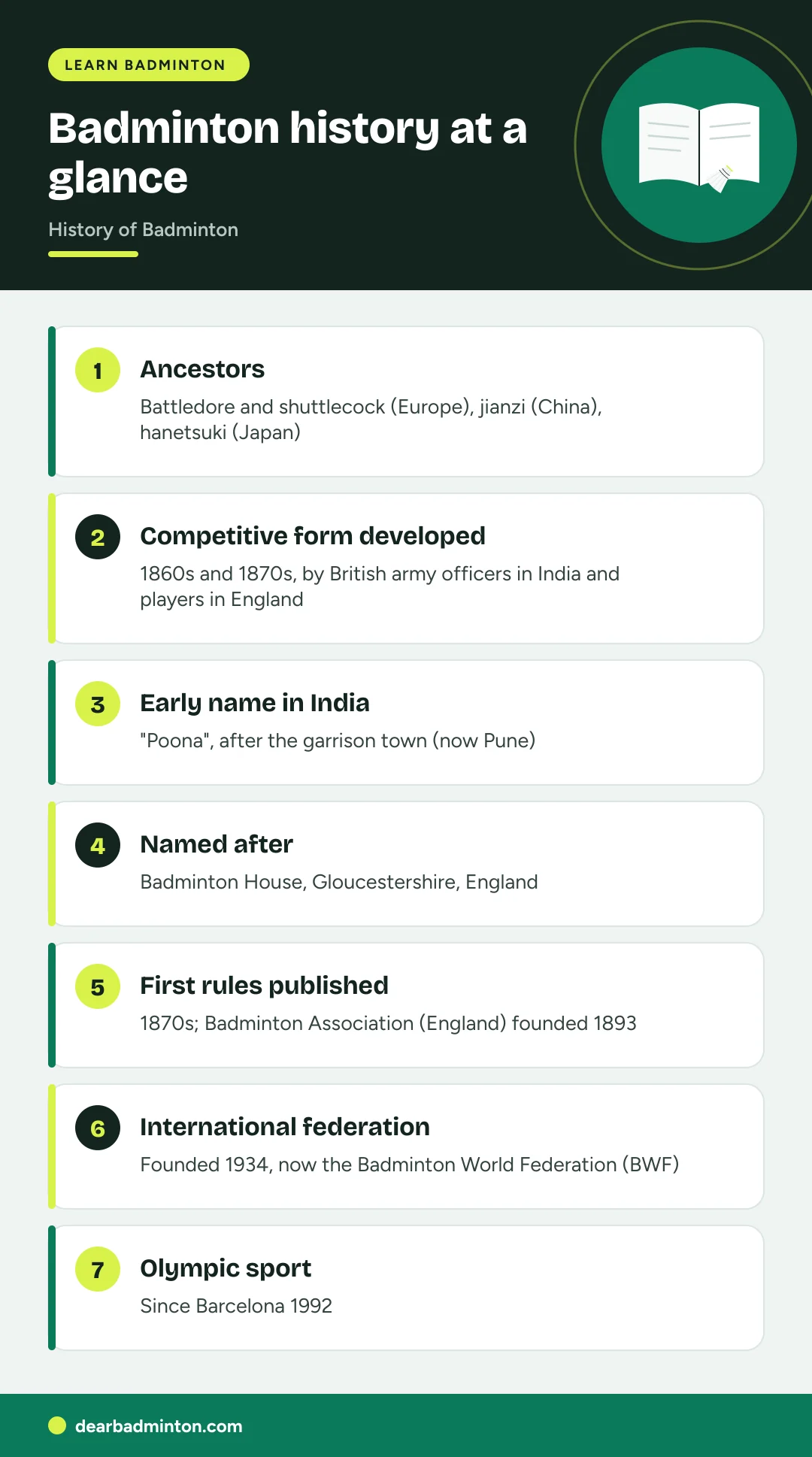
Badminton history at a glance
- Ancestors: battledore and shuttlecock (Europe), jianzi (China), hanetsuki (Japan)
- Competitive form developed: 1860s and 1870s, by British army officers in India and players in England
- Early name in India: “Poona”, after the garrison town (now Pune)
- Named after: Badminton House, Gloucestershire, England
- First rules published: 1870s; Badminton Association (England) founded 1893
- International federation: founded 1934, now the Badminton World Federation (BWF)
- Olympic sport: since Barcelona 1992
Ancient shuttlecock games
The idea of keeping a feathered object in the air is ancient. In China, jianzi (a shuttlecock kicked with the feet) has been played for over 2,000 years and is still popular today. In Japan, hanetsuki, played with wooden paddles and a shuttlecock, is a traditional New Year game. Similar games were played in India, Thailand and other parts of Asia.
In Europe, the children’s game of battledore and shuttlecock was widespread by the 1600s. Two players used small wooden or parchment paddles (battledores) to keep a shuttlecock going between them for as long as possible. It was cooperative rather than competitive: there was no net and no court, and the aim was to make the rally last.
Poona: badminton in British India
The competitive version, with a net and the aim of making the opponent miss, developed in the mid-1800s. British army officers stationed in India played a version of battledore with a net, and the game became particularly associated with the garrison town of Poona (now Pune). In India it was often simply called “Poona”, and the officers are thought to have drawn up an early set of rules there around 1873.
Officers returning to England brought the game home, where it met the same idea being played at country houses.
How badminton got its name
The name comes from Badminton House in Gloucestershire, the home of the Dukes of Beaufort. Around 1873 the game was played at a party there, and it became known as “the Badminton game”, later just badminton. The family is often credited with popularising it in English society. Before that, players used names such as battledore, Poona or simply shuttlecock.
Badminton House is still home to the Beaufort family and is also known for the Badminton Horse Trials, one of the world’s top equestrian events. The village and estate share the name, which is why searching “Badminton” brings up horses as well as rackets.
The first rules and associations
| Year | Milestone |
|---|---|
| 1873 | Game played at Badminton House; early rules drafted in Poona around the same time |
| 1877 | Rules published by the Bath Badminton Club, the first known club |
| 1893 | The Badminton Association (now Badminton England) founded with 14 member clubs; first official Laws published |
| 1899 | First All England Championships, the oldest badminton tournament in the world |
| 1934 | International Badminton Federation (IBF) founded by nine national associations |
| 1949 | First Thomas Cup (men’s world team championship) |
| 1957 | First Uber Cup (women’s world team championship) |
| 1977 | First IBF World Championships |
| 1992 | Badminton becomes a full Olympic sport at Barcelona |
| 2006 | IBF renamed Badminton World Federation (BWF); rally scoring to 21 adopted |
| 2018 | Fixed 1.15 m service height introduced |
Badminton goes global
In the early 20th century badminton spread through the British Empire and beyond. It was hugely popular in Canada, the United States and Denmark in the 1920s and 1930s. After the Second World War, Asian nations rose to dominate: Malaysia and Indonesia won most early Thomas Cups, followed by China, which has been the leading nation since the 1980s. Denmark remains Europe’s strongest country, and Japan, South Korea, India and Thailand produce world champions today.
The Olympic debut at Barcelona 1992 (after appearing as a demonstration sport in 1972 and an exhibition sport in 1988) brought badminton to a global TV audience. Mixed doubles was added at Atlanta 1996.
How the game itself changed
- Rackets went from wood to steel and aluminium in the 1970s and 1980s, and then to carbon fibre composites, cutting weight from over 130 g to around 80 g to 90 g today.
- Scoring changed in 2006 from 15-point service-only scoring to 21-point rally scoring. See badminton scoring.
- Serving rules changed in 2018 to a fixed maximum height. See serve rules.
- Smash speeds rose with modern rackets and strings, with record smashes now measured above 500 km/h.
Frequently asked questions
Where did badminton originate?
Modern badminton developed in British India (where it was called Poona) and England in the mid-1800s, from much older shuttlecock games played in Asia and Europe.
When was badminton invented?
The competitive game with a net took shape in the 1860s and 1870s. The first rules were written in the 1870s and the first national association formed in 1893.
Why is it called badminton?
After Badminton House in Gloucestershire, England, where the game was popularised among English society around 1873.
What was badminton originally called?
It was known as battledore and shuttlecock in Europe, and as Poona in British India.
How old is badminton?
The modern sport is about 150 years old. Shuttlecock games in general are more than 2,000 years old.
Who invented badminton?
No single person. The game evolved from shuttlecock games, and British officers in India and players in England shaped its rules in the 19th century.
New to the sport? Read how to play badminton.