What are the key differences between Badminton & Platform Tennis?
Here is something almost nobody knows. Platform tennis and badminton share a direct historical connection that goes back to 1928.
When James Cogswell and Fessenden Blanchard were building their first court in Scarsdale, New York, badminton was one of the sports they considered playing on it. Overhanging foliage made it impossible.
So, they adapted. And when they later expanded the court to accommodate their evolving game, they chose a specific size: 44 feet by 20 feet. Exactly the dimensions of a badminton court.
These two sports were born from the same problem. How do you play a racquet sport when conditions make conventional tennis impossible? One went indoors with a feather shuttle. The other went outdoors with a spongy ball and wire fencing.
I have spent years on the badminton court. When I first read about platform tennis properly, what struck me was not how different it is from badminton.
It was how much the design logic of both sports overlaps. Compact court. Net in the middle. Social doubles culture. Speed and placement over brute power.
But the experience of playing each one? That’s where they go in completely different directions. Here’s the full and honest picture.
Quick Verdict:
Badminton is faster, more explosive and technically harder at every level. It builds reflexes, wrist skill and athletic movement that few other sports match. I always believe it so.
On the other hand, Platform tennis is more accessible, distinctly social, playable outdoors in winter and deeply embedded in the community culture of the northeastern United States.
They suit different personalities, different climates and different sporting goals entirely.
Badminton vs Platform Tennis: Head-to-Head Comparison Table
Everything you need before we go deeper.
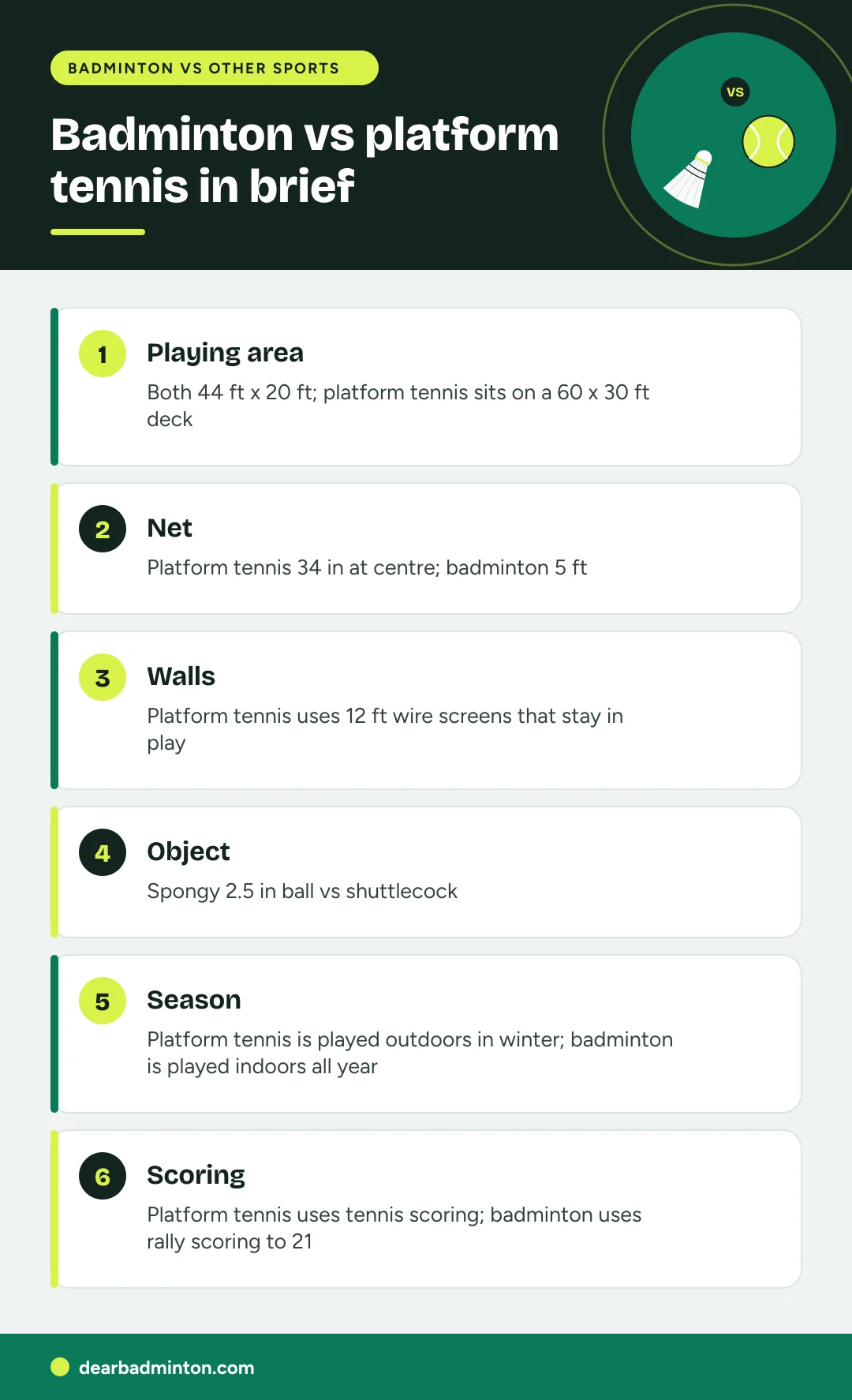
| Category | Badminton | Platform Tennis |
|---|---|---|
| Invented | Ancient origins, modern form 1873 England | 1928, Scarsdale, New York |
| Founders | Duke of Beaufort’s estate guests | James Cogswell and Fessenden Blanchard |
| Governing Body | BWF, 190 plus member nations | American Platform Tennis Association (APTA) |
| Setting | Always indoors | Outdoors, raised platform, heated court |
| Court Length | 13.41 metres (44 feet) | 13.41 metres (44 feet) |
| Court Width | 6.1 metres doubles | 6.1 metres (20 feet) |
| Net Height | 1.524 metres | 0.86 metres (34 inches) |
| Projectile | Feather shuttlecock, 4.74 to 5.50g | Spongy rubber ball, 2.5 inch diameter |
| Racket or Paddle | Strung racket, 80 to 100g | Solid graphite and titanium paddle, 18 inches |
| Bounce Allowed | No | Yes, once |
| Wall in Play | No | Yes, 12-foot wire fencing screens |
| Fastest Speed | 493 km per hour world record | Significantly slower |
| Serves Allowed | 2 in singles, 1 in doubles | 2 in singles, 1 in doubles |
| Scoring | Rally points to 21, best of 3 | Tennis scoring, games and sets |
| Formats | Singles and doubles | Primarily doubles |
| Olympic Sport | Since 1992 | No |
| Global Players | Approximately 220 million | Primarily northeastern USA |
| Easier for Beginners | Moderate curve | Very easy, especially with racquet experience |
| Calorie Burn Per Hour | 450 to 600 competitive | 300 to 450 competitive |
| Primary Fitness Demand | Explosive anaerobic | Mixed aerobic and strategic |
| Primary Season | Year-round indoors | Winter and cool weather outdoors |
1. The origin story nobody tells:
Badminton was formalised in 1873 in England with ancient roots spanning two thousand years. Platform tennis was invented in 1928 in Scarsdale, New York, specifically as a winter outdoor sport. The two sports share a direct historical connection: badminton was one of the original options considered by platform tennis’s inventors, and the court was later expanded to badminton’s exact dimensions.
Most articles on platform tennis tell you it was invented in 1928 by two neighbours in New York who wanted a winter sport. That’s true. But they miss the part that makes the story genuinely interesting.
Cogswell and Blanchard started with a steep, rocky slope on Cogswell’s property. Too difficult for a tennis court. They considered volleyball. Too wide. They considered badminton. The overhanging trees made it impossible.
So, they settled on a form of deck tennis, lowered the net and started experimenting with a paddle and ball they found in a sporting goods store.
As the game developed, they expanded the court. The final dimensions, 44 feet long by 20 feet wide, are identical to a badminton court. Not by coincidence.
Badminton had already shaped their thinking about court size. The sport that couldn’t be played on that property because of a few overhanging branches quietly influenced the dimensions of the sport that could.
By 1935, the first national championship was held at Fox Meadow Club. The sport spread through clubs, private communities and winter sporting culture across the northeastern United States.
Today, the American Platform Tennis Association governs the sport in the US, where it is most popular. Internationally, the sport exists but remains primarily a northeastern American phenomenon.
Interesting fact! In New England, platform tennis is almost universally called simply “Paddle.” Not platform tennis. Not platform paddle. Just Paddle, said with the quiet confidence of a sport that has been part of local winter culture for nearly a century.
2. Court and environment: Indoors vs outdoors in winter
Badminton is always played indoors on a hard surface under controlled conditions. Platform tennis is always played outdoors on a raised platform, with wire fencing screens that keep the ball in play. Heaters under the deck warm the court surface (not the air) for year-round winter play.
The Badminton Court:
A doubles badminton court is 13.41 metres long and 6.1 metres wide. The net stands at 1.524 metres at the centre. Lines define every zone with precision.
Every outcome is transparent and immediate. Badminton must be played indoors because the shuttlecock’s aerodynamic sensitivity means even a light breeze disrupts its flight path completely.
The controlled indoor environment is both a strength and a limitation. You play in consistent conditions regardless of weather. You also never play in the open air, feel sunshine on the court or experience the crisp cold of a winter evening.
For a complete breakdown of every court line and rule, our badminton rules and regulations guide covers everything in plain language.
The Platform Tennis Court:
The platform tennis court is the same size as a badminton court: 44 feet by 20 feet. That similarity is not accidental, as the history section explains. But the court environment is entirely different.
The deck sits on a raised platform, typically elevated several feet off the ground. The space beneath the platform houses heating equipment that warms the court surface from below during cold weather.
This keeps snow and ice from accumulating on the playing surface. The heaters warm the deck, not the air. Players dress in layers and use warming huts between sets when temperatures drop.
Surrounding the court is a 12-foot galvanised wire fence, strung tightly enough that balls can bounce off it and remain in play. This screen system is the defining tactical feature of platform tennis.
A ball that would be out in tennis or badminton is still in play once it rebounds off the fence. Players learn to use the screens as strategic weapons, angling shots to create rebounds their opponents can’t reach.
The outdoor winter atmosphere is part of platform tennis culture. Bonfires between sets. Hot drinks in the warming hut. The particular pleasure of playing an athletic sport in cold air, then retreating somewhere warm. None of that exists in badminton’s sports hall environment.
3. Equipment: Two different tools, two different games
Badminton uses an ultra-light strung racket and a feather shuttle that decelerates sharply in flight. Platform tennis uses a solid graphite and titanium paddle with holes cut into the face and a spongy rubber ball that can bounce once and bounce off the surrounding screens.
The Badminton Racket:
A professional badminton racket weighs 80 to 100 grams, some models as little as 70. Maximum length is 680mm. String tension runs 20 to 30 pounds. Power comes from the wrist. The racket’s lightness allows the snap and rotation that generates shuttle speed. Grip it too tightly and you slow every shot.
The feather shuttlecock weighs between 4.74 and 5.50 grams and is built from 16 feathers in a cork base. When struck at full power it travels at over 400 km per hour.
Air resistance then slows it so sharply that it can lose most of its speed within the first third of its flight. That dramatic deceleration is the tactical foundation of badminton.
Reading the shuttle early, before it slows into an unexpected position, separates good players from great ones.
Before your next racket purchase, our best badminton rackets guide for every level covers every spec worth knowing.
The Platform Tennis Paddle:
A platform tennis paddle is 18 inches long, made from graphite and titanium. It has no strings. The face is solid with holes cut into it, typically up to 87 holes.
Those holes do two things: they reduce air resistance during the swing and they add bite to the ball at contact, helping generate spin in a way a smooth solid face couldn’t.
Power in platform tennis comes from the arm and shoulder, not the wrist. The paddle is heavier and stiffer than a badminton racket. The swing is more like a compact tennis groundstroke than the wrist-snap of badminton.
Badminton players picking up a platform tennis paddle for the first time consistently report that their wrist wants to snap through contact. That habit produces erratic shots with a solid paddle. The arm must lead.
The Ball:
The platform tennis ball is a dense, spongy rubber sphere measuring 2.5 inches in diameter. Unlike the shuttlecock, it bounces. One bounce is allowed per rally. It also bounces off the surrounding screens, which fundamentally changes the tactical nature of every point.
A ball hit off the back screen can come back into play at a completely different angle, giving the defending team a second chance that doesn’t exist in badminton once the shuttle passes you.
4. Speed and reaction time:
Badminton is considerably faster. The world record shuttlecock smash reached 493 km per hour. Platform tennis ball speeds are significantly lower and the one-bounce rule gives players more time to respond. Badminton demands faster raw reactions. Platform tennis rewards anticipation, positioning and tactical reading over pure reflex speed.
Badminton holds the Guinness World Record for fastest racket sport. Tan Boon Heong’s 2013 smash reached 493 km per hour. In professional match conditions, smashes regularly exceed 380 to 400 km per hour.
A receiving player has approximately 0.3 seconds to respond from the back of the court. That sits at the limit of human reflex response.
Platform tennis ball speeds are considerably lower. The spongy ball, the solid paddle and the smaller swing arc all reduce peak speeds compared to badminton.
The one-bounce rule also gives players more time to read and respond than badminton’s no-bounce structure allows.
But platform tennis creates its own reaction demands through the screen system. A ball rebounding off the back fence can arrive at an unexpected angle with a speed that surprises players who haven’t developed screen-reading skills.
Learning to read fence rebounds requires weeks of consistent play before it becomes automatic. That spatial processing challenge has no equivalent in badminton.
So, badminton demands faster raw reactions. Platform tennis demands sharper spatial anticipation of ball angles off multiple surfaces. Different cognitive demands, comparable difficulty once you are operating at competitive level in each sport.
5. Is badminton harder than platform tennis?
Badminton is technically harder overall. Platform tennis is easier to start enjoying, particularly for players with prior racquet experience. At advanced level, platform tennis’s screen strategy and doubles coordination create real complexity. But badminton’s wrist mechanics, reaction speed and movement demands set a higher technical ceiling.
Why Badminton is Harder?
The wrist mechanics of badminton are among the most technically demanding in any racket sport. The backhand smash, generating explosive rotational power from the wrist at a completely unnatural angle, takes years of specific practice. Nothing in platform tennis prepares you for it.
Badminton’s three-dimensional court movement, sprinting, lunging, jumping and reading deceptive strokes simultaneously, creates a physical and cognitive demand that platform tennis doesn’t replicate at the same intensity.
The no-bounce rule adds urgency to every single shot. There is no recovery option once the shuttle passes you.
Why Platform Tennis Has Its Own Difficulty?
The screen system creates a tactical layer that has no equivalent in badminton. Reading where a ball will emerge from a back-screen rebound, positioning your partner to cover the court, constructing a doubles point through controlled shot placement over multiple exchanges. These skills take time and feel counterintuitive to players from open-court sports.
The one-serve-only rule in doubles adds pressure to every service game. Unlike tennis, where a second serve rescues a fault, and unlike badminton’s rally point structure, a platform tennis doubles fault hands the point to the opponents immediately. That pressure shapes serve strategy throughout every match.
For Beginners?
Platform tennis wins the accessibility comparison clearly. The APTA specifically notes that players with prior racquet experience can start competitive play immediately.
The ball bounces, the court is small, the screens keep the ball in play and the slower pace gives new players time to develop tactical awareness before physical demands overwhelm them.
Badminton has a moderate beginner curve. The shuttle’s unique flight takes several sessions to calibrate. Overhead technique requires deliberate development. The game is enjoyable from the start but competitive rally play takes weeks to develop.
6. Physical fitness: Which sport works you harder?
Badminton is more physically demanding overall, burning 450 to 600 calories per hour through explosive anaerobic intervals. Platform tennis burns 300 to 450 calories per hour in competitive play with a more aerobic and strategic demand pattern. Both deliver real fitness benefits. They do so through completely different physiological mechanisms.
Badminton Fitness:
Badminton is a sprint sport. Short explosive rallies of 4 to 15 seconds, followed by brief recovery, mirror high-intensity interval training in their metabolic pattern.
Heart rate during competitive singles reaches 90 to 95 percent of maximum. Elite players perform over 300 directional changes during a singles match.
I wore a heart rate monitor during a competitive singles match once. My heart rate spent most of active play above 90 percent of maximum.
The pauses between rallies weren’t long enough to bring it back down before the next point began. It felt less like sport and more like a sprint test with tactical decisions attached.
Badminton builds explosive leg power, wrist and forearm strength, rotator cuff resilience and fast-twitch muscular capacity. The overhead game places specific demands on the shoulder complex that few other sports replicate.
Our badminton fitness and training guide covers the physical preparation badminton demands, from footwork conditioning to off-court strength work.
Platform Tennis Fitness:
Platform tennis operates at a more aerobic and sustained pace. The ball bounces, rallies can extend through multiple screen rebounds and the doubles format means each player covers half the court rather than all of it.
Heart rates during competitive platform tennis typically sit at 65 to 80 percent of maximum, a demanding but sustainable zone that develops cardiovascular base fitness over longer sessions.
The screen-play element adds a specific physical demand. Chasing down rebounds from the back screens requires quick bursts of acceleration from mid-court to the baseline, often in cold weather with heavy clothing.
The physical effort of that cold-weather outdoor play is genuinely underestimated by players who haven’t experienced it.
Platform tennis in winter is physically different from any indoor sport. Cold air, heavy clothing and the outdoor surface create a workout that surprises most first-time players from indoor court sports.
What Research Says About Both?
A major study published in the British Journal of Sports Medicine found that regular racket sport participation is linked to a 47 percent reduction in all-cause mortality risk compared to sedentary individuals.
That was the highest figure of any exercise category in the study, higher than swimming, aerobics, football and cycling. Both badminton and platform tennis fall within this finding.
Playing either sport regularly is, in measurable terms, associated with a longer and healthier life.
Both sports have strong social cultures, particularly in doubles. Platform tennis is explicitly built around community, camaraderie and social play. Badminton offers the additional option of individual singles competition. If social sport is your goal, platform tennis’s culture delivers it with particular warmth.
Platform tennis’s social identity is not accidental. It grew through private clubs, neighbourhood courts and winter sporting communities in the northeastern United States.
The warming hut between sets, the bonfire after matches, the post-game drink with opponents: these rituals are embedded in the culture of the sport.
The APTA specifically positions platform tennis as a sport known for camaraderie and good sportsmanship. That is a genuine cultural fact, not just marketing.
Badminton has its own social culture, particularly in doubles and mixed doubles play. Community sports halls across Asia and increasingly Europe host regular recreational badminton sessions that carry real warmth and community.
But badminton also offers something platform tennis doesn’t: the option of genuine individual singles competition. Platform tennis is always doubles. There is no singles pathway beyond informal recreational play.
If you want a sport that is always a shared social experience, platform tennis delivers that by design. If you want the flexibility to sometimes compete alone against a single opponent, badminton gives you that choice.
8. Scoring systems and match formats:
Badminton uses rally points to 21 per game, best of three. Platform tennis uses identical tennis scoring with games, sets and matches. The key differences are platform tennis’s one-serve rule in doubles and its exclusively doubles format at competitive level.
Badminton Scoring Rules:
Badminton uses the rally point system introduced by the BWF in 2006. Every rally produces a point regardless of who served. You need 21 points to win a game.
Matches are best of three games. At 20 all, deuce is called and the first side to lead by two consecutive points wins. The maximum score is capped at 30.
Badminton offers five competitive formats: men’s singles, women’s singles, men’s doubles, women’s doubles and mixed doubles. All five carry equal prestige at the Olympic Games.
Platform Tennis Scoring Rules:
Platform tennis uses identical scoring to tennis. Points go 15, 30, 40, game. At 40-40 deuce is called, and the first team to win two consecutive points takes the game. Six games wins a set. Two sets wins the match.
The key serving rule: in doubles, each server gets only one attempt. A fault immediately loses the point. This single-serve rule shapes the entire strategic approach to serving in platform tennis doubles. Serves are placed carefully rather than hit aggressively. The margin for error is zero.
Platform tennis is played exclusively as doubles at competitive level. Two players per side, always. The cooperation and communication between partners is central to competitive success.
9. Injury risk and age suitability:
Badminton carries moderate injury risk at competitive level, primarily to the shoulder, ankle and knee from explosive jumping and sudden direction changes. Platform tennis is gentler on the body, particularly the joints, making it well-suited to players across a very wide age range.
Badminton Injuries:
The rotator cuff takes the most load in badminton through repeated overhead shots. Ankle sprains from sudden direction changes are the most frequent acute injuries.
Knee injuries from jumping, hard landings and rapid stops affect some players, particularly at high training frequency on hard court surfaces.
Badminton is non-contact. The shuttlecock is too light to cause direct impact injuries. Eye injuries are uncommon. With proper warm-up and sensible training habits, the injury picture is manageable at most levels.
Platform Tennis Injuries:
Platform tennis at recreational and club level is considerably gentler on the body than competitive badminton. The slower ball, smaller movement demands and doubles format, where each player covers half the court, reduce the explosive load on joints.
Cold weather play adds a different consideration: muscles need thorough warm-up in low temperatures before any court sport.
The compressed scoring and outdoor physical environment mean players should warm up carefully and dress appropriately. But the sport is genuinely accessible to players with joint concerns who might find badminton’s jumping and lunging too demanding.
Age Suitability:
Platform tennis was described by the APTA as excellent for families and players of all ages and skill levels. That positioning reflects reality. The sport’s accessible pace, social format and forgiving screen system make it playable from childhood into older age without significant modification.
Badminton in doubles format, with managed intensity, is also sustainable across a wide age range. Competitive singles is more physically demanding and suits players who are specifically conditioned for its explosive requirements.
10. Cost, accessibility and global reach:
Badminton has 220 million players globally with strong court infrastructure across Asia and Europe. Platform tennis is primarily a northeastern US sport with dedicated club infrastructure but limited global reach. Equipment costs are comparable. Court access depends almost entirely on where you live.
Badminton Costs:
A beginner badminton racket costs 15 to 50 US dollars. Court rental at an indoor sports hall runs 10 to 25 dollars per hour. The ongoing cost is shuttlecocks.
Feather shuttles cost 15 to 30 dollars per tube of six and can be damaged in a single competitive session. Synthetic shuttles are cheaper and more durable for recreational play.
Platform Tennis Costs:
A beginner platform tennis paddle costs 40 to 100 US dollars. Competitive paddles run 100 to 250 dollars. The spongy balls are affordable and last longer than feather shuttlecocks.
Court access at a private club typically requires membership, which varies widely in cost. Some public parks in northeastern US cities have platform tennis courts available free or at minimal cost.
The private club culture of platform tennis is its most significant accessibility limitation. In many parts of the country and most of the world, platform tennis courts simply don’t exist outside of specific private sporting communities.
Global Reach:
Badminton is one of the most played sports on earth with an estimated 220 million participants. It dominates South and Southeast Asia and has growing presence across Europe.
Platform tennis is largely confined to the northeastern United States, with some presence in other cold-climate regions of North America and a small number of European countries.
If you don’t live near a platform tennis court, the sport is effectively inaccessible. If you don’t live near an indoor badminton hall, you face the same problem. But badminton halls exist in considerably more places globally than platform tennis courts.
Final Verdict:
Choose badminton if you want the world’s fastest racket sport, explosive fitness that rivals interval training, technical depth across wrist mechanics and footwork, and five competitive formats including individual singles. You want a sport with 220 million fellow players and an Olympic legacy. Our badminton skills and tactics guide is the place to start.
Choose platform tennis if you want an outdoor winter sport built around community, warmth and social doubles play. You want a sport you can start enjoying immediately, particularly if you have prior racquet experience. You want a sport that is kind to the joints, playable in cold weather and deeply embedded in the culture of the communities where it thrives.
Choose both if you want variety across seasons. Badminton year-round indoors. Platform tennis through the autumn and winter outdoors. The skills partially overlap, the fitness qualities complement each other and the social experiences are entirely different in the best possible way.
The historical connection between these two sports is worth remembering. They share DNA from 1928 Scarsdale. One went indoors, one stayed out. Both found their people. Both are worth playing.
FAQs
Is platform tennis the same as badminton?
No. Both sports share identical court dimensions, 44 feet by 20 feet, because platform tennis’s founders expanded their original court to badminton’s size. But they’re completely different sports. Badminton uses a feather shuttle and strung racket indoors. Platform tennis uses a spongy ball and solid paddle outdoors on a raised platform surrounded by wire fencing screens.
Which is harder, badminton or platform tennis?
Badminton is technically harder overall. Its reaction speed demands, wrist mechanics and three-dimensional movement set a higher technical ceiling. Platform tennis is harder to access in cold weather and requires screen-reading skills that take weeks to develop. For complete beginners, platform tennis is easier to start enjoying quickly, especially with prior racquet experience.
Can badminton players pick up platform tennis easily?
Mostly yes. Badminton players bring sharp reflexes, good hand-eye coordination and racquet sense that transfer immediately. The main adjustment is suppressing the wrist-snap of badminton in favour of the arm-driven paddle swing of platform tennis. Screen reading must be developed from scratch. Most badminton players find themselves competitive at recreational platform tennis within a few sessions.
Why is platform tennis called Paddle?
In New England, platform tennis is colloquially known as Paddle. The nickname reflects how deeply embedded the sport is in local winter sporting culture. Players in the northeastern United States grew up calling it Paddle the way other regions call their local sports by shortened familiar names. The official name is platform tennis.
Is platform tennis an Olympic sport?
No. Platform tennis has no international governing body and is not included in the Olympic programme. Badminton has been an Olympic sport since 1992. Platform tennis is governed nationally, primarily through the American Platform Tennis Association in the United States.
Conclusion:
Badminton and platform tennis were born from the same problem. Both give you a compact court, a net, a racket or paddle and an opponent to outsmart.
One does it at 400 kilometres per hour in an indoor hall. The other does it with a spongy ball bouncing off wire screens in February air. Both are worth your time.
The right one depends on where you live, who you want to play with and whether you want your sport to be a sprint or a conversation.