Badminton vs Racquetball: Speed, fitness and which one is harder to play
Whenever I walk on any other racket sports court than badminton, I carry my rich badminton experience all along.
This is obviously natural for everyone who is more inclined to one racket sport and is now trying to explore the other sport. Just like you who is transitioning from badminton to racquetball.
Similarly, when I walked onto a racquetball court for the first time with twenty-five years of badminton legacy behind me.
Within just ten minutes, I found myself unknowingly standing in the wrong corner, reading the wrong wall and completely turned around by a rubber ball that refused to behave like anything I had trained for.
My badminton fitness kept me in the rallies. Everything else needed rebuilding from scratch.
That experience is exactly why this comparison matters. Badminton and racquetball look similar on paper yet operate on fundamentally opposite physical and tactical principles.
One sends a feathered shuttle soaring at 500 kilometers per hour across an open net court. The other locks two players inside a four-walled box and turns every surface into a weapon.
Whatever brought you here, this is the most complete and honest answer you will find anywhere online.
1. Important clarification that everyone ignores: Racquetball or Racketball
Racquetball and racketball are two completely different sports. American racquetball is played on a four-walled court with a rubber ball. UK racketball, also called squash 57, is played on a squash court with a larger, bouncier ball. This article compares badminton with American racquetball, which carries the larger global search audience.
In the United States, Canada and most of the world, racquetball refers to the four-walled American sport invented in 1950 and governed by the International Racquetball Federation.
Both compare interestingly with badminton. However, treating them as identical is the most common error across every article on this topic. Clarity first, comparison second.
In the United Kingdom, however, racketball means squash 57, a completely different variant played on a standard squash court with different equipment and considerably longer rallies.
2. Badminton vs Racquetball: Tabular comparison
Scan this before reading anything else. It gives you the full picture in thirty seconds.
| Category | Badminton | Racquetball |
|---|---|---|
| Origin | Ancient Asia, modern form 1873 England | USA, invented by Joe Sobek in 1950 |
| Governing Body | BWF, 190 plus member nations | International Racquetball Federation |
| Court Type | Open indoor, divided by net | Fully enclosed four-walled box |
| Court Length | 13.41 meters | 12.19 meters |
| Court Width | 6.1 meters doubles | 6.09 meters |
| Net Present | Yes, 1.524 meters high | No net |
| Projectile | Feather shuttlecock, 4.74 to 5.50 grams | Hollow rubber ball, 39.69 grams |
| Racket Length | Maximum 680 mm | Maximum 558.8 mm |
| Racket Weight | 80 to 100 grams | 140 to 185 grams |
| Fastest Speed | 493 km per hour world record | 240 to 260 km per hour |
| Scoring | Rally points to 21, best of 3 | First to 15, best of 2 from 3 games |
| Tiebreaker | To 30 maximum | To 11 points |
| Eyewear | Optional | Mandatory by IRF rules |
| Wrist Tether | Not required | Mandatory |
| Olympic Sport | Since 1992 | No |
| Global Players | Approximately 220 million | Approximately 5 to 6 million |
| Three-Player Format | No | Yes, cut-throat format |
| Better for Beginners | Moderate learning curve | Slightly easier initially |
| Calories Per Hour | 450 to 600 competitive singles | 450 to 580 competitive |
| Primary Fitness | Explosive anaerobic | Mixed aerobic and anaerobic |
3. Origins: Two racket sports with two different stories
Badminton has ancient roots going back two thousand years with modern origins in 1873 England. Racquetball is a purely American invention from 1950, designed deliberately to be simpler and faster than squash or tennis.
Badminton: A sport as old as civilisation
Badminton traces its roots across ancient China, Greece, India and Japan, where civilisations used feathered objects and paddles in games going back over two thousand years.
The modern sport, however, was born in 1873 at Badminton House in Gloucestershire, England, when guests at the Duke of Beaufort’s estate introduced a net to the old battledore and shuttlecock game being played indoors. The sport took its host’s estate as its name and never looked back.
By 1877, the Bath Badminton Club had formalised the rules. By 1934, the Badminton World Federation was governing the sport internationally. By 1992, badminton was Olympic.
Today, an estimated 220 million people play it worldwide. In China, Indonesia, Malaysia and across South and Southeast Asia, moreover, badminton is not merely a sport. It is a cultural identity woven into daily life.
Racquetball: America’s own invention
Racquetball, by contrast, is a younger, sharper and distinctly American story. In 1950, a Connecticut athlete named Joe Sobek grew frustrated with sports he found too slow or technically demanding for casual recreation.
Drawing on handball and squash, he designed a strung paddle racquet, adapted the rules of handball and created what he initially called paddle rackets.
The sport spread rapidly through YMCA facilities throughout the 1960s. By the early 1980s, at its peak, an estimated 8 to 10 million Americans played racquetball regularly. Corporate sponsorship flowed in. Professional tours attracted television coverage.
For a brief, brilliant moment, racquetball looked poised to become one of America’s defining recreational sports. Then it lost its momentum, and the reasons why are rarely discussed honestly anywhere online.
4. Why did racquetball lose popularity?
Racquetball declined from approximately 10 million players at its 1980s peak to around 5 to 6 million today. The primary causes were expensive court maintenance, competing 1990s fitness trends, Olympic exclusion and, most recently, the explosive growth of pickleball drawing former players away.
This is the question that surfaces online most consistently for this topic. It deserves a complete answer because it tells you something instructive about both sports.
The Court Economics Problem:
Dedicated racquetball courts are expensive to build and maintain. Unlike badminton halls that serve multiple sports, a racquetball court is a specialised enclosed box.
When the fitness industry diversified in the late 1980s, gym operators began converting their racquetball courts to yoga studios and cardio floors because those uses generated higher revenue per square metre.
As courts disappeared, access became harder. Harder access reduced participation. Reduced participation justified removing more courts. The cycle reinforced itself over two decades.
The 1990s Fitness Competition:
Furthermore, the 1990s unleashed competing fitness alternatives. Step aerobics, spinning, CrossFit and yoga all competed directly for the recreational time that racquetball had previously owned.
Many players who were attracted primarily by fitness benefits, rather than deep competitive passion, simply moved on.
Olympic Exclusion:
Badminton entered the Olympics in 1992 and received an enormous global visibility boost that transformed its participation numbers, youth development and commercial infrastructure.
Racquetball, on the other hand, has applied for Olympic inclusion multiple times without success. That absence has severely limited the sport’s ability to attract new generations of players.
Pickleball’s Rise:
Most recently, pickleball has drawn enormous numbers of former racquetball players in North America. It fills the same competitive social need with far lower barriers and no specialised court requirement.
Consequently, racquetball’s decline reflects structural and commercial factors rather than any lack of quality in the game itself. The sport remains physically demanding, tactically intelligent and deeply enjoyable for those who play it.
Interesting fact! Despite declining in the United States, racquetball is actively growing in Latin America, particularly in Mexico, Bolivia and Guatemala, where the sport has built strong competitive infrastructure and a passionate player base.
5. Court dimensions and playing environment:
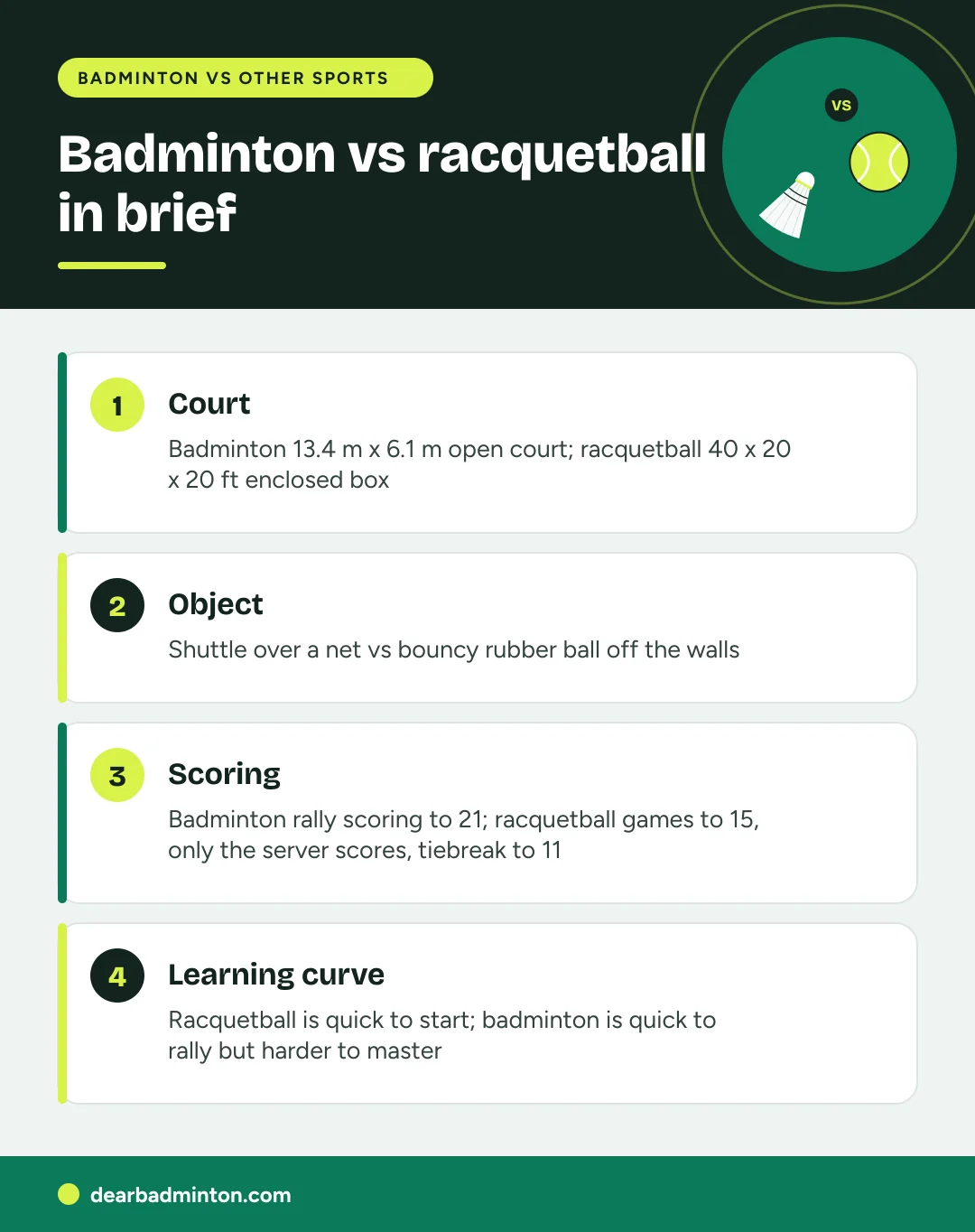
A badminton court is 13.41m long, open with a net. A racquetball court is 12.19m long, fully enclosed by four walls, floor and ceiling. No net exists in racquetball. Every surface is a legal playing area after the serve.
These two courts are almost identical in floor area. Nevertheless, they create completely different sporting experiences the moment you step inside.
The Badminton Court:
The badminton court is an open rectangle divided at the centre by a net standing 1.524 meters high at the centre and 1.55 meters at the posts. Lines define the singles width of 5.18 meters and doubles width of 6.1 meters, the short service line, long service line and back boundary line.
Everything that matters in badminton happens either above the floor or within clearly defined lines. Every outcome is transparent and immediately obvious.
For a complete breakdown of every line, zone and rule on the court, our guide to the complete badminton rules and regulations covers everything from beginner fundamentals through advanced competition standards.
The Racquetball Court:
Step into a racquetball court, however, and the disorientation is immediate. Four solid walls, a floor and a ceiling completely enclose the 12.19 by 6.09 meter space. There is no net. There are no conventional out-of-bounds lines on the walls during a rally.
The front wall carries a service line and receiving line. The side walls, back wall and ceiling are all legal playing surfaces once the rally begins, provided the ball reaches the front wall before touching the floor.
This creates a genuinely three-dimensional environment unlike anything in badminton. A single shot can travel front wall, side wall, back wall and ceiling in one continuous movement.
Reading those trajectories correctly requires spatial intelligence that takes months of consistent play to develop automatically.
Additionally, both players share the same enclosed space throughout every rally, which means they must continuously yield right of way and call hinders when playing the ball safely is impossible.
That shared-space dynamic has no equivalent in badminton, where the net permanently separates opponents.
6. Equipment: Rackets, rrojectiles and safety gear
Badminton uses an ultra-light strung racket of up to 680mm and a feather shuttlecock under 5.5 grams. Racquetball uses a shorter, heavier strung racket of maximum 558.8mm and a hollow rubber ball of approximately 40 grams. Eyewear and a wrist tether are mandatory in racquetball.
Badminton Racket:
A professional badminton racket weighs between 80 and 100 grams. Some elite models weigh as little as 70 grams, lighter than a chicken egg. The maximum length is 680mm.
String tension runs between 20 and 30 pounds. Power comes overwhelmingly from the wrist. The racket’s lightness is engineered specifically to allow the wrist snap and rotation that generates shuttle speed.
A tight grip, therefore, kills wrist speed and kills shot quality. Before choosing your next racket, our guide to the best badminton rackets for all levels covers every specification you need.
Racquetball Racket:
A racquetball racket is considerably shorter, heavier and stiffer. Maximum length is 558.8mm under IRF specifications. Weight runs between 140 and 185 grams, roughly double to triple a badminton racket. The frame is strung, but the hitting surface drives the ball through impact rather than whipping through it.
Moreover, every racquetball player must attach their racket to their playing wrist with a cord tether at all times. That requirement exists because the shared court space means a racket leaving a player’s hand during a powerful swing could cause serious injury. It is mandatory under IRF rules, not optional.
The Shuttlecock:
A regulation feather shuttlecock weighs between 4.74 and 5.50 grams and consists of 16 goose or duck feathers embedded in a cork base. Its aerodynamic properties are unique in all of sport. When struck at full power, it travels at speeds exceeding 400 kilometers per hour.
However, aerodynamic drag then slows it so dramatically that it decelerates from 300 kilometers per hour to under 50 within a single second of flight. Nothing else in sport behaves this way.
Consequently, reading the shuttle early, before it decelerates into an unexpected position, is the skill that most clearly separates good badminton players from great ones.
The Racquetball:
A racquetball is a hollow rubber sphere weighing 39.69 grams with a diameter of 57.15mm and a hardness of 55 to 60 durometers, ensuring consistent bounce across different court temperatures.
Unlike squash balls, racquetball balls need no warming up. They are lively and responsive from the moment play begins, bouncing off any combination of walls, ceiling and floor in ways that reward tactical intelligence over time.
Mandatory Eyewear:
Protective eyewear is mandatory in racquetball under IRF rules. The racquetball is approximately the same diameter as the human eye socket.
A direct hit without protection can cause devastating injury. Goggles are therefore not a preference. They are a non-negotiable safety requirement that every player must own before stepping on court.
7. Which sport is truly faster?
Badminton is the fastest racket sport in the world by Guinness World Record. The world record smash reached 493 km per hour. Racquetball tops out at approximately 240 to 260 km per hour in competitive play. Badminton demands faster individual reaction times at every level.
Badminton’s Guinness World Record status is not a marketing claim. It is a measured fact. The world record smash, set by Malaysia’s Tan Boon Heong in a 2013 speed test, reached 493 kilometers per hour. In professional match conditions, smashes routinely exceed 380 to 400 kilometers per hour.
By comparison, the fastest racquetball shots in professional play reach approximately 240 to 260 kilometers per hour. That is genuinely fast by any standard. Nevertheless, it is significantly slower than a professional badminton smash.
Furthermore, the badminton court gives a receiving player approximately 0.3 seconds to respond to a smash from the back of 13 meters. That sits at or beyond the standard limit of human reflex response, which is precisely why elite badminton players train their nervous systems as deliberately as their muscles.
In racquetball, meanwhile, the wall system means players can sometimes allow the ball to pass them and use the back wall rebound as processing time. That tactical option is simply unavailable in badminton. Once the shuttle passes you, the rally is over.
Badminton also operates across three dimensions. The shuttle travels at varying heights from tight net shots barely clearing the tape to high defensive clears.
Racquetball’s primary dimension is horizontal, though ceiling shots add a vertical element. The verdict, therefore, is unambiguous. Badminton is faster and demands faster reactions.
8. Is badminton harder than racquetball?
Badminton is technically harder due to reaction speed demands, wrist mechanics and three-dimensional movement. Racquetball is harder in court spatial reasoning and sustained aerobic endurance. At beginner level, racquetball is slightly easier to start enjoying.
Why Badminton is Harder?
The wrist mechanics in badminton represent one of the most technically demanding skill sets in any racket sport. The backhand smash, which generates explosive rotational power from the wrist at a completely unnatural angle, takes years of dedicated practice to execute consistently. No equivalent exists in racquetball.
Additionally, deceptive stroke play in badminton, using identical body position to produce a smash, drop shot or net roll at the last possible moment, demands technical sophistication that racquetball does not require at equivalent levels.
Moreover, badminton covers three dimensions. The overhead game of smashes, clears and drops requires vertical movement that racquetball, primarily a floor-level horizontal sport, does not replicate.
Our in-depth badminton skills and tactics guide shows just how layered this complexity becomes at advanced levels.
Why Racquetball is Harder in Different Ways?
Wall reading, on the other hand, has no badminton equivalent. Predicting where a ball emerges from a back-wall rebound, a side-wall combination or a corner between two walls requires three-dimensional spatial reasoning that takes months to develop automatically.
Furthermore, the sustained aerobic endurance that long racquetball rallies demand tests cardiovascular capacity in ways that badminton’s shorter rally structure sometimes does not replicate.
The Honest Conclusion:
Badminton is technically harder overall. Its reaction speed requirements, wrist mechanics and vertical movement complexity set a ceiling that genuinely takes years to approach.
Racquetball, however, is harder in spatial reasoning and sustained aerobic terms. Neither sport is simply harder. They challenge different athletic qualities in ways that complement each other well for cross-training players.
9. What is the most difficult racquet sport?
Badminton ranks as the most physically and technically demanding racquet sport overall. Its extreme reaction speed requirements, wrist mechanics and explosive movement demands exceed those of any other racket sport. Squash typically ranks second for sustained physical endurance.
The consensus among experienced multi-sport players and sports scientists is consistent. Badminton demands the fastest reactions, the most technically complex stroke production and the most explosive movement patterns of any racket sport played globally.
Its Guinness World Record is one data point in a broader picture of extreme physical and technical demand.
Squash ranks second for its sustained cardiovascular intensity. Tennis ranks third for power, endurance and surface variety.
Racquetball sits broadly at the tennis level of overall difficulty, harder than pickleball and padel for most players but somewhat less technically demanding than squash or badminton at competitive levels.
10. What is the easiest racket sport to learn?
Pickleball is the easiest racket sport for complete beginners. Padel is second. Racquetball is easier than badminton or squash initially because the lively ball and large sweet spot allow basic rallying quickly. Badminton has a moderate curve before play becomes genuinely rewarding.
For practical context, here is the honest beginner difficulty ranking from easiest to hardest.
Pickleball first, by a significant margin. The slower ball, smaller court and forgiving format produce immediate rallying for almost any beginner. Padel second, where the wall keeps the ball in play and the doubles partner compensates for early errors.
Racquetball in the middle, where the lively ball and short racket with its large sweet spot make basic play accessible within a few sessions. Badminton next, requiring more initial investment in technique before competitive play feels rewarding.
Squash and tennis at the top of the difficulty curve, each demanding specific athletic and technical development before enjoyment arrives.
11. Which sport burns more calories?
Both sports burn comparable calories at competitive intensity, approximately 450 to 600 per hour for a 70-kilogram player. Badminton’s explosive interval structure creates a stronger afterburn effect. Racquetball’s sustained aerobic demand develops cardiovascular base fitness more effectively over longer sessions.
Competitive badminton singles burns 450 to 600 calories per hour. At peak intensity, that figure rises toward 650. The explosive stop-go structure of badminton, moreover, mirrors high-intensity interval training almost exactly, triggering the excess post-exercise oxygen consumption effect and elevating metabolic rate for hours after play ends.
Competitive racquetball burns approximately 450 to 580 calories per hour at similar body weight. Rallies tend to run longer than badminton singles because the ball is harder to kill outright against a wall.
As a result, heart rates during competitive racquetball typically sustain at 75 to 85 percent of maximum, compared to badminton’s 90 to 95 percent during intense exchanges.
The calorie figures are broadly comparable. The difference, therefore, is in how those calories are burned rather than how many. Badminton burns through explosive anaerobic intervals.
Racquetball burns through sustained aerobic effort. Both approaches produce outstanding fitness results. They simply develop different physiological systems.
A landmark study published in the British Journal of Sports Medicine found that regular racket sport participation is associated with a 47 percent reduction in all-cause mortality risk compared to sedentary individuals, the highest figure of any activity category in the study. Both sports fall within this extraordinary finding.
12. Scoring systems and match formats: Badminton and Racquetball
Badminton uses rally points to 21 per game, best of three. Racquetball traditionally uses side-out scoring where only the server scores, with games to 15 and matches best of two from three games. Racquetball also features a unique three-player cut-throat format.
Badminton Scoring:
Badminton uses the rally point system introduced by the BWF in 2006. Every rally produces a point regardless of who served. At 20 all, deuce is called and the first player to lead by two consecutive points wins the game. The maximum score is capped at 30.
For a complete understanding of how every point, fault and interval rule operates, our badminton scoring system guide covers everything in detail.
Racquetball Scoring:
Traditional racquetball uses side-out scoring, where only the serving side scores. If the receiving side wins the rally, they win the serve but not a point. Games run to 15 points and matches are best of two from three games.
A tiebreaker, if needed, runs to 11 points. Unlike badminton, there is no deuce rule. Win by one point is sufficient at any score.
Additionally, racquetball features cut-throat, a three-player format where one player serves against two and serve rotates among all three players. This format has no badminton equivalent but solves the practical problem of odd-number player groups elegantly.
13. Injury risk and safety:
Badminton’s most common injuries are rotator cuff strains, ankle sprains and knee injuries from explosive jumping and lunging. Racquetball’s primary risks are eye injuries without eyewear, lateral epicondylitis and shoulder strains. Mandatory eyewear eliminates the most serious racquetball-specific risk entirely.
Badminton Injuries:
The rotator cuff is the most injury-prone area in competitive badminton. Repeated overhead shots, particularly the jumping smash, place cumulative loading on the shoulder tendons that must be managed through specific strengthening work.
Ankle sprains from sudden directional changes are the most frequent acute injuries. Knee injuries occur from the combination of jumping, hard landings and rapid stops under load.
The important mitigating factor, however, is badminton’s non-contact nature. The shuttlecock is too light to cause direct impact injury. Eye injuries are genuinely uncommon. Overall, badminton’s injury profile is moderate for an explosive sport.
Racquetball Injuries:
Eye injuries represent the most serious safety concern specific to racquetball. The ball’s diameter closely matches the human eye socket, making an unprotected direct impact potentially catastrophic.
Consequently, wearing proper protective eyewear eliminates this risk almost entirely and must be treated as mandatory rather than optional.
Lateral epicondylitis, commonly called tennis elbow, occurs from the heavier ball, racket vibration and repetitive groundstroke mechanics.
Shoulder strains occur from powerful drives and overhead shots. Lower back tightness develops from the rotational demands of the horizontal swing pattern.
For both sports, proper warm-up, gradual volume increase and sport-specific conditioning work dramatically reduce injury risk at any age.
14. Cost, accessibility and global reach:
Badminton is played by 220 million people globally with strong infrastructure across Asia. Racquetball has approximately 5 to 6 million players concentrated in North America and Latin America. Equipment costs are broadly comparable. Court availability is the more important practical consideration for racquetball players.
Badminton Costs:
A beginner badminton racket costs 15 to 50 US dollars. Court rental runs 10 to 25 dollars per hour. The ongoing cost to budget for is shuttlecocks.
Feather shuttles cost 15 to 30 dollars per tube of six and can be damaged within a single competitive session. Synthetic alternatives are more durable and affordable for recreational play.
Racquetball Costs:
A beginner racquetball racket costs 20 to 60 US dollars. Add 15 to 40 dollars for quality protective eyewear, which is a mandatory one-time investment.
Racquetball balls cost 5 to 15 dollars per can and last considerably longer per session than feather shuttlecocks. Court rental runs 10 to 25 dollars per hour where courts are available.
That availability question is increasingly the critical issue. In many US cities, court availability has declined significantly as gyms have repurposed racquetball courts for other uses.
Consequently, checking local court availability before committing to the sport is practical advice worth taking seriously.
Final Verdict: Which sport aligns with your needs?
Choose badminton if:
You want the fastest racket sport on earth, explosive fitness development, technical mastery across wrist skill, footwork and deception, and a sport embedded in the world’s richest sporting culture with 220 million fellow players.
Choose racquetball if:
You want intense cardiovascular training inside an enclosed court, a sport that rewards spatial intelligence and endurance equally, and a game that is slightly easier to begin enjoying than badminton.
Choose both if:
Your goal is complete athletic development. Badminton sharpens explosive power and reaction speed. Racquetball builds aerobic endurance and three-dimensional spatial reasoning. The two sports develop fitness qualities that complement each other rather than overlap.
Above all, get on a court. Whichever one makes you feel most alive is always the right answer.
FAQs
No. Racquetball is an American enclosed-court sport played with a rubber ball against four walls, with no net. Badminton is a net sport played with a feathered shuttlecock on an open indoor court.They share only a racket and an indoor setting. Every other dimension of equipment, court, rules, technique and physical demand is completely different.
In the UK, racketball refers to squash 57, a variant played on a squash court with a larger, bouncier ball and slightly larger racket. This is entirely different from American racquetball. British players searching for racquetball will find squash 57 at most squash clubs, while American-style racquetball courts remain rare in the UK.
Racquetball peaked at approximately 10 million players in the early 1980s and has since declined to around 5 to 6 million. The primary causes were expensive court maintenance leading gyms to repurpose courts, competition from 1990s fitness trends, Olympic exclusion while badminton gained global visibility from its 1992 inclusion, and more recently the explosive growth of pickleball drawing former players away.
Badminton, officially recognised by Guinness World Records. The world record shuttlecock smash speed of 493 kilometers per hour, set by Malaysia’s Tan Boon Heong in 2013, has never been approached by any other racket sport projectile under official testing conditions.
Yes, more easily than most cross-sport transitions. Badminton develops extraordinary reaction speed, excellent hand-eye coordination and strong competitive instincts that transfer immediately to racquetball. The main adjustments are learning wall geometry and adapting to a heavier racket with a different swing mechanics profile. Most badminton players find themselves competitive at recreational racquetball within two to three months.
Conclusion:
To say the least, badminton and racquetball are extraordinary sports built on fundamentally opposite principles. Badminton gives you speed, technical depth and explosive fitness unmatched in any other racket sport. Racquetball gives you a unique spatial challenge, sustained cardiovascular intensity and a game that rewards geometric intelligence as much as athleticism. Neither is simply better. The right choice is the one that matches your goals, your personality and the court that is nearest to your door.