Two racket sports, one question: Which one is logically suitable for you?
Every badminton player has heard it at least once. You mention the sport and someone nods and says, oh yes, the fastest sport in the world. You feel quietly proud and move on. Then a table tennis player walks into the room.
I have had this conversation more times than I can count. In sports halls, over coffee after training, standing by a court while my legs are still burning. And every single time, both sides reach for one number. Shuttle speed. Ball speed. Hits per second. As if one statistic settles everything.
It does not. Not even close.
Badminton and table tennis are two of the most demanding sports on the planet, yet they sit at opposite ends of almost every meaningful comparison.
One sends a feathered shuttle flying across a full indoor court at speeds that seem impossible. The other squeezes all that intensity onto a surface you could fit in your dining room, where the ball moves so fast your eyes struggle to follow it.
Speed is just one chapter of a much bigger story. Here is the full picture, explained simply and honestly.
My own verdict:
Badminton is faster by raw projectile speed and demands more physical movement, more court coverage and more explosive fitness.
Table tennis is faster in hits per second, demands sharper close-range reactions and has more players globally. Neither sport is simply better. They suit different people, different bodies and different goals entirely.
Badminton vs Table Tennis: Head-to-Head Comparison Table
Scan this before reading anything else. Everything you need at a glance.
| Category | Badminton | Table Tennis |
|---|---|---|
| Top projectile speed | 493 km per hour | 170 km per hour |
| Hits per second in rallies | 1.72 average | 2.00 average |
| Court or table size | 81.75 sq metres doubles | 4.18 sq metres |
| Net height | 1.524 metres | 0.15 metres |
| Calories burned per hour | 300 to 600 | 200 to 350 |
| Active play per match | About 48 percent | About 7 to 16 percent |
| Global players | 220 million | 350 million |
| Olympic sport since | 1992 | 1988 |
| Joint impact | Higher | Much lower |
| Spin level | Limited | Extreme, up to 8,000 RPM |
| Easier for complete beginners | Yes | Harder initially |
| Governing body | BWF | ITTF |
1. Where these two sports come from?
Badminton has roots going back two thousand years with modern origins in England in 1873. Table tennis was invented in England in the 1880s as a simple after-dinner game. Both became Olympic sports and both now have hundreds of millions of players worldwide.
Badminton: Older Than You Think
Badminton has existed in some form for over two thousand years. Ancient versions of the game appeared in China, Greece, India and Japan, where people used paddles and feathered objects for fun long before sport was formalised.
The modern game started in 1873 at Badminton House in England, when guests at the Duke of Beaufort’s estate put a net across the room and started hitting a shuttlecock over it. The sport took the name of the house and spread quickly.
By 1877, the first rules were written. By 1934, the Badminton World Federation was governing the sport internationally. By 1992, badminton had entered the Olympics.
Today, an estimated 220 million people play it worldwide. In countries like Indonesia, Malaysia, China and South Korea, badminton is not just a hobby. It is part of the national identity.
Table Tennis: From a Dinner Table to the World
Table tennis began in the 1880s as a game played after dinner in wealthy English homes. People stacked books to make a net, used cigar box lids as paddles and hit a champagne cork back and forth. It sounds absurd today, but that simple game grew with speed.
By 1900, proper celluloid balls had replaced the cork. By 1926, the International Table Tennis Federation was founded. The sport entered the Olympics in 1988 in Seoul, four years before badminton.
Today, an estimated 350 million people play it globally, making it the most played racket sport on earth. In China, table tennis carries enormous national pride. Players like Ma Long are recognised the way Western cultures recognise football stars.
Interesting fact! Table tennis went by several names in its early years including Gossima, Whiff Whaff and Ping-Pong. The name Ping-Pong was trademarked in England in 1901, which is precisely why the official sport ended up being called table tennis instead.
2. The courts: Why the size changes everything?
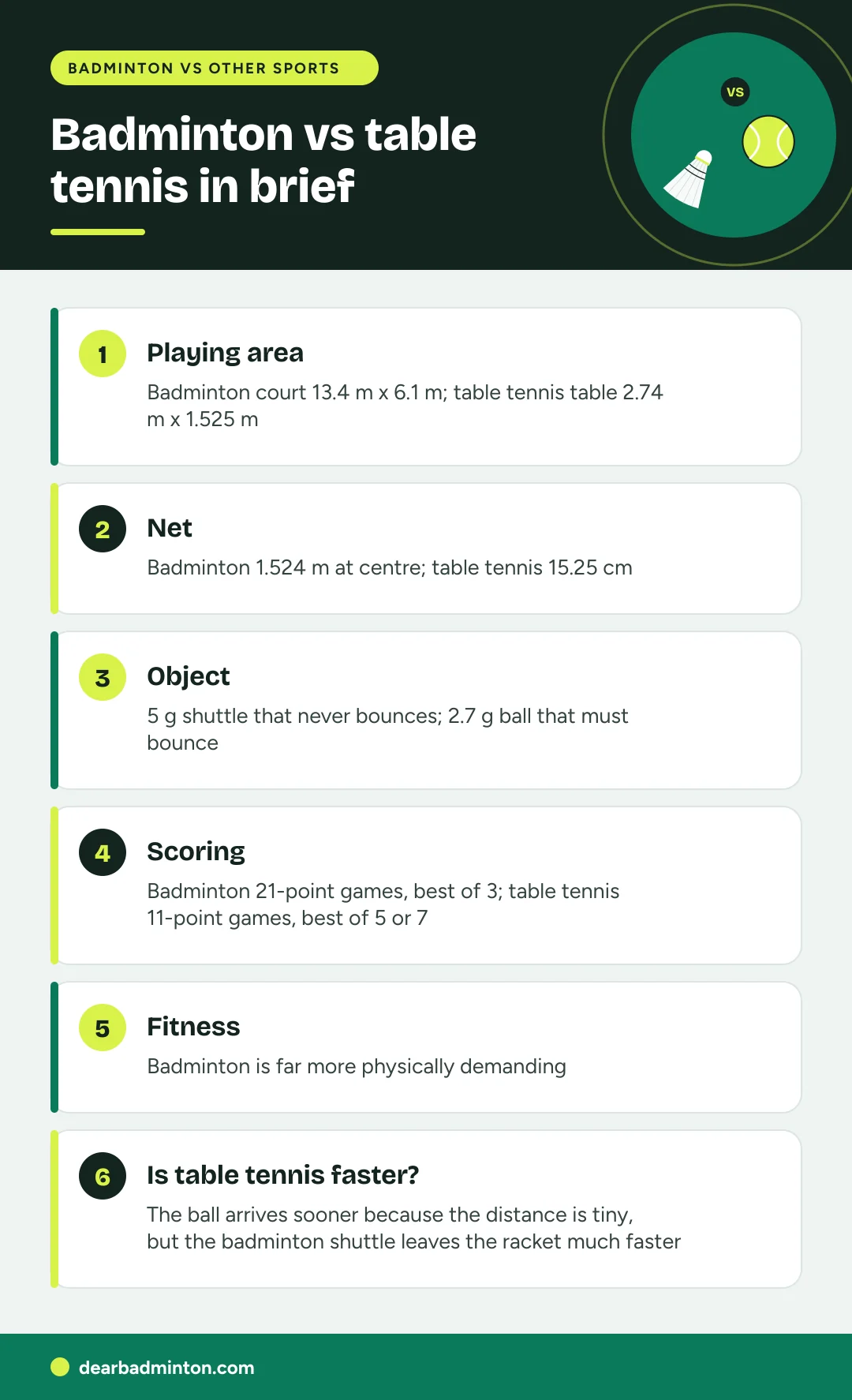
A doubles badminton court covers 81.75 square metres. A table tennis table covers just 4.18 square metres. The badminton court is more than nineteen times larger. That single fact shapes every physical difference between these two sports.
The Badminton Court:
A doubles badminton court is 13.4 metres long and 6.1 metres wide. For singles, the width narrows to 5.18 metres. The net stands at 1.524 metres at the centre, which is taller than most people’s hip height.
What makes badminton different is that you move in all directions, not just side to side. You sprint forward to the net, rush back to the baseline, jump for overhead smashes and lunge low for tight net shots, sometimes all within the same rally.
That three-dimensional movement is unlike anything in any other racket sport. Badminton must be played indoors because even a light breeze outside changes the shuttle’s flight path completely.
For a full breakdown of how the court works in competitive play, our complete badminton rules and regulations guide covers every line, zone and rule in plain language.
The Table Tennis Table:
Stand at a table tennis table for the first time and the size catches you off guard. It is just 2.74 metres long and 1.525 metres wide, standing 76 centimetres off the floor. The net across the middle is only 15.25 centimetres high, roughly the height of a television remote.
Everything happens at close range and high speed. The ball travels the full length of the table in under 40 milliseconds. That is faster than your eyes can fully process what they are seeing.
As a result, good table tennis players are not consciously watching the ball and then deciding to move. Their bodies are already reacting while their brains are still catching up.
That compression of space and speed is exactly what makes table tennis so hard to play well. Being even slightly out of position means the next shot catches you completely wrong-footed.
3. Equipment: Two very different tools
Badminton uses an ultra-light strung racket and a feather shuttlecock that slows sharply in flight. Table tennis uses a solid rubber-coated paddle and a lightweight plastic ball that travels consistently but with heavy spin. The equipment creates completely different demands in each sport.
The Badminton Racket:
A professional badminton racket weighs between 80 and 100 grams. The lightest elite models weigh around 70 grams, less than a small apple. The maximum length is 680mm. String tension runs between 20 and 30 pounds.
Power in badminton comes from the wrist. The racket is so light that a sharp wrist snap at contact is all the speed you need. Gripping too tightly throughout the swing slows your shots down.
The best players hold the racket loosely between shots and tighten only at the moment they hit. That takes months to feel natural, but once it does, the improvement in your game is immediate.
Before your next racket purchase, our guide to the best badminton rackets for every level will save you time and money.
The Table Tennis Paddle:
A table tennis paddle looks simple but is surprisingly technical. The blade can be any shape or size under ITTF rules, provided it is at least 85 percent wood. The rubber sheets on each side are where the real complexity lives.
Different rubbers create completely different ball behaviours. Some grip the ball for heavy topspin. Others make it skid low. Anti-spin rubbers confuse opponents by doing almost nothing at all.
Choosing the right rubber combination is one of the most important equipment decisions in the sport and it evolves constantly as players improve.
The Shuttlecock vs the Table Tennis Ball:
Here is where physics makes things interesting. The shuttlecock weighs between 4.74 and 5.50 grams and is made from 16 feathers set into a cork base.
When hit hard, it travels at over 400 km per hour. However, air resistance slows it so sharply that it loses most of its speed within the first third of its flight. A shuttle leaving the strings at 400 km per hour arrives at the other end of the court closer to 50 to 60 km per hour.
I saw slow-motion footage of a professional smash for the first time years ago and could not believe what I was watching. The shuttle left the strings as a complete blur and then, almost gently, slowed through the air.
Nothing else in sport behaves this way. That dramatic slowdown is not a flaw. It is the foundation of everything tactically interesting about badminton.
The table tennis ball weighs just 2.7 grams and measures 40mm across. It must be white or orange for contrast against the table. Unlike the shuttle, it does not slow dramatically in flight. What makes it hard to return is not pace but spin.
At elite level, a ball can carry up to 8,000 rotations per minute. Reading that spin from an opponent’s paddle and adjusting your return angle in under a second is one of the hardest skills in the sport.
Interesting fact! Table tennis switched from celluloid to plastic balls in 2015. The change was small but it affected ball speed and spin enough that many professional players spent months rebuilding their technique. The feather shuttlecock, meanwhile, has barely changed in design for over a hundred years.
4. Speed: Five ways to look at this honestly
Badminton leads in projectile speed at 493 km per hour versus table tennis’s 170 km per hour. Table tennis leads in rally speed at 2.00 hits per second versus badminton’s 1.72. Badminton demands faster movement across a large space. Table tennis demands faster reactions across a tiny one. Speed in sport has five dimensions and these two sports lead in different ones.
Most articles on this topic pick one speed number and call the debate settled. That approach misses the point. Speed in sport is five separate things, and badminton and table tennis lead in genuinely different categories.
a. Projectile Speed
The shuttlecock wins clearly. Malaysian professional Tan Boon Heong recorded a smash of 493 km per hour under official testing. Guinness World Records recognised badminton as the fastest racket sport on that basis. In professional matches, smashes regularly exceed 380 to 400 km per hour.
A table tennis ball at full professional drive speed reaches approximately 170 km per hour. That is slower in raw terms. However, the table is only 2.74 metres long. That ball covers the full length of the table in under 40 milliseconds.
Your conscious visual system takes around 200 milliseconds to fully register what it sees. Table tennis players are therefore not seeing the ball and then deciding to move. Their bodies are already in motion before the brain has finished processing the shot.
b. Rally Speed
Analysis of elite-level matches shows that table tennis produces approximately 2.00 hits per second compared to badminton’s 1.72. Table tennis wins this category. The shorter distance between players means the ball returns faster, even at lower absolute speeds.
c. Movement Speed
Badminton wins here by a clear margin. Research on elite badminton players found they cover around six to seven kilometres during a competitive singles match. That is roughly double the distance elite tennis players cover in the same period.
Table tennis players, competing across 4.18 square metres, cover a fraction of that distance. However, every movement they make must be explosive, precise and immediate.
d. Reaction Time
Both sports push human reaction speed to its limit, but in different ways. In table tennis, the challenge is physical. Responding to a ball arriving in under 40 milliseconds means your body moves on instinct rather than conscious thought. In badminton, the challenge is reading deception.
An experienced player shapes their body identically for a smash, a drop shot and a net roll. The opponent must read the actual cue, resist the fake and commit to the right direction, all within a fraction of a second.
e. Cognitive Speed
This dimension appears in almost no comparison article, and it is arguably the most important of the five. In table tennis, players must identify the type of spin on the ball from the very first millisecond their opponent’s paddle makes contact.
Topspin, backspin, sidespin, no spin. Getting it slightly wrong sends the return into the net or wide. In badminton, that same cognitive load comes from reading deception and anticipating patterns built through years of competitive experience. Both sports make serious demands on the brain. They simply do so in different ways.
5. Physical Fitness: Which sport works your body harder?
Badminton burns 300 to 600 calories per hour and keeps players in active movement for around 48 percent of match time. Table tennis burns 200 to 350 calories per hour with active play at 7 to 16 percent of match time. Badminton is more physically demanding overall. However, table tennis builds real strength in the core and demands sharp mental concentration throughout.
I wore a heart rate monitor during a badminton singles match a few years ago, mostly out of curiosity after reading a coaching article that suggested the data would surprise me. It did.
My heart rate spent most of the active play above 90 percent of its maximum. The pauses between rallies were not long enough to bring it back down before the next point began. Competitive badminton is, in effect, a long series of sprints with very short rests in between.
Table tennis does not create those cardiovascular peaks, but dismissing it as easy would be a mistake. The explosive hip and shoulder rotation needed to generate heavy topspin places real demand on your core and lower back.
The concentration required across a full match is exhausting in a way that simply does not show up on a heart rate monitor.
Calories and Active Time:
The most useful comparison here is not calories per hour in isolation. It is how much time within a match you are actually in motion. Badminton players are in active play for about 48 percent of total match time.
Table tennis sits at around 7 to 16 percent, much closer to tennis in this measure. In practical terms, badminton gives you almost no recovery time between movements.
You finish one explosive action and the next begins immediately. That cumulative load builds faster than in almost any other racket sport.
Joint Impact:
For anyone with knee, ankle or hip concerns, this difference matters. Badminton’s jumping, deep lunging and sudden stopping under load places considerable stress on the lower body joints over time, particularly at competitive level.
Table tennis is much kinder in this respect, making it a sustainable option for players at any age or physical condition where impact is a relevant factor.
For building the physical base badminton demands, our badminton fitness and training guide covers footwork conditioning and off-court strength work from the ground up.
6. Is badminton harder than table tennis?
Badminton is easier for complete beginners to start enjoying. Table tennis has a steeper early learning curve due to ball speed and paddle angle sensitivity. At advanced level, both sports are hard in completely different ways. Neither is simply harder overall.
I once introduced a friend who had never held a racket to badminton. Within twenty minutes she was getting the shuttle back over the net, moving around the court and laughing out loud.
The shuttle’s dramatic slowdown as it travels through the air gives beginners time to adjust their position and make decent contact. That natural forgiveness is one of badminton’s strongest qualities as a starter sport.
Table tennis is a different story for beginners. The ball moves fast and low across a very short table. Getting the paddle angle right, managing the bounce and keeping the ball in play consistently requires more precise technique from the very first session. Many beginners find the early stages frustrating before the skill clicks.
However, here is the part most articles skip entirely. At advanced level, both sports become hard in ways that are difficult to describe until you have experienced them. The gap between a casual table tennis player and a competitive one is among the widest in any sport.
A trained player would win every rally against a recreational player without discomfort. Badminton is no different at that level. Both sports have technical ceilings so high that even committed club players spend years working toward them.
The difference is simply which sport lets you start enjoying yourself fastest. For beginners, badminton gets there sooner.
7. Long-term health: What does the research tell us
Badminton burns more calories per hour than table tennis at equivalent intensity. Both sports are strong for cardiovascular health. A major study found regular racket sport participation linked to a 47 percent reduction in all-cause mortality risk, the highest figure of any exercise category in that research.
Competitive badminton singles burns between 450 and 600 calories per hour for a person weighing around 70 kilograms.
The explosive interval structure, short intense rallies followed by brief rest, mirrors the effect of high-intensity interval training. Consequently, the body keeps burning calories at an elevated rate for hours after the session ends.
Competitive table tennis burns between 200 and 350 calories per hour recreationally, rising toward 450 at serious competitive intensity. The lower overall body movement accounts for most of the difference.
However, table tennis sessions can comfortably run for two to three hours because the physical demands are more sustainable. Total calorie burn across a longer session can therefore close the gap.
For both weight management and cardiovascular fitness, either sport serves you well. The most important factor is always which one you will keep playing consistently.
The sport you enjoy showing up for week after week will always produce better long-term results than the one you start and abandon.
A major study published in the British Journal of Sports Medicine found that regular racket sport participation is linked to a 47 percent reduction in all-cause mortality risk compared to people who do not exercise.
That was the highest figure of any activity category in the entire study, higher than swimming, aerobics, football and cycling.
Both badminton and table tennis sit within that finding. Playing either sport regularly is, in measurable terms, linked to a longer life.
8. Injury risk and who each sport suits
Badminton’s most common injuries are shoulder strains, ankle sprains and knee injuries from jumping and sharp direction changes. Table tennis is much gentler on joints and well-suited to players of all ages. Both sports are safe with proper warm-up, good technique and sensible training loads.
Badminton Injuries:
The shoulder takes the most punishment in badminton, particularly the rotator cuff, which stabilises the joint during overhead shots. Repeated smashes and clears build load on these muscles over time and they need specific strengthening work to stay healthy.
Ankle sprains from sudden direction changes are the most frequent sudden injuries. Knee pain from jumping and hard landings affects some players, especially those who train frequently on hard court surfaces.
The good news is that badminton is a non-contact sport. The shuttlecock is too light to cause direct impact injuries. Collision with another player is very rare in singles. With proper preparation and sensible training habits, the injury picture is manageable for most players.
Table Tennis Injuries:
Table tennis is remarkably gentle on the body by comparison. The most common complaints are elbow pain from repetitive strokes, lower back tightness from the bent-forward playing stance and wrist strain from heavy spin shots.
None of these are serious in most cases and they respond well to rest, technique correction and simple strengthening exercises.
For older players, players returning to sport after a long break or anyone managing a joint condition, table tennis is one of the most suitable racket sports available. You can play at any intensity level, on almost any surface and at practically any age.
9. Cost, accessibility and global reach
Both sports are affordable to start. Badminton needs an indoor court and ongoing shuttlecock purchases. Table tennis needs a table but balls are very cheap and last well. Badminton has 220 million players globally. Table tennis has 350 million. Both have strong international competitive structures.
Badminton Costs:
A beginner badminton racket costs between 15 and 50 US dollars. Intermediate rackets run 50 to 150 dollars. The ongoing cost to factor in is shuttlecocks.
Feather shuttles cost 15 to 30 dollars per tube of six and can be damaged within a single competitive session. Synthetic shuttles are cheaper and more durable for recreational use. Court rental at an indoor sports hall typically runs 10 to 25 US dollars per hour.
Table Tennis Costs:
A beginner table tennis paddle costs 15 to 40 US dollars. Competitive paddles with quality rubber cost considerably more, from 80 to 300 dollars for serious players. Balls are cheap at 5 to 15 dollars for a pack and last well.
The main cost consideration for home play is the table itself, between 200 and 500 dollars for a decent indoor model. However, most sports centres, schools and community halls have tables available at no extra charge.
Accessibility:
Badminton requires a booked indoor court, which means a session fee in most cases. Table tennis can be played almost anywhere a table exists. For the player who wants maximum flexibility in when and where they play, table tennis holds a clear advantage.
Final Verdict: Which sport is right for you?
Choose badminton if you want explosive, athletic, high-intensity competition across a full court. You want the world’s fastest racket sport. You want five competitive formats from singles through mixed doubles. You want a sport that builds reflexes, footwork and physical fitness that few other sports can match. Our badminton skills and tactics guide is the best place to start building that foundation.
Choose table tennis if you want a sport you can play anywhere, at any age and at any fitness level. You want the world’s most played racket sport with 350 million fellow players. You want a sport that is kind to your joints and builds precision, spin mastery and sharp decision-making over a lifetime.
Choose both if you want the most complete athletic and cognitive development possible. Badminton builds explosive power and three-dimensional movement. Table tennis builds fine motor control and spin recognition. Together they develop a range of qualities neither sport produces on its own.
The best sport is always the one that brings you back to the court tomorrow. Pick up a racket and find out which one that is.
FAQs
Badminton holds the world record for fastest projectile speed at 493 km per hour. Table tennis tops out at around 170 km per hour. However, table tennis produces more hits per second, approximately 2.00 versus badminton’s 1.72, because the table is far shorter. Both sports are fast. They are fast in different ways.
For complete beginners, badminton is easier to start enjoying because the shuttle slows in flight and gives you time to adjust. Table tennis is harder initially due to ball speed and paddle angle demands. At advanced level, both sports are deeply challenging but test completely different skills.
Badminton burns more calories per hour, approximately 450 to 600 for competitive singles versus 200 to 350 for recreational table tennis. Badminton’s explosive movement across a large court keeps heart rate much higher throughout. However, longer table tennis sessions can close the gap in total calorie burn per session.
Table tennis is generally more suitable for older players or anyone with joint concerns. It places very little impact on the knees and ankles. Badminton involves jumping, deep lunging and sudden stops that can be hard on joints over time. Both can be played comfortably at any age with sensible intensity management.
Table tennis has approximately 350 million players worldwide, making it the most played racket sport on earth. Badminton has approximately 220 million players, with its largest following across South and Southeast Asia. Both are Olympic sports with strong international governing bodies.
Conclusion:
Badminton gives you speed, explosive fitness and athletic movement that no other racket sport matches. Table tennis gives you precision, spin mastery and a sport you can play anywhere for the rest of your life. Both will make you fitter, sharper and more mentally alert than you were before you started. The only wrong choice is never starting at all. Pick up a racket. Your court is waiting.