Badminton vs Beach Tennis: Speed, Fitness and Which Sport is Right for You?
I did not plan to play beach tennis that afternoon. I was on holiday, sitting on a warm beach somewhere in southern Europe, watching two couples rally back and forth over a net with solid paddles and a soft yellow ball.
Something about it looked familiar. The no-bounce urgency. The overhead shots. The way one player disguised a lob as an attack at the very last second.
I borrowed a paddle and walked on court. Within five minutes, my wrist was doing things that only made sense in badminton. Within ten, I had hit three balls into my own half of the court. My badminton brain understood the tactical shape of the game perfectly. My beach tennis body had no idea what it was doing.
That disconnect told me something worth sharing. These two sports look alike from a distance. Up close, they are built on completely different physical logic. If you are trying to decide between them, or you play one and are curious about the other, here is the honest, complete comparison you need.
Quick Verdict:
Badminton is faster, more explosive and more technically demanding at every level. It builds wrist power, sharp reflexes and three-dimensional court movement.
Beach tennis is easier to start, always played outdoors as doubles, and one of the fastest-growing recreational sports in the world right now. Neither is simply better. They solve different needs for different people.
Head-to-Head Comparison Table
Scan this first. Every key difference in one place.
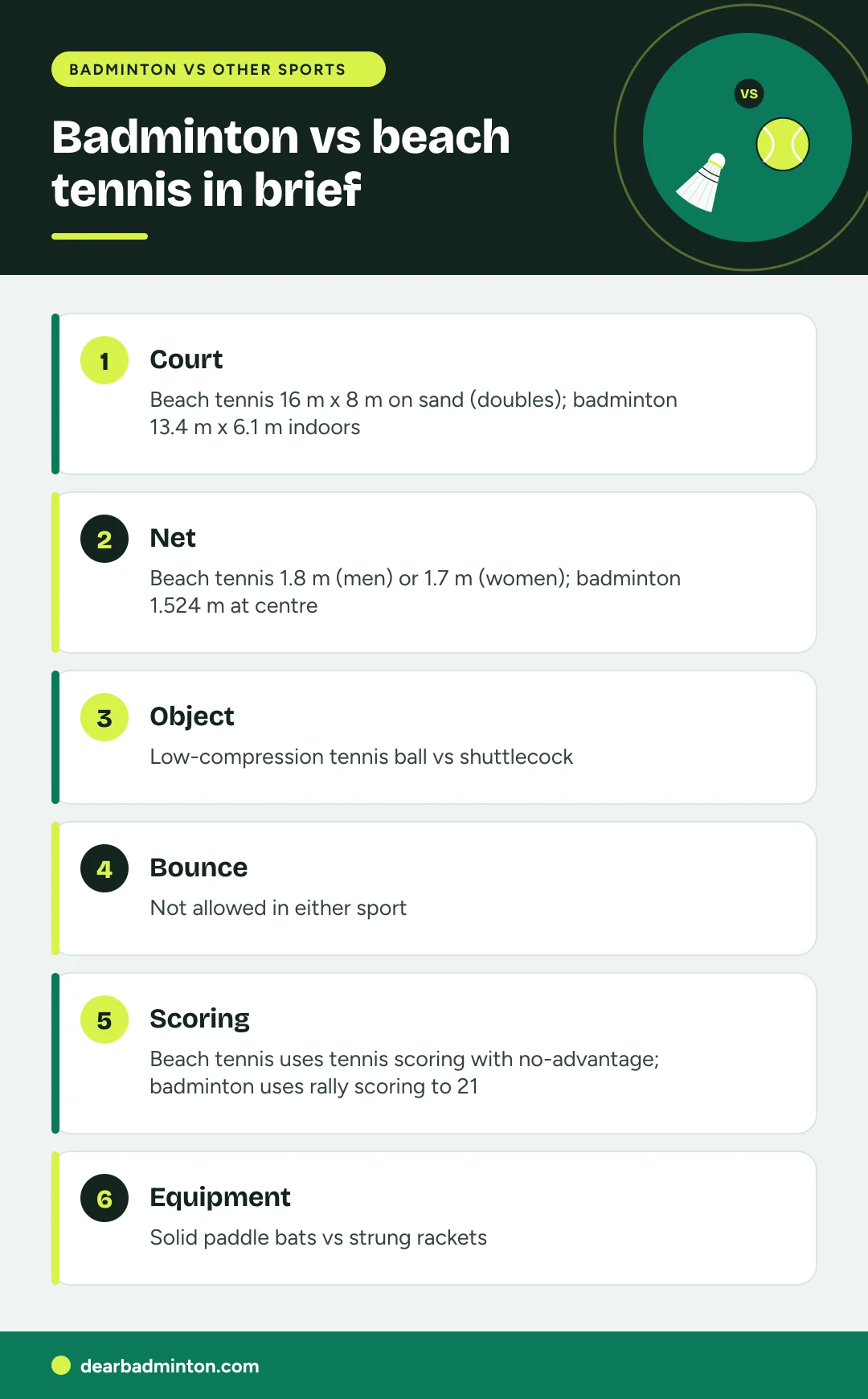
| Category | Badminton | Beach Tennis |
|---|---|---|
| First Played | Ancient origins, modern form 1873 England | Circa 1972, Comacchio, Italy |
| Rules Formalised | 1877, Bath Badminton Club | 1976, Torredembarra, Spain |
| Governing Body | BWF, 190 plus member nations | ITF, International Tennis Federation |
| Surface | Indoor wood or synthetic | Outdoor sand |
| Court Length | 13.41 metres | 16 metres |
| Court Width | 6.1 metres doubles | 8 metres |
| Net Height | 1.524 metres | 1.7 metres |
| Projectile | Feather shuttlecock, 4.74 to 5.50g | Depressurised Type 2 tennis ball |
| Racket or Paddle | Strung racket, 80 to 100g | Solid paddle, max 50cm long |
| Bounce Allowed | No | No |
| Fastest Speed | 493 km per hour world record | Approximately 100 to 150 km per hour |
| Core Shots | Smash, drop, clear, drive, net shot | Volley, spike, lob |
| Formats | Singles, doubles, mixed doubles | Primarily doubles only |
| Scoring | Rally points to 21, best of 3 | Tennis scoring, golden point at deuce |
| Olympic Sport | Since 1992 | No |
| Calories Per Hour | 450 to 600 competitive | 300 to 500 competitive |
| Easier for Beginners | Moderate curve | Very easy to start |
| Setting | Always indoors | Always outdoors |
| Global Players | 220 million | Hundreds of thousands to millions, growing fast |
1. Origins: How These Two Sports Were Born
Badminton was formalised in 1873 in England with roots going back two thousand years. Beach tennis began around 1972 when Italian holidaymakers in Comacchio played with tennis rackets over existing volleyball nets on the beach. Both grew into international sports with dedicated global communities.
Badminton: A Sport With Ancient DNA
Badminton traces its roots across ancient China, Greece, India and Japan, where people played with feathered objects and paddles for centuries before sport was ever formally organised.
The modern game was born in 1873 at Badminton House in Gloucestershire, England, when guests at the Duke of Beaufort’s estate introduced a net to the old battledore and shuttlecock game being played indoors. The name stuck. The sport spread.
By 1877, the Bath Badminton Club had written the first formal rules. By 1934, the Badminton World Federation governed the sport internationally. By 1992, badminton was in the Olympics and has remained there ever since.
Today an estimated 220 million people play worldwide. In Indonesia, Malaysia, China and South Korea, it is woven into the national identity in a way most sports never achieve.
Beach Tennis: From Holiday to World Stage
Beach tennis has a far simpler and more charming story. Around 1972, tennis players vacationing in Lido degli Estensi near Comacchio, northern Italy, began hitting balls over the volleyball nets already installed on the beach using their own rackets. No rules. No courts. Just people improvising fun with what was available.
The game was first played with its current set of rules in 1976 in Torredembarra, Spain. The first championship followed in 1978 at the same location.
From those Italian shores, the sport spread slowly along the Italian coast, where an estimated 1,600 beach tennis nets now exist.
Brazil became the sport’s second great home. Beach tennis arrived in Rio de Janeiro around 2008 and spread with speed that surprised everyone. It now occupies roughly a third of beach volleyball courts along the Brazilian coastline.
Most Brazilian tennis clubs have converted at least one court to beach tennis. The International Tennis Federation recognised beach tennis in 2008, giving it a formal world ranking system for the first time.
Interesting fact! Rafael Nadal, Serena Williams, Maria Sharapova, Andy Murray and the Bryan Brothers have all played beach tennis. The sport’s accessibility and outdoor atmosphere draw elite athletes from across the sporting world, not just those who grew up with rackets.
2. The One Rule That Connects Both Sports
Both badminton and beach tennis share a rule found in very few other sports. Neither the shuttlecock nor the beach tennis ball can bounce. Once either touches the ground, the point ends. This shared no-bounce rule creates the fast, continuous rally structure that defines both sports and makes switching between them feel more natural than most cross-sport transitions.
In tennis, squash and racquetball, the ball bounces once before a player must return it. That bounce provides time to readjust, breathe and set up the next shot.
In badminton and beach tennis, that option simply does not exist. Touch the ground and the point is over. Everything must stay airborne from the very first contact to the very last.
This creates a specific kind of pressure that players from bouncing-ball sports do not fully understand until they experience it. There is no reset. No pause. No moment to catch your feet while the ball settles. The rally is continuous until one side fails, and that failure is immediate.
For a badminton player stepping onto a beach tennis court for the first time, this rule feels instantly familiar. The instinct to keep everything in the air is already built in. That is your starting advantage.
Everything else, the heavier paddle, the different ball and the sand beneath your feet, introduces challenges the rest of this article covers in full.
3. Courts and Environment: Precision Indoors vs Freedom Outdoors
Badminton is always played indoors on a hard surface. Beach tennis is always played outdoors on sand. That surface difference alone reshapes movement demands, injury profiles and the entire feel of each sport.
The Badminton Court:
A doubles badminton court is 13.41 metres long and 6.1 metres wide. For singles, the width narrows to 5.18 metres. The net stands at 1.524 metres at the centre, taller than most people’s hip height. Lines define every zone with precision. The shuttle lands in or out and the result is immediately obvious.
Badminton must be played indoors. The shuttlecock’s aerodynamic sensitivity means even a light breeze completely disrupts its flight. Consequently, every session happens in a sports hall with controlled conditions, consistent lighting and no weather variables.
That predictability is a strength. It also means no summer evenings outside, no fresh air and no natural light during play.
For everything you need to know about lines, zones and rules on the badminton court, our complete badminton rules and regulations guide covers it all in plain language.
The Beach Tennis Court:
A standard beach tennis court is 16 metres long and 8 metres wide. The net sits at 1.7 metres, the same height as a beach volleyball net. There are no service boxes, no tramlines and no complex zone markings. The boundary is simple. In or out.
The sand surface changes everything about movement. There is no hard floor to push explosively off. Every step sinks. Every lunge demands more muscular effort to produce the same speed.
Research consistently shows that running on sand requires approximately 20 to 30 percent more energy than equivalent movement on hard ground. Over a full match, that extra demand accumulates into a workout that surprises most hard-court players the first time they experience it.
The outdoor environment also adds a tactical layer that indoor badminton never faces. Wind, sun angle, temperature and humidity all affect ball flight and player comfort.
Experienced beach tennis players read the weather the way sailors read the sea. That environmental awareness is a genuine skill with no equivalent in badminton.
4. Equipment: Two Very Different Tools
Badminton uses an ultra-light strung racket and a feather shuttle that slows sharply in flight. Beach tennis uses a solid paddle with no strings and a depressurised ball that maintains pace. The equipment creates different power mechanics, swing styles and shot demands in each sport.
The Badminton Racket:
A professional badminton racket weighs between 80 and 100 grams. Some elite models weigh around 70 grams, less than a small apple. Maximum length is 680mm. String tension runs between 20 and 30 pounds.
Power in badminton comes from the wrist. The racket is so light that a sharp wrist snap at contact generates all the speed you need. Gripping too tightly throughout the swing slows the shot.
The best players hold loosely between shots and snap firm only at the moment of impact. That habit takes months to feel natural, but once it does, the improvement is immediate.
Before your next racket purchase, our best badminton rackets guide for every level covers every specification worth knowing before you spend a penny.
The Beach Tennis Paddle:
A beach tennis paddle is solid with no strings. Under international regulations, maximum dimensions are 50 centimetres long, 26 centimetres wide and 38 millimetres thick.
Unlike a badminton racket, it does not flex or create a trampoline effect on contact. Power therefore comes from a full arm and shoulder action. The wrist stays relatively firm through impact.
This is the most important technical difference between the two sports, and it is exactly where badminton players most often struggle in their first beach tennis sessions.
Shuttlecock vs Depressurised Ball:
The shuttlecock weighs between 4.74 and 5.50 grams and is built from 16 feathers set into a cork base. When hit at full power it travels at over 400 km per hour.
However, air resistance slows it so sharply that it loses most of its speed within the first third of its flight. A shuttle leaving the strings at 400 km per hour arrives at the other end closer to 50 to 60 km per hour.
I saw slow-motion footage of a professional smash for the first time years ago and could not believe what I was watching. The shuttle blurred off the strings and then, almost gently, slowed through the air.
Nothing else in sport behaves this way. That slowdown is not a design flaw. It is the entire tactical foundation of badminton. Reading the shuttle early, before it decelerates into an unexpected position, is what separates good players from great ones.
The beach tennis ball is a Type 2 depressurised tennis ball, softer and slower through the air than a standard tennis ball. This slower flight creates longer rallies and gives players more time to read the trajectory.
Unlike the shuttle, the beach tennis ball does not decelerate sharply mid-flight. It maintains pace from one end of the court to the other and its wind behaviour is far more predictable than a feather shuttle’s.
One practical note worth making: beach tennis paddles need no restringing and the balls are cheap and long-lasting. The ongoing equipment cost is considerably lower than competitive badminton, where feather shuttlecocks at match level are a real recurring expense.
5. Speed: Which Sport is Actually Faster?
Badminton is faster by a wide margin. The world record shuttlecock smash reached 493 km per hour. Beach tennis ball speeds in competitive play reach approximately 100 to 150 km per hour. Badminton demands faster individual reactions at every level of play.
Badminton holds the Guinness World Record for the fastest racket sport. Malaysian professional Tan Boon Heong recorded a smash of 493 km per hour under official testing conditions. In professional match play, smashes regularly exceed 380 to 400 km per hour.
A receiving player at the back of a 13 metre court has approximately 0.3 seconds to read, move and respond. That sits at the limit of standard human reflex response, which is why elite badminton players train their nervous systems as deliberately as their muscles.
Beach tennis ball speeds reach approximately 100 to 150 km per hour on powerful drives and spikes. Fast by recreational standards but well below professional badminton pace.
The sand surface also slows player movement compared to a hard court, which means the effective reaction time available in beach tennis is more forgiving in practice.
Neither sport is slow. Both demand sharp reflexes and fast decision-making. The difference is one of degree rather than kind, and that degree is considerable at competitive level.
6. Core Shots: What Each Sport Actually Looks Like
Beach tennis is played entirely with volleys. The three core shots are the volley, the spike and the lob. There are no groundstrokes because the ball cannot bounce. Badminton has a broader shot library including smashes, drops, clears, drives and net shots, creating deeper tactical complexity at advanced level.
This distinction matters practically for anyone considering both sports.
Because the ball cannot bounce in beach tennis, every shot is a volley. The game is played entirely in the air from the first contact to the last. The volley is the foundation.
The spike is the attacking weapon, driven sharply downward into the opponent’s half. The lob is the primary defensive reset, floating high over opponents at the net to recover court position and restart the tactical pattern.
That volley-only structure makes beach tennis feel closer to badminton than to tennis in rally tempo. Both require keeping everything airborne continuously.
However, the paddle and ball demand different timing, contact feel and power generation than a strung racket and shuttle.
In badminton, the shot library runs considerably deeper. Smashes, drop shots, clears, drives, net rolls, flick serves and deceptive stroke combinations create tactical layers that beach tennis, with its three-shot core, does not replicate at the same depth.
That depth is both badminton’s greatest strength and its steeper learning challenge for new players.
Our badminton skills and tactics guide breaks down every shot in the badminton library with clear guidance on when and how to use each one.
7. Physical Fitness: Which Sport Works Your Body Harder?
Badminton is more physically demanding overall, burning 450 to 600 calories per hour through explosive anaerobic intervals. Beach tennis burns 300 to 500 calories per hour but adds the significant extra cost of sand movement, which increases muscular effort by approximately 20 to 30 percent compared to equivalent movement on a hard court.
Badminton Fitness:
Badminton is a sprint sport at its core. Short explosive rallies of four to fifteen seconds, followed by brief recovery periods, mirror high-intensity interval training in their metabolic pattern.
Heart rate during competitive singles reaches 90 to 95 percent of maximum. Elite players perform over 300 directional changes during a singles match, a neuromuscular demand comparable to professional football players in agility requirements.
I wore a heart rate monitor during a competitive singles match a few years ago out of curiosity. My heart rate spent most of active play above 90 percent of maximum.
The pauses between rallies were not long enough to bring it back down before the next point began. Competitive badminton is, in effect, a long series of sprints with very short rests between them.
Badminton builds explosive leg power, wrist and forearm strength, rotator cuff resilience and fast-twitch muscular capacity. The overhead game of smashes and clears places demands on the shoulder complex that few sports replicate at the same intensity.
For building the physical base badminton demands, our badminton fitness and training guide covers footwork conditioning and off-court strength work from the ground up.
Beach Tennis Fitness:
Beach tennis operates across a more aerobic energy profile. Rallies tend to run longer than badminton singles rallies because the sport lacks a shot powerful enough to end points decisively by force alone in the way a badminton smash can. The no-bounce rule keeps both players working continuously throughout.
The sand surface is the defining physical variable. Every sprint, lunge and lateral step on sand costs more energy than the equivalent movement on a hard court.
The calf muscles, glutes and hip flexors work continuously just to maintain footing and generate movement. Over a full match, that accumulated demand produces a workout that catches most hard-court players off guard the first time.
Beach tennis also develops strong shoulder and upper body conditioning through its full arm swing. The core works constantly to maintain balance on an unstable surface.
Overall, beach tennis produces a more whole-body aerobic workout. Badminton produces a more intense anaerobic one.
A major study published in the British Journal of Sports Medicine found that regular racket sport participation is linked to a 47 percent reduction in all-cause mortality risk, the highest figure of any exercise category in the study, higher than swimming, aerobics, football and cycling.
Both sports fall within this finding. Playing either one regularly is, in measurable terms, linked to a longer and healthier life.
8. Is Badminton Harder Than Beach Tennis?
Badminton is technically harder overall. Beach tennis is harder in one specific area: sand movement demands more physical effort and takes longer to build than hard-court footwork. For complete beginners, beach tennis is significantly easier to enjoy from the first session.
I once introduced a friend who had never held a racket to badminton. Within twenty minutes she was getting the shuttle back over the net, moving around the court and laughing out loud.
The shuttle’s sharp deceleration in flight gives beginners natural time to get into position and make contact. That forgiveness is one of badminton’s strongest qualities for new players.
Beach tennis is even more forgiving at beginner level. The depressurised ball travels slowly, the no-bounce rule is intuitive and the volley-only structure removes the complexity of playing a bouncing ball at varying heights.
Most complete beginners can sustain a real beach tennis rally within minutes of first picking up a paddle.
At advanced level, however, both sports become hard in ways that casual play never reveals. The gap between a recreational beach tennis player and a competitive one is substantial.
The same is true of badminton. Both sports have technical ceilings that even dedicated club players spend years approaching.
The difference is simply which sport lets you start enjoying yourself fastest. Beach tennis wins that comparison clearly.
9. What Transfers Between the Sports
The no-bounce instinct and lob awareness transfer directly from badminton to beach tennis. Reaction speed and tactical pattern recognition also carry over. However, wrist-dominant badminton technique actively interferes with the arm-driven beach tennis paddle swing. Sand footwork must be built from the beginning.
What Carries Over?
The no-bounce instinct moves immediately. That trained reflex of keeping everything airborne transfers without any relearning required. It is your most valuable asset when you first step onto a beach tennis court.
Lob awareness transfers strongly too. The defensive lob in badminton that resets a rally and pushes opponents back maps directly onto beach tennis, where the lob over opponents at the net is one of the three core shots. The tactical idea is the same. Only the execution differs slightly.
Reaction speed and pattern recognition also carry over. Years of reading an opponent’s body position before they strike, and committing to a movement before the shot is fully made, create anticipatory habits that are useful on any court.
What Needs Rebuilding?
The wrist snap of badminton actively works against you in beach tennis. A solid heavy paddle amplifies small wrist movements into large trajectory errors.
The arm and shoulder must do the work. Suppressing the wrist habit takes conscious practice and weeks of consistent repetition.
Sand footwork is a completely new skill. The explosive push from a hard badminton court does not translate to sand, where the surface gives slightly under pressure.
Efficient sand movement requires a lower centre of gravity, shorter strides and different weight distribution. Be patient with this adjustment. It takes several weeks of regular sand play before it begins to feel natural.
10. Scoring Systems and Match Formats
Badminton uses rally points to 21 per game, best of three. Beach tennis uses tennis scoring with a golden point at deuce instead of advantage. Beach tennis is primarily doubles. Badminton offers five competitive formats including singles.
Badminton Scoring:
Badminton uses the rally point system introduced by the BWF in 2006. Every rally produces a point regardless of who served. You need 21 points to win a game.
The match is best of three games. At 20 all, deuce is called and the first side to lead by two consecutive points wins the game. The maximum score is capped at 30.
There is a 60-second interval when the leading score reaches 11 in each game and a two-minute break between games. In the deciding third game, players change ends at 11.
Badminton offers five formats: men’s singles, women’s singles, men’s doubles, women’s doubles and mixed doubles.
All five carry equal prestige at the Olympics. Singles in particular provides a form of pure individual competition that beach tennis simply cannot offer.
Beach Tennis Scoring:
Beach tennis uses tennis scoring. Points count as 15, 30, 40 and game. Sets run to six games with a two-game lead required. Matches are typically best of three sets with a tiebreaker at six games all.
The key scoring difference from tennis is the golden point rule at deuce. Rather than playing out an advantage, the first player to win a point at deuce takes the game immediately. This keeps matches moving at a pace suited to outdoor recreational play.
Beach tennis is almost exclusively doubles. You need four players every session. That format is both its greatest social strength and its main accessibility limitation compared to badminton, where you can simply book a court for two and play competitive singles immediately.
11. Injury Risk and Age Suitability
Badminton’s most common injuries are rotator cuff strains, ankle sprains and knee injuries from explosive jumping on hard surfaces. Beach tennis on sand is considerably kinder to the joints, making it more suitable for older players or anyone managing lower body concerns.
Badminton Injuries:
The rotator cuff takes the most load in badminton through repeated overhead shots. Ankle sprains from sudden direction changes are the most frequent acute injuries.
Knee pain from jumping and hard landings affects some players, particularly at competitive frequency on hard court surfaces.
The key mitigating factor is that badminton is non-contact. The shuttle is too light to cause direct impact injuries.
Collision with another player is rare in singles. With proper warm-up and sensible training habits, the injury profile is manageable at most levels.
Beach Tennis Injuries:
Sand absorbs landing impact in a way hard courts never do, making beach tennis considerably kinder to the knees, ankles and hips during intense play.
The most common complaints are shoulder strain from the full arm swing, lower back tightness from the athletic bent-knee stance and occasional ankle rolls on uneven sand.
For older players, players returning to sport after time away or anyone managing a joint condition, beach tennis offers a genuinely low-impact competitive sporting experience.
You can play at any intensity level on sand and still get a thorough workout without the joint loading that hard-court sports produce.
Badminton in doubles format with managed intensity is also well-suited to older recreational players. The lighter equipment, non-contact nature and flexible pace make it sustainable far into later life.
Our badminton footwork techniques guide covers movement patterns that protect the joints while maintaining effective court coverage.
12. Cost, Accessibility and Global Reach
Badminton has stronger global infrastructure with 220 million players and indoor courts in most urban areas worldwide. Beach tennis is most accessible in coastal and warm-climate regions but is growing fast, with indoor sand courts now appearing in Europe and North America.
Badminton Costs:
A beginner badminton racket costs 15 to 50 US dollars. Court rental at an indoor sports hall runs 10 to 25 dollars per hour. The main ongoing cost is shuttlecocks.
Feather shuttles cost 15 to 30 dollars per tube of six and can be damaged in a single competitive session. Synthetic shuttles are more affordable and durable for recreational play.
Beach Tennis Costs:
A beginner beach tennis paddle costs 30 to 80 US dollars. Competitive paddles run 80 to 200 dollars. Type 2 depressurised balls are cheap and last considerably longer per session than feather shuttlecocks.
Many public beach courts are free to use in countries where the sport is well established.
The absence of ongoing shuttlecock costs makes beach tennis cheaper to play regularly once initial equipment is purchased. That practical affordability is part of why the sport has grown so quickly in recreational markets.
Final Verdict: Which Sport Should You Choose?
Choose badminton if you want the world’s fastest racket sport, explosive fitness that rivals sprint interval training, technical mastery across wrist mechanics and footwork, and five competitive formats including the individual challenge of singles.
You want a sport embedded in one of the world’s richest sporting cultures with 220 million fellow players behind you. Our badminton skills and tactics guide is the ideal place to start building that technical foundation.
Choose beach tennis if you want an outdoor sport that combines athletic competition with sunshine, sand and the social energy that comes from always playing as a team of two.
You want a sport that is easy to pick up immediately, kind to your joints and growing at speed across every continent. You want the no-bounce discipline of badminton with a paddle, a beach and an open sky above you.
Choose both if you want the most complete racket sport experience available. Badminton sharpens explosive power, reaction speed and wrist precision. Beach tennis builds aerobic endurance, upper body strength and the ability to compete on an unstable surface in real weather conditions.
The shared no-bounce rule creates a connection between the two sports that makes cross-training between them more natural than almost any other cross-sport combination in racket sports.
One question worth asking honestly: do you want your sport to take you indoors into precision and intensity, or outdoors into sunshine and sand? Both are worthy answers. Both lead to a court worth returning to every week.
FAQs
Is beach tennis the same as badminton?
No. Both share the no-bounce rule, meaning neither the ball nor shuttle can touch the ground during a rally. However, they differ in almost every other way. Badminton is played indoors with a feather shuttle and a strung racket. Beach tennis is played outdoors on sand with a solid paddle and a depressurised tennis ball.
Which is harder, badminton or beach tennis?
Badminton is technically harder overall, requiring sharper reaction speeds, complex wrist mechanics and three-dimensional court movement. Beach tennis is harder in one specific respect: sand movement demands considerably more muscular effort than hard-court footwork and takes several weeks to develop naturally. For complete beginners, beach tennis is easier to enjoy straight away.
Which sport burns more calories?
Badminton burns more calories per hour at competitive intensity, approximately 450 to 600 for singles versus 300 to 500 for beach tennis. However, sand movement in beach tennis adds approximately 20 to 30 percent extra muscular effort compared to hard-court play, which closes the gap during longer sessions.
Can badminton players pick up beach tennis easily?
Partly. The no-bounce instinct and lob awareness transfer directly. However, wrist-dominant badminton technique actively interferes with the arm-driven beach tennis paddle swing, and sand footwork must be rebuilt. Most badminton players find themselves competitive at recreational beach tennis within a few months of consistent practice.
Is beach tennis an Olympic sport?
Not yet. Beach tennis is governed by the ITF and continues to grow internationally. Badminton has been Olympic since 1992. Given beach tennis’s expansion across more than 50 countries, the conversation around Olympic inclusion remains active.
Conclusion:
Badminton gives you speed, precision and explosive fitness that no other net sport matches. Beach tennis gives you sunshine, sand and a social sporting experience that is hard to replicate indoors.
Both ask you to keep something airborne and refuse to let it fall. That shared discipline is where the two sports connect, and it is enough to make any badminton player feel at home on a beach court within minutes of picking up a paddle.
The rest is simply learning how different everything else can be. There is only one way to find out.