Badminton vs Padel 👉 Find top 10 key differences here

Badminton or Padel: Which one you should pick for yourself

Two years ago, a sporting friend of mine dragged me onto a padel court with four minutes of notice and zero preparation. I literally had no idea about the difference between badminton and padel.

However, I had my badminton reflexes, twenty-five years of muscle memory and absolute confidence that I would be fine.

While on the court, I was not fine. To my surprise, I smashed the ball directly into the back wall behind me. And, you know, I did it thrice.

That particular experience taught me more about badminton and padel than any sport guide or article ever could. Initially, they look related. They feel related for approximately thirty seconds. Then everything diverges completely.

My take on them:

Badminton is faster, more explosive and technically harder sport. It rewards wrist skill, sharp reflexes and agility.

Padel is easier to start. It is always social. Moreover, it is playable outdoors and is growing faster than any sport on earth.

Neither is simply better. They suit different people, different goals and different lifestyles entirely.

Badminton vs Padel: Side by side comparison table

CategoryBadmintonPadel
Invented1873, Badminton House, England1969, Acapulco, Mexico
Global Players220 million25 to 30 million, growing fast
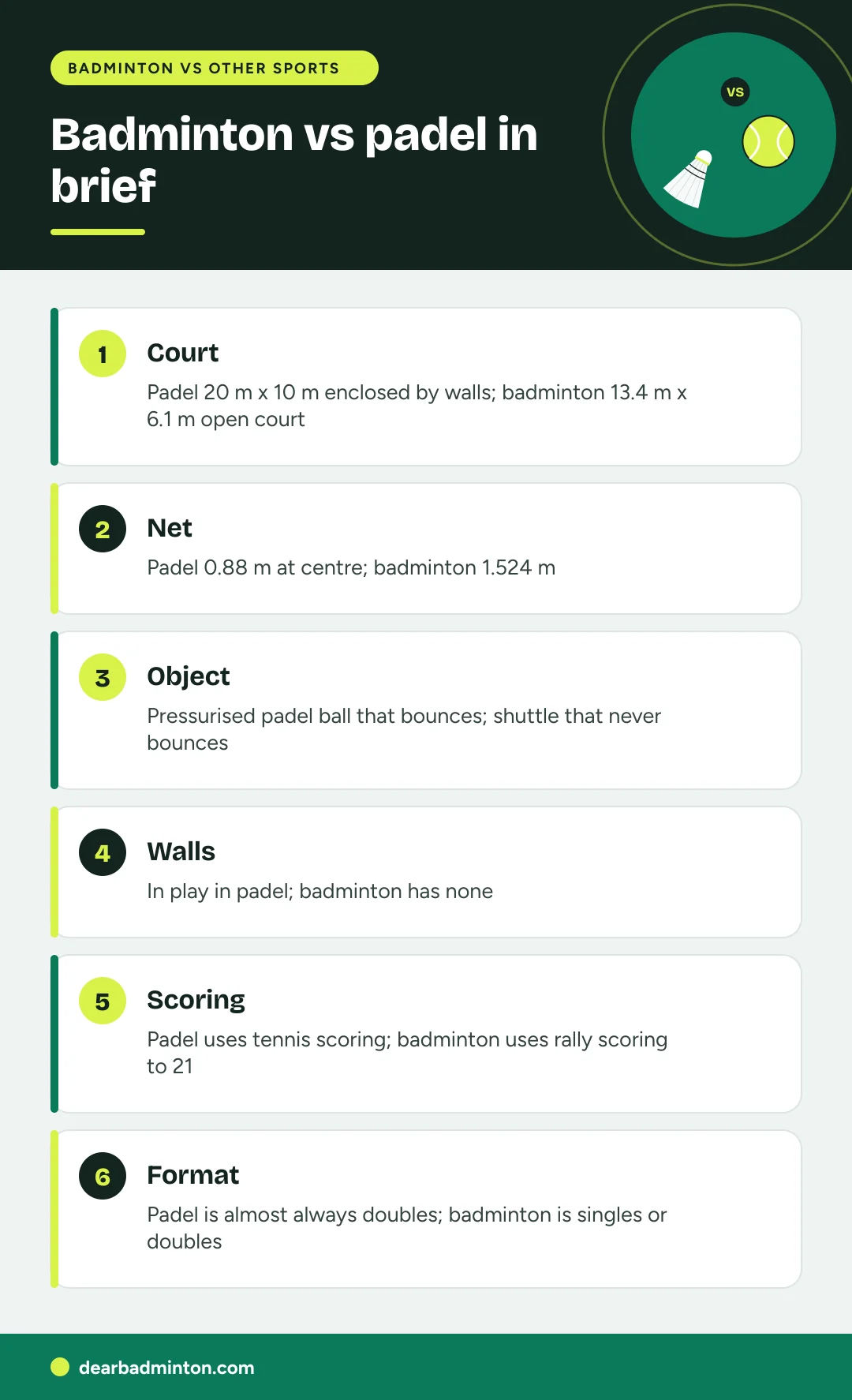
Court Size13.41m x 6.1m, open indoor20m x 10m, enclosed glass walls
Indoor or OutdoorAlways indoorBoth available
Net Height1.524m at centre0.88m at centre
ProjectileFeather shuttlecock, 4.74 to 5.50gRubber felt ball, similar to tennis
Racket Weight80 to 100 grams340 to 390 grams, solid face
World Record Speed493 km per hour150 to 200 km per hour
ScoringRally points to 21, best of 3Tennis scoring, games and sets
FormatsSingles and doubles, 5 categoriesDoubles only, always 4 players
Olympic SportSince 1992Not yet
Easier for BeginnersModerate curveSignificantly easier, immediately fun
Calories Burned per Hour450 to 600 competitive singles350 to 500 recreational, 650 competitive
Primary Fitness DemandExplosive anaerobicMixed aerobic and anaerobic
Injury RiskModerate, shoulder and ankleModerate, elbow and shoulder

1. Origins of both sports and the padel growth story:

Badminton has ancient roots going back two thousand years with modern origins in 1873 England. Padel was invented in 1969 in Mexico and is now the fastest growing sport in the world, expanding from 5 million players in 2008 to approximately 30 million by 2026.

Badminton’s story started in ancient China, India, Greece and Japan, where feathered corks and paddles used to entertain the civilisations long before formal sport existed.

The modern game took shape in 1873 when guests at the Duke of Beaufort’s English estate introduced a net to the old battledore and shuttlecock game.

The sport took the estate’s name. By 1934 the Badminton World Federation started governing the sport internationally. By 1992 badminton was Olympic.

Padel arrived far more recently and far more specifically. Enrique Corcuera, a Mexican businessman, built walls around a small court at his holiday home in Acapulco in 1969 because he did not have space for tennis.

He adapted the rules, introduced a lower net and created something entirely new. A Spanish nobleman brought it to Marbella in 1974. Spain fell in love immediately.

From there, the growth story becomes extraordinary. Padel went from 5 million players globally in 2008 to an estimated 25 to 30 million by 2026.

Spain alone has over 20,000 courts and 6 to 7 million players. Italy, Sweden, Belgium, the Netherlands, the United Kingdom and the United States are all in the middle of padel explosions right now.

This growth matters to badminton players specifically. Padel courts are being built near you faster than any other sport infrastructure is expanding. The question of whether to try it is becoming practical rather than theoretical.

Interesting fact! Padel is now the second most played sport in Spain by participation, having overtaken tennis in Spanish participation numbers. A sport invented fifty years ago in a Mexican garden has surpassed a sport with a century of Spanish tradition.

2. Court, environment and the outdoor difference:

A badminton court is 13.41m long and always indoors. A padel court is 20m long, fully enclosed by glass and metal walls and can be played outdoors. The walls are active playing surfaces in padel, not boundaries.

Step onto a badminton court and the environment is familiar to anyone who has played any net sport. Open space. Clear boundaries. A net in the middle that separates you from your opponent. As a rule, the shuttle must clear the net and land within the lines. Simple, transparent & precise.

Step onto a padel court and the experience is fundamentally different. Four glass and metal walls completely enclose the space. The net at 0.88 metres sits considerably lower than a badminton net.

Most strikingly, those walls are not there to mark out-of-bounds. They are weapons. A ball that hits the back wall during a rally is still in play. Players use wall rebounds for defensive recovery and tactical attacking shots alike.

This creates a completely different spatial challenge. In badminton, you read the shuttle’s flight and move to intercept it. In padel, you read the shuttle’s flight, then predict where it will emerge from the back wall after contact, then move to that position. Three-stage spatial reasoning rather than one. It takes months to develop automatically.

The outdoor factor is a basic lifestyle difference worth acknowledging. Badminton is always indoors. Because, the shuttlecock’s aerodynamic sensitivity makes outdoor play essentially impossible.

Padel offers outdoor courts at many facilities, particularly in countries with mild climates. For players who spend every badminton session under fluorescent lighting, playing a racket sport outdoors on a warm evening is genuinely appealing.

Franck Binisti, founder of Padel Magazine, specifically identifies this outdoor availability as one of the most compelling attractions for badminton players discovering padel.

3. Equipment: Where the sports diverge most visibly:

A badminton racket weighs 80 to 100 grams, is strung and wrist-driven. A padel racket weighs 340 to 390 grams, has a solid perforated face and requires arm-driven power. The shuttlecock decelerates from 300 km per hour to under 50 within one second of flight. No other sports projectile does this.

Pick up both rackets in the same session and the difference feels tangible. The badminton racket feels like an extension of your fingers. The padel racket feels like a small solid bat. They are built for completely different physical actions.

Badminton racket:

A badminton racket weighs about 80 to 100 grams. Carbon fibre, titanium or composite frame. Strung at 20 to 30 pounds tension. Power comes from wrist snap and rotation.

A relaxed, flexible grip that tightens only at contact is the hallmark of an experienced player. Our guide to the best badminton rackets for all levels explains exactly what to look for before buying.

Padel racket:

A padel racket is about 340 to 390 grams. Solid carbon fibre or fiberglass face with small perforated holes. No strings. Power comes from arm drive with a firm, stable wrist at contact.

It has three shapes. Round for beginners with a larger sweet spot, diamond for power players, teardrop for balance. Beginners should always start with a round or teardrop frame.

The projectiles tell an equally compelling story:

The badminton shuttlecock weighs between 4.74 and 5.50 grams. Sixteen goose feathers embedded in a cork base create aerodynamic drag so extreme that the shuttle can decelerate from 300 km per hour to under 50 km per hour within a single second of flight.

Nothing else in sport behaves this way. This physics is the foundation of badminton’s entire tactical complexity, because reading the shuttle early, before it decelerates into an unexpected position, separates good players from great ones.

The padel ball is essentially a slightly deflated tennis ball. It maintains pace through its flight rather than decelerating dramatically.

Its behaviour after contacting a wall depends on the angle, speed and spin applied, creating spatial puzzles that players must solve continuously.

4. Speed, reaction time and the fastest sport debate:

Badminton is the fastest racket sport in the world by Guinness World Record. The world record smash reached 493 km per hour. Padel ball speeds in competitive play reach 150 to 200 km per hour. Badminton demands faster individual reactions. Padel’s wall system gives players additional processing time unavailable in badminton.

Badminton holds the Guinness World Record for fastest racket sport. Tan Boon Heong’s 2013 record smash reached 493 km per hour. In professional match conditions, smashes regularly exceed 380 to 400 km per hour.

A player receiving a smash from the back of a 13-metre court has approximately 0.3 seconds to read, move and respond. That is at the limit of standard human reflex response.

Padel operates at considerably lower projectile speeds. The wall system actually changes the reaction dynamic fundamentally. When a ball hits the back wall, players often have a full second or more to read its trajectory and position themselves.

This additional processing time, simply unavailable in badminton, changes the cognitive demand from pure reflex to anticipatory spatial reasoning.

Badminton wins the speed comparison clearly. However speed is only one dimension of difficulty, which the next section addresses directly.

5. Is badminton harder than padel?

Badminton is technically harder at every level due to reaction speed demands, wrist mechanics and three-dimensional movement complexity. Padel is harder in wall geometry mastery and positional discipline with a partner. For beginners, padel is significantly easier to start enjoying immediately.

I will be direct because this question deserves honesty.

Why badminton is harder?

The wrist mechanics required in badminton are extreme. The backhand smash, which generates explosive rotational power from the wrist at a completely unnatural angle at full speed, takes years of dedicated practice. Our in-depth badminton skills and tactics guide covers exactly how to develop it systematically.

The deceptive stroke play of badminton uses identical body position to produce a smash, drop shot or net roll at the last possible wrist flick. Reading this deception while under physical pressure is a cognitive demand that padel does not replicate at equivalent intensity.

Three-dimensional movement. Badminton covers all four court corners plus the net zone plus the vertical dimension of jumping smashes. Padel’s movement is primarily horizontal.

Why padel is harder in different ways?

Wall geometry has no badminton equivalent. Predicting where a ball emerges from a back-wall rebound, a side-wall combination or a corner between two walls requires three-dimensional spatial pattern recognition that takes months to develop automatically.

Positional discipline with a partner in padel is a subtle but demanding tactical skill. Experienced padel pairs move as a unit, covering zones fluidly while maintaining optimal position for the next shot.

The beginner reality:

For complete beginners, padel is significantly easier to enjoy immediately. The wall keeps the ball in play when you mishit. Your doubles partner covers gaps in your movement. The underarm serve is simple to execute. Most beginners can sustain a genuine padel rally within their first fifteen minutes.

Badminton requires more initial investment. The shuttlecock’s unique flight takes several sessions to calibrate. Overhead technique needs deliberate development. However, once basic competence arrives, badminton rewards every improvement in skill faster and more visibly than padel.

6. The technique interference problem:

Badminton players switching to padel experience significant technique interference. Wrist snap fundamental to badminton must be suppressed in padel. Grip changes automatic in badminton must be replaced by a fixed continental grip. The lunging patterns differ between sports. This resolves within three to six months of consistent padel practice.

When I hit that ball into my own back wall during my first padel session, it was not incompetence. It was twenty-five years of badminton muscle memory activating at exactly the wrong moment.

My wrist snapped through contact the way it has ten thousand times before. In badminton, that produces a clean smash. In padel, it produces chaos.

This is the specific challenge no formal comparison article properly addresses, yet it is the most practically important issue for any badminton player considering padel.

Wrist suppression:

In badminton, wrist snap is the primary power source for smashes, drops and net shots. In padel, the wrist must stay firm and stable through contact. The heavier solid racket amplifies small wrist movements into large trajectory errors.

Continental grip:

Badminton players shift fluidly between forehand and backhand grips through automatic wrist rotation. In padel, the continental grip is used for virtually all shots without grip changes. This single-grip system feels deeply foreign until it becomes automatic.

Opposite leg lunging:

Padel requires lunging with the opposite leg compared to badminton in certain court positions. This specific biomechanical reversal is counterintuitive and takes deliberate retraining.

Managing both sports successfully:

Keep the two sports mentally separate. Know which racket is in your hand before the point starts and consciously activate the corresponding movement programme. Do not try to convert badminton technique into padel technique. They are different systems built for different purposes.

7. What transfers from badminton to padel?

The lob shot transfers almost directly from badminton to padel, where it is the most important defensive shot in the game. Reaction speed transfers powerfully. Doubles teamwork instincts transfer completely. These advantages give badminton players an immediate and significant head start in padel.

Not everything about this transition is a challenge. Several badminton skills transfer to padel with remarkable directness.

The lob is your biggest asset:

In badminton, the defensive clear and attacking lob are fundamental shots every player develops early. In padel, the lob over opponents controlling the net is arguably the most important shot in the entire game.

The tactical concept, trajectory and purpose are essentially identical. Badminton players arrive in padel with this skill already partly developed when most other beginners are still struggling to execute it.

Drop shot awareness transfers:

The tactical understanding of when to play a soft shot to the forecourt to disrupt an opponent’s positioning carries directly across sports, even if the specific execution technique differs.

Reaction speed is a genuine competitive advantage:

Multiple experienced cross-sport players report the same observation. Badminton-trained reflexes make the reaction demands of padel feel considerably less overwhelming than they do for players coming from slower sports.

Your nervous system has been trained to respond to a 400 km per hour shuttle. A 180 km per hour padel smash feels manageable by comparison.

Doubles teamwork transfers completely:

Badminton doubles players already understand partner communication, court coverage division and the tactical logic of moving opponents. Padel’s mandatory doubles format rewards exactly these instincts immediately.

8. Fitness, calories and what each sport builds:

Badminton singles burns 450 to 600 calories per hour through explosive anaerobic intervals reaching 90 to 95 percent maximum heart rate. Padel burns 350 to 500 recreational and up to 650 competitive calories per hour at a sustained 65 to 80 percent maximum heart rate. Both are outstanding for fitness through different physiological mechanisms.

Badminton is fundamentally an anaerobic sprint sport. The phosphocreatine and anaerobic glycolytic systems power explosive two to fifteen second efforts per rally. Recovery between rallies is brief.

Heart rate during intense singles reaches 90 to 95 percent of maximum, an intensity zone equivalent to flat-out interval sprinting. This mirrors the most evidence-based forms of HIIT training in sports science.

Professional badminton players perform over 300 directional changes during a singles match. The neuromuscular demand of that explosive stop-go volume is comparable to elite football players in agility and conditioning requirements.

Padel sits in a mixed aerobic and anaerobic zone. Rallies run longer because the wall system keeps the ball in play. Players sustain continuous motion for 15 to 30 seconds per rally at intermediate and advanced levels.

Heart rate typically sustains at 65 to 80 percent of maximum, a demanding but more aerobically sustainable zone that develops cardiovascular base fitness effectively.

Muscle development comparison:

Badminton builds explosive leg power, wrist and forearm strength, rotator cuff resilience and explosive core rotation. The inner thigh adductors and hip flexors carry particular loads through the deep lunging movements fundamental to badminton footwork.

Padel develops stronger glutes and hip extensors through its sustained squatting stance, better back muscle endurance through its horizontal swing pattern and broader core stability through sustained lateral movement.

These profiles are complementary rather than overlapping. Players who cross-train between both sports develop a more complete athletic profile than either sport produces alone.

For weight loss:

Badminton edges ahead for calories per session at equivalent intensity. Padel’s social format and lower intensity mean many players sustain higher weekly session frequency. Total weekly calorie burn can be comparable depending on how often you play each sport.

A landmark study published in the British Journal of Sports Medicine found that regular racket sport participation is associated with a 47 percent reduction in all-cause mortality risk compared to sedentary individuals, the highest figure of any activity category in the study. Both sports fall within this extraordinary finding.

9. The social dimension and format reality:

Padel is always doubles, always four players. Badminton offers singles, doubles and mixed doubles across five competitive formats. If you want solo competition or flexible player numbers, badminton wins. If you want a guaranteed social experience every session, padel wins.

Padel is built around social sport by design. Every competitive match involves four people sharing a compact enclosed court. The format is not optional. You cannot play competitive padel singles. You need four players every time you book a court.

This creates an immediate, genuine social dynamic that many players find addictive. The post-match culture at padel clubs is strong. Community forms naturally around the format.

However, it has a practical limitation. On a Tuesday evening when only you and one friend want to play, badminton singles is immediately available.

Padel requires finding two more players first. Many clubs offer mixing sessions that resolve this, but the logistical reality is worth acknowledging honestly.

Badminton offers complete format flexibility. Singles for pure individual competition. Doubles for social play. Mixed doubles for partner-based team competition.

All five formats carry equal prestige at the Olympic level. Our complete badminton rules and regulations guide covers every format in detail.

10. Cost, accessibility and global reach of each sport:

Badminton is played by 220 million people globally, dominant across Asia. Padel has 25 to 30 million players but is the fastest growing sport in the world, with court infrastructure expanding rapidly across Europe, South America and North America. Equipment costs are broadly comparable for both sports.

Badminton costs:

Beginner racket 15 to 50 US dollars. Court rental 10 to 25 dollars per hour. Feather shuttlecocks 15 to 30 dollars per tube of six and can be damaged within a single competitive session. Synthetic shuttlecocks are more affordable for recreational play.

Padel costs:

Beginner racket 30 to 80 US dollars. Court rental 20 to 60 dollars per hour, typically split four ways making per-person cost 5 to 15 dollars. Padel balls 5 to 15 dollars per can and last considerably longer than feather shuttlecocks.

The accessibility shift happening right now in 2026:

Padel courts are being built across Europe and the Americas at extraordinary rates. Spain has over 20,000 courts. Sweden has more padel courts per capita than any country in the world.

In Western countries, padel infrastructure is now growing faster than any other court sport. Badminton retains a significant advantage in Asia, where community courts are abundant and affordable.

Final Verdict: Which sport is right for you?

Choose badminton if:

You want the fastest racket sport on earth, explosive fitness development, technical mastery across wrist, footwork and deception, five competitive formats and a sport embedded in the world’s richest sporting culture with 220 million players.

Choose padel if:

You want a sport you can enjoy immediately regardless of fitness level, the social experience of always playing with a team, outdoor courts in good weather, a gentler injury profile and a sport whose global community is growing explosively around you right now.

Choose both if:

You are serious about athletic development. Badminton sharpens your explosive power, reaction speed and wrist technique. Padel builds your aerobic endurance, spatial reasoning and partner communication. The fitness qualities complement each other rather than overlap.

FAQs

Is padel easier than badminton for beginners?

Yes, significantly. The wall keeps the ball in play when beginners mishit, the underarm serve is immediately learnable and the doubles partner covers court gaps. Most beginners enjoy a genuine padel rally within their first session. Badminton requires more initial technique investment before competitive play feels rewarding.

Can badminton players play padel well?


Yes, often surprisingly well. Badminton players bring extraordinary reaction speed, excellent hand-eye coordination and strong doubles instincts to padel. The main adjustments are continental grip, wrist suppression and wall reading. Most badminton players are competitive at recreational padel within two to three months.

Which sport burns more calories, badminton or padel?

Badminton burns more calories per hour at competitive intensity, approximately 450 to 600 versus 350 to 500 for recreational padel. However padel’s social format means many players sustain higher weekly session frequency, making total weekly calorie burn broadly comparable depending on individual playing habits.

Does badminton technique interfere with padel?

Yes, significantly at first. Wrist snap, grip changes and lunging patterns from badminton actively work against padel mechanics. This resolves with consistent practice and deliberate mental compartmentalisation of the two sports, typically within three to six months.

Is padel an Olympic sport?

Not yet as of 2026. The International Padel Federation has applied for Olympic inclusion. Padel’s extraordinary growth trajectory makes inclusion within the next two Olympic cycles genuinely possible. Badminton has been Olympic since 1992.

Leave a Comment

x